What AI Is Revealing About Leadership Communication

Table of Contents
Every important leadership decision eventually becomes a leadership communication challenge.
A CEO addresses employees during a difficult restructuring. A financial advisor records a market update for clients. A customer experience leader responds to a service outage. In each case, leaders spend hours refining the message. The facts are checked, the wording is reviewed, and every sentence is carefully considered.
But according to communication expert Deirdre Breakenridge, the words themselves may be only one part of whether that message actually builds trust.
As organizations increasingly rely on video to communicate with customers, employees, investors, and the public, a new challenge has emerged. Most leaders have been trained on what to say. Very few have been trained on what their audience is seeing while they say it.
That gap is exactly what Breakenridge has spent decades studying.
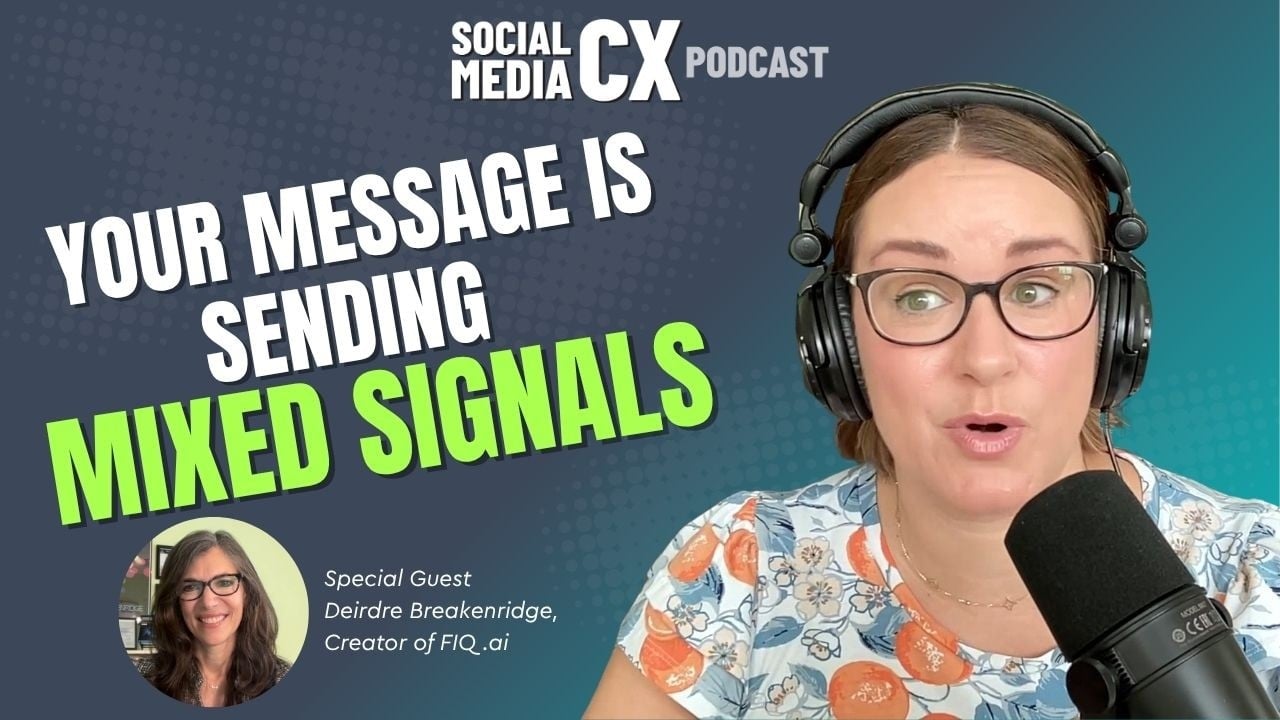
As founder and CEO of Pure Performance Communications and creator of FIQ.ai, she combines more than 30 years of communication coaching with artificial intelligence to help leaders better understand how their messages are actually being perceived. Rather than replacing coaching, AI provides another layer of insight by identifying communication patterns that are often difficult for speakers—and even experienced coaches—to recognize in the moment.
The technology is new.
The communication challenge is not.
Your Words Are Only Part of the Message
One of the simplest demonstrations Breakenridge shared illustrates the problem immediately.
She enthusiastically said the words, “I’m so excited about sharing FIQ,” while intentionally delivering them with a flat expression and little vocal energy.
The words communicated excitement.
Everything else communicated the opposite.
“There was incongruence,” Breakenridge explained.
Most audiences would never describe that mismatch using the word incongruence. They simply walk away feeling that something didn’t quite match.
That reaction matters because people rarely evaluate communication based only on the script. They evaluate the complete experience of the person delivering it.
Breakenridge referenced the well-known Mehrabian communication model, which suggests that words represent only a small portion of how emotional meaning is interpreted, while vocal delivery and nonverbal communication contribute much more to how a message is received.
The exact percentages have been debated over the years, but Breakenridge’s larger point remains the same.
When people watch a leader on video, they are processing much more than the words.
They notice facial expressions.
Vocal pace and tone shape their impressions.
They also recognize when confidence appears genuine—or forced.
Most of those judgments happen automatically.
Why Leadership Communication Has Changed
For many organizations, video has become one of the primary ways leaders communicate with their audiences.
Customers expect updates directly from executives during a crisis. Advisors educate clients through short videos. Customer experience teams respond publicly to difficult situations. Internal leaders increasingly communicate through recorded messages rather than in-person meetings.
That shift changes the nature of communication.
Written statements allow readers to focus entirely on the words.
Video asks audiences to evaluate the person delivering them.
According to Breakenridge, that creates a new responsibility for leaders.
The question is no longer only, “Is this the right message?”
It is also, “Does everything about my delivery reinforce that message?”
When those elements align, audiences are more likely to perceive authenticity.
When they don’t, the disconnect can quietly undermine the very trust leaders are trying to build.
Why This Matters in High-Trust Industries
The implications become even greater in industries where trust is central to every customer relationship.
Financial institutions.
Healthcare organizations.
Insurance companies.
Government agencies.
Enterprise organizations navigating public change.
These organizations frequently ask leaders to communicate during moments of uncertainty.
A CEO explains a difficult business decision.
A customer experience executive addresses a widespread service issue.
A financial advisor reassures clients during market volatility.
In each situation, audiences are looking for more than information.
They are looking for confidence, calm, and credibility.
Breakenridge described how communication teams can use AI before a video is released to identify patterns that might otherwise go unnoticed.
A speaker who normally appears relaxed may suddenly begin speaking much faster under pressure.
Someone carefully following a prepared script may become so deliberate that they no longer sound natural.
Neither issue necessarily changes the content of the message.
But both can change how the audience experiences it.
That distinction represents an important shift in leadership communication.
For years, organizations focused primarily on developing the right message.
Today, leaders also need to understand how that message is being perceived once they step in front of the camera.
What AI Measures in Leadership Communication
Breakenridge created FIQ around four communication characteristics that she believes influence how audiences experience a speaker: Calm, Clear, Concise, and Confident.
While confidence is often treated as something leaders should project, Breakenridge views it differently.
Confidence is the result.
Calm is the foundation.
She describes calm as the integration of the rational and emotional parts of the brain. When speakers are calm, they are better able to think clearly, stay present, and communicate naturally.
From there comes clarity.
Clear communicators organize their thoughts, get to the point, and make it easier for audiences to follow their message.
Concise communication builds on that by removing unnecessary filler words, repetition, and what Breakenridge referred to as “word salad.” The goal is not to sound scripted. The goal is to communicate with greater intention.
When those three elements come together, confidence becomes something audiences perceive naturally rather than something speakers try to perform.
The framework reflects a larger philosophy behind the technology.
FIQ is not trying to tell leaders how to act.
It is helping them understand how they are currently being perceived.
AI Is a Mirror, Not a Replacement for Coaching
Throughout the discussion, Breakenridge was careful to distinguish between what AI can do and what still requires human judgment.
FIQ analyzes communication patterns, but it is not designed to replace an executive coach.
Instead, it gives coaches and communicators additional information they would not otherwise have.
A facial expression.
A change in vocal pace.
An increase in filler words.
A shift in emotional expression during a difficult topic.
Those observations create opportunities for better coaching conversations, but they still require interpretation.
As Breakenridge explained, AI can identify patterns.
People provide the context.
That distinction is important as organizations look for practical ways to incorporate AI into leadership development.
The technology does not eliminate expertise.
It extends it.
What a Live Demonstration Revealed
One of the most interesting moments came when Brooke Sellas volunteered one of her own unscripted videos for a live analysis using FIQ.
The exercise wasn’t intended to produce a perfect score.
It was designed to demonstrate what AI could observe that a speaker might never notice independently.
The analysis highlighted several filler words, a speaking pace that was slightly faster than Sellas’ normal baseline, and a facial asymmetry that the software initially categorized as “disgust.”
Rather than accepting the output at face value, Breakenridge explained why human interpretation still matters.
The expression wasn’t actually communicating disgust.
It reflected a natural asymmetry in Sellas’ face that influenced how the AI classified the movement.
The moment reinforced one of Breakenridge’s central points.
AI provides another perspective.
It does not replace experience, coaching, or understanding the individual speaker.
For leaders, that distinction matters.
The value is not receiving a score.
The value is becoming aware of communication habits that audiences may already be noticing.
The Future of Leadership Communication
As organizations continue to rely on video, leadership communication is becoming about more than crafting the right message.
Leaders also need to understand how that message is experienced.
That means paying attention not only to the script, but also to facial expressions, vocal delivery, pace, and the consistency between what is being said and how it is being communicated.
Breakenridge summarized it with a single principle: alignment.
When words, voice, and body language reinforce one another, communication becomes more authentic and more believable.
When they don’t, audiences often recognize the disconnect, even if they cannot explain why.
AI cannot build trust on behalf of a leader.
But it can reveal communication patterns that were previously difficult to see.
For organizations investing in executive communication, customer experience, and leadership visibility, that may be one of AI’s most valuable contributions—not replacing human communication, but helping leaders better understand how their message is truly being received.
Want to see AI analyze executive communication in real time? Watch Brooke Sellas put FIQ.ai to the test during her conversation with Deirdre Breakenridge, including a live analysis of Brooke’s own unscripted video and a discussion of how AI can strengthen leadership communication without replacing human coaching.
Read the Transcript
[00:00:00] Your Leadership Message Isn’t Landing
Deirdre Breakenridge: When it comes to your messages, 7% are the words that you use. Then there’s 38%, that’s your voice. 38% is how much your voice matters when you speak, and then 55% is your body language, and yes, that does include the face.
Hey, hey. Welcome back to the Social Media CX Show. I’m your host, Brooke Sellas, CEO of B Squared Media, author of Conversations That Connect, and today we’re talking about something most brands never train for, which is what your face is saying while you’re on camera. Not your words, but your face. Social video is everywhere now.
It’s not a nice-to-have anymore, and it’s often the first place a customer meets the human side of your brand. But there’s a problem. Most of the people we’re putting in front of a camera, from customer experience reps to executives and leaders, have never once been trained on what their expressions are communicating while they talk.
My guest today has spent her career studying influence and communication, and she built an AI tool that reads facial microexpressions to show people exactly where their words and where their face stop matching up. Let’s get into it.
Brooke Sellas | B Squared Media: Deirdre Breakenridge is the founder and CEO of Pure Performance Communications, where she spent over 30 years helping leaders communicate with more confidence and clarity. She’s also the founder behind FIQ.ai. FIQ stands for Facial Impact Quotient. It’s a speaker learning and training platform that analyzes facial expressions and micro expressions to give speakers real feedback on how they’re being perceived, and we’re gonna jump into the tool a little bit today. Deirdre, welcome to the show.
Deirdre Breakenridge: Thank you, Brooke. It’s great to be here
Brooke Sellas | B Squared Media: I am so excited that you’re here. Quick backstory on Deirdre and myself. We met, it feels like 100 years ago, but it wasn’t that long ago.
Deirdre Breakenridge: No, not long ago at all. 2023. Yeah, I think so.
Brooke Sellas | B Squared Media: When we were both volunteering for Best Buddies in New Jersey, and we quickly became fast friends. And then Deirdre was building this tool, and I got to kind of see the inner workings of it as she was building it. And y’all, you’re about to be mind-blown during this episode when you see this tool. I’m not even lying.
So I’m excited to chit-chat with you about it today.
Deirdre Breakenridge: Thank you. Me too. And, and your feedback has always been instrumental.
Brooke Sellas | B Squared Media: Aw.
Deirdre Breakenridge: Helping us, so thank you.
Brooke Sellas | B Squared Media: Of course. Happy to help, and it’s such a cool product. So really wanna start with your origin story because there’s a lot that goes into you before we get to FIQ. What got you interested in facial expressions and microexpressions in the first place?
Deirdre Breakenridge: Well, let me go back to kindergarten. No, I’m kidding. We won’t go that, that far back. I have been studying body language 10,000 hours over the decades, and what I realized when I was doing a study on millennials is that the face is a place where you can really catch expressions and feelings, and that’s what I dove into, understanding that within a flash you can detect somebody’s real emotions.
Brooke Sellas | B Squared Media: Mm-hmm.
Deirdre Breakenridge: That’s the place today that is on video a ton.
We’re always on video. I think it’s time we start paying attention to the face.
Brooke Sellas | B Squared Media: Yes. It’s such a good example of what’s happening, right, with social, like where social’s going. Like video’s becoming such a big thing. You constantly are seeing like faces, human face. Well, human and now AI, but.
Deirdre Breakenridge: True.
Brooke Sellas | B Squared Media: Stick with the human ones. The human faces in your feed, and that kind of makes you stop the scroll, especially when you see someone in, in my opinion, this is what works for me.
When I see someone who’s like really into the story, and they’re super expressive, right? I’m like, “Well, what are they talking about? Let me hit unmute here and stop for a second and see what’s going on.
Deirdre Breakenridge: Exactly. The face tells a story in and of itself, but we also have to remember it’s not just the face when you’re speaking. So if you’re sending people out on video, company representatives, or you have influencers, it’s the pairing of the face, the voice, and how somebody engages through the camera, and that’s what FIQ is.
We study facial expressions, and that’s 1/10 to 1/25 of a second, 106 emotions. We also break down the voice because expressions and a voice tell a lot about a speaker, and then how you come through with yours eyes, the way you move your body, the positioning of your head. It all matters.
[00:05:17] When Your Face Contradicts Your Words
Brooke Sellas | B Squared Media: It all matters. This is like, scary as someone who’s a speaker. And by the way, Deidre and I have had plenty to talk about, about my own stuff, so we’ll get into that a little bit later. But I love how you’re describing everything, because I think it’s a really good example of the gap that sometimes exists between what we say and what we show.
Because sometimes what we’re showing, I feel like, is lying on what we’re saying, or the opposite, right? So talk to me a little bit about why this matters more right now than it did five years ago.
Deirdre Breakenridge: Okay. If we’re in the video frame constantly, and that’s where people are getting their signals from, because it automatically happens. We’re sending out hundreds of signals as we speak. If my words are saying how excited I am to be sharing about FIQ, but yet my voice sounds like this, Brooke, “I’m so excited about sharing FIQ,” and my face is very neutral, what does that say?
Brooke Sellas | B Squared Media: You’re not excited.
Deirdre Breakenridge: There’s incongruence.
Brooke Sellas | B Squared Media: Yeah, you’re not excited. And this shift that you’re describing, I’m assuming is why we think about social media as a lot of written content, at least in the past. Now social media is a lot of on-camera social content. And so me, what I’m hearing you say is, is tone of voice is no longer the whole story.
Just because you’re reciting the brand talking points, may be deviating from that story just with your face, even though you’re saying the words.
Deirdre Breakenridge: That’s right. And people detect this. They’ll walk away even if it’s just subtle. Do enough low energy or you’re flashing signs of disgust which shows in the nose or the mouth, or even sometimes the perception of anger in the brow. You could just be an intense speaker. Someone can walk away and say, “Oh, yeah, Deirdre just wasn’t on her game today,” or, “She seemed a little agitated.”
Brooke Sellas | B Squared Media: Yes, myself.
Deirdre Breakenridge: Those are all signals I’m sending. I wanna know.
Brooke Sellas | B Squared Media: If you’re a podcaster listening to this podcast right now, I know you know what I’m talking about. There are times when I’ve been having a bad day, but I still have to film the podcast, right? And I can tell my energy levels, the tone, my inflection, all of that is very different to myself.
Now, somebody, you know, a stranger watching may not notice the difference between those two, but we know when we’re on it and when we’re not on it.
[00:07:55] Why People Trust What They See
Deirdre Breakenridge: That’s right. In any message, this is a rule to remember, the Mehrabian rule. When it comes to your messages, 7% are the words that you use. Then there’s 38%, that’s your voice. 38% is how much your voice matters when you speak, and then 55% is your body language, and yes, that does include the face.
Brooke Sellas | B Squared Media: I wrote that down. Mehrabian. How do you say it?
Deirdre Breakenridge: Yeah, Mehrabian rule.
Brooke Sellas | B Squared Media: Mehrabian.
Deirdre Breakenridge: Yeah, M-E-H-R-A-B-I-A-N. I hope I spelled that correctly.
Brooke Sellas | B Squared Media: Well, I wrote it down, y’all. I’m gonna put that in the show notes for everybody to go take a look. We’ll link out to it, but that’s, that’s so cool. I hadn’t heard of that before. For the brands listening, especially for, I know you work a lot with financial service audiences, and so do we, so especially for our financial friends, the people who show up on camera are now the face of trust, right?
So a lot of brands, not just financial brands, but a lot of brands are using influencers or faces of the brand to elicit trust. So maybe it’s a support lead, or maybe it’s an executive issuing a statement about something, or maybe it’s an advisor recording something educational. That’s a lot that’s riding on a few seconds of video.
So I guess what my question is, is like, in a 30-second snippet, this is happening, right? It doesn’t matter how short or long the video is.
Deirdre Breakenridge: Yes. Okay, so think about whoever you’re putting on video, you wanna think more about congruence and alignment than you want over that perfection or you’re thinking in terms of performative.
Brooke Sellas | B Squared Media: Yeah.
Deirdre Breakenridge: So alignment and congruence, which means a speaker has to understand their communication style, number one.
That’s why we always baseline professionals so that they understand the nuances of their voice, their vocal cues, the words that they use, the meaning behind the words, even right down to sentence structure, no word salad, no fillers, to how does your body move? And when you’re in the frame, your shoulders, your hands, hands engaged, your chin positioning, head, eyes, everything.
And everything has to be aligned in order for you to create impact.
Brooke Sellas | B Squared Media: I’m getting nervous because, you’re taking me back to my defending my thesis in college. And when we were practicing defending Dr. Gru, and Dr. Gru, and if you’re listening, “um,” used to ding a bell. Every time you would say “um,” or “uh,” or any sort of filler word “like,” “um.”
Deirdre Breakenridge: Yes.
Brooke Sellas | B Squared Media: She would ding a bell.
Deirdre Breakenridge: Well, it makes you aware. That’s really important that she did that, because that helps you to get over when you need to pause, slow yourself down, pause, close your mouth, and then speak. I always say, “See the period, let your breath be your first word,” and if you can take a breath, you won’t put in that filler word.
And FIQ tracks your filler words. It tells you. It’s great.
Brooke Sellas | B Squared Media: It is so good. I need to use it more because, yeah, so I’m happy to dunk on myself, but I speak too fast. I don’t pause. I’m a very, like, energetic, passionate speaker, and I need, sometimes need to bring it down a notch. When I get really excited or nervous, which by the way, you might be shocked to know this because you’ve seen me on stage, but I hate being…
I have such stage fright, so bringing my voice down to like, its normal levels when I’m excited or nervous it’s hard for me.
Deirdre Breakenridge: Well, you’re a good speaker, Brooke. You’re a really good speaker, and I think it’s harnessing all of that good energy so that you can bring it down a notch and have that commanding presence. And do enough practice exercises on FIQ and even off of FIQ. You can change anything.
Brooke Sellas | B Squared Media: Well, we know we’ve already changed the register of my voice, right?
Deirdre Breakenridge: Yes.
Brooke Sellas | B Squared Media: It to be more of its natural state, which is a little bit lower than it is when I’m excited or nervous. So thanks for that.
[00:12:20] The Habit That Makes You Sound More Confident
Deirdre Breakenridge: Yes. I have executives practice a little exercise where I say, “Tell me something that’s exciting.” And then they say it, and I’ll say, “Use your higher range. I wanna hear you in your higher range.” Not a high range, but a higher range. And then I’ll say, “Now just tell me a piece of information. Just share a piece of a story.”
And they go into their mid-range for storytelling. And then I’ll say, “Now I want you to tell me something that I need to remember.” Now my voice is going lower, and then they go lower. Once you start understanding where your voice falls, the different pitch levels and inflection, you then naturally start to use that.
And it’s a technique, but you have to hear it, and you have to understand it.
Brooke Sellas | B Squared Media: Yeah.
Deirdre Breakenridge: Yes.
Brooke Sellas | B Squared Media: You definitely have to practice. Yeah, so let’s talk about the tool itself.
[00:13:12] The Four Traits of Trusted Communicators
Brooke Sellas | B Squared Media: So just explain FIQ to everyone who’s watching or listening in plain terms. What does it actually do?
Deirdre Breakenridge: Okay, it helps you to close the gap between the messages that you wanna share and the way you intend to share, and the impact that you actually have. Because the wider the gap, the farther it is to get to impact. We work on four Cs. It’s calm, clear, concise, and confident. And when you’re on FIQ, yes, it is AI analysis, but it’s all coach-led.
We don’t leave you alone with with the system, because we believe the coach, the human in the room, is important, and you can be vulnerable with your coach. And when you’re on FIQ, when you understand the skills and how to get calm. Calm is an inner state, it’s all about your brain.
When you can have that integration between your rational thinking center and your emotional thinking center, it’s much easier to share, to get your words out, and calm shapes your thoughts.
Then you can get to clear. Clear is a pillar that think of crystal clear. You get to the point, you’re crystal clear. But it’s also your voice is crystal clear, and there’s a certain energy around that. Then you get to edit your delivery. That’s concise. No word salad, no fillers, how quickly or not you speak to get to confidence, which is an external state.
And that’s people being confident in you. Now, you have to feel confident, but people will be confident in you, and that’s when intent and perception come together. And that’s what we’re trying to do, help professionals to feel comfortable so they can be more confident and create impact.
[00:15:15] What Customers Notice Before You Do
Brooke Sellas | B Squared Media: Yeah. I mean, it makes so much sense when you say it, right? We just don’t think about it, I guess, ’cause we talk all the time every day. I wanna bring this to social care specifically for a second, because a lot of what we’re seeing is some brands are responding to, like, complaints, let’s say, online or on social or reviews with a video response. So let’s say that a customer experience rep is filming one of those response videos. A different example could be, gosh, I’m having a hard time on the fly here. A spokesperson.
Deirdre Breakenridge: Mm-hmm.
Brooke Sellas | B Squared Media: Recording a statement after an outage, right? We just had some power outages here because the heat, right?
Maybe it’s one of our financial advisor friends recording some sort of educational reel on rates or whatever. What does the audience pick up on that the speaker has no idea that they’re showing?
So thinking of all of those scenarios, and if brands are making these videos, what should they be thinking about that the audience is going to pick up on that they don’t have any idea that it’s happening or showing?
Deirdre Breakenridge: The cadence in their voice. So is the speaker smooth and certain? Do they have a steady influence, which is, are they calm and confident? That’s going to help in a situation, especially if a customer is upset. Or does their voice sound choppy and robotic, and their energy is frenetic, and they’re not.
They’re moving, their body’s jerking. That says a lot. Does their face look intense? ” Okay, Mr. Customer, I’m really here to help you.” No. So I’m exaggerating, but there are very subtle cues and signals, and even in the words that you use. Are your words engaging? Are your words soothing? Do they make somebody feel as if you’re really the experienced person in the room, or just somebody who’s appeasing them?
All of this matters and is taken into consideration. Does that help?
Brooke Sellas | B Squared Media: Yes, it does help, and I think now is the perfect time to hand it over to you to show a live demo of the tool. So I’m gonna hand it over to Deirdre. She’s gonna share her screen, go into the tool, show you a little bit about it, and we have a fun clip that use.
Deirdre Breakenridge: Yes.
Brooke Sellas | B Squared Media: As a video example to show you how the tool works.
Deirdre Breakenridge: Okay, so I’m thinking you can, you can see my screen?
Brooke Sellas | B Squared Media: Yes.
Deirdre Breakenridge: All right, so this is the dashboard. Everybody comes in, and every time you do a session, you get an FIQ score, and that’s calm, clear, concise, and confident. And you also get an average of your last three sessions. So I’m in the advanced realm, happy to report.
There is a one higher bucket on top, is the executive excellence bucket. I always strive for it. Hard to stay there. So let me start a session and show everybody. I’m on FIQ, and it’s already reading my face for 106 emotions. And that quadrant, you see this little tadpole, it kind of jumps around. I’m in the high energy, commanding presence realm, which is great because when you’re on a podcast, you wanna be there.
I also sometimes dip into steady influence. That’s the lower right-hand quadrant. And if you’re on the right, it’s all what we call the positive valence emotions, and being lower right just simply means you’re calm, contemplative, relaxed, serene. The little tadpole just keeps jumping around.
Brooke Sellas | B Squared Media: Yeah, it’s crazy how much he moves.
Deirdre Breakenridge: Yes, it’s a microexpression. And, you know, I could be joyous, I could be amused, light-hearted. I’m trying to read with my progressive glasses. Interested. And now let me see if I can dip lower. Sometimes I just breathe. See if it goes down. When it goes down.
Brooke Sellas | B Squared Media: Yeah.
Deirdre Breakenridge: It’s more reflective, and it’s the calm energy.
I have a lot of high energy. When you go over to the left, not that it’s bad, but there are some negative energies on that side. Upper left is more of the frenetic or stress energy. And now I’m hopeful and balanced. I finally got there. When you go to the lower left, that’s passive hesitation, because sometimes when we speak, we are a little tentative or we’re neutral.
Maybe we’re tired. Getting myself over to the left. There’s a lot of emotions in these four quadrants, and the little tadpole just keeps tracking. And what’s interesting is that as it does the, the face for the emotions, it’s also tracking my voice. We detect the pitch range, your tone. You could be warmer.
You could be brighter. It’s also the speed at which you speak and your energy, your volume, how you project your voice. And do you wanna see a video analyzed, Brooke?
[00:20:30] AI Reviews Brooke’s Communication Live
Brooke Sellas | B Squared Media: Yes. So I’m nervous, y’all, because it’s a video of me, but yeah, let’s do it. Let’s do it.
Deirdre Breakenridge: Session where I record myself or I talk about a topic, and this is how you work with a client. And you give a two-minute impromptu, topic discussion, and then I get a report. But I thought it would be fun if we just analyze you. So hang on one second and I’m gonna try to get the video.
It’s gonna be tricky ’cause I have to drag the video.
Brooke Sellas | B Squared Media: Yeah. Well, while she’s doing that, y’all, I just wanna put a disclaimer here. I have not seen this video been done. This is, oh boy, this is new for me, so let’s see what happens.
Deirdre Breakenridge: I’ll take you back, Brooke. You were on The DM Show, and you were talking about customer loyalty, and there was a small segment on our show when you were discussing AI, customer loyalty, and hallucinations. So this is a brief clip, and what I’m gonna do is I’m gonna analyze your video and watch what happens.
Brooke Sellas | B Squared Media: So surprised by the way that I’m like down in the lower quadrants.
Deirdre Breakenridge: Well, so when you pause and you’re thinking, you’re crafting your story on the fly, you’re gonna go into the low, the passive hesitation quadrant automatically. The closer you are to the center of the circle just means there’s a, a neutral in, in all the quadrants. It’s not, it’s not a negative. It’s not a bad thing to be there.
There’s all different calibrations of emotions. And right now FiQ has analyzed your transcript, it did a pre-analysis, the FiQ bot analyzed you, and you can still see my screen?
Brooke Sellas | B Squared Media: Yeah.
Deirdre Breakenridge: You can see it’s an uploaded video. Now, you’re in my dash, so here it is. Don’t let any of the emotion bars, nothing throw you off.
It’s always good to see different emotions. That means your face is working. The disgust simply means, and I have it too, and I tell this to plenty of executives daily, there’s just a little incongruence in your mouth. That’s what it is. When you speak, you’re not perfectly symmetrical, and if there’s a little bit of a raise in your top lip and your bottom lip goes a different way, that’s gonna register in the disgust.
Now, at the same time, you could be in a commanding presence quadrant, and there’s contempt and disgust sometimes get mixed together. Contempt is superiority, and sometimes you get this little smirk in your mouth or one side goes up and the other stays down, and that’s pride, and it can register there as well.
So these are your scores. Low arousal just means face not moving a lot, but it’s moving. I say, and this is something just to think about, because you’re always speaking with somebody who could be high arousal, a lot of face, a lot of energy, excitement, or low arousal, very calm, face doesn’t move, you wanna be 50/50 so you can capture whoever’s attention and you’re not over the top.
Because if you’re all low arousal and you’re with somebody who’s high arousal, there could be an imbalance Your balance is mostly positive. You’re over 60%, that’s good. The negative just registers ’cause of that little bit of disgust and maybe some surprise, which also is on the left side. But in your case, it’s not, “Oh my gosh, I’m surprised,” or, “I’m afraid,” it’s illustrating with your brow.
Any questions?
Brooke Sellas | B Squared Media: This is fascinating. No, no, keep going
Deirdre Breakenridge: Okay. So when it comes to your speech, you’re an alto. You’re average. You might get up into mezzo-soprano when you go into your higher range, but this is where you average out. You have a boardroom voice. You know how to project. 75 is boardroom. It’s also good for video projection.
113 is warmer. You have a warmer style about you. And 84 is slower, so you were going slower, taking your time, and it showed in those pauses. And you did have some fillers, just a couple. “Um,” two times, picked up. That’s pretty good in, I mean, I forget how many seconds. But I challenge you, Brooke, to pinch yourself every time you hear yourself say um.
Brooke Sellas | B Squared Media: Uh-huh.
Deirdre Breakenridge: So start seeing the period when you speak, slowing yourself down a little bit, and you’ll notice that you’ll start to say “uh” and stop yourself.
And then “uh” will be your filler word until you close your mouth, and there will be no fillers at all. And here you are. You’re proficient, which is good. Proficient means that you have… You’re above foundation. You’re above developing. You’ve landed in proficient. If you kept practicing and you stayed on FIQ and did the exercises and worked with a coach, you would move to advanced, and then you would get to executive excellence.
And here’s a whole report. Everything.
Brooke Sellas | B Squared Media: This is so cool.
Deirdre Breakenridge: Thank you. And you do.
Brooke Sellas | B Squared Media: I’ve seen it before, but like, this is, by the way, this is like so, it’s just so grown up. It’s just so cool to see the whole thing. I’ve seen the whole thing, so I love this.
Deirdre Breakenridge: Well, great. And you have strengths, you have areas for growth, you get your pillar breakdown, why you were scored the way that you scored, recommended exercises, and always your next steps. And that pretty much, I mean, there’s other, you can use your FIC bot, you can use your personal FIC bot which knows your session scores.
And one thing that I do also love that I’ll share is that you can compare sessions. If I click these two boxes, I could compare and get an analysis, a trend report. And that’s really helpful when you’re trying to see your improvement and you’re doing exercises to know what’s working and that you’re getting better.
Brooke Sellas | B Squared Media: Yeah, for sure. That was so cool. Thank you for sharing that and
I have a lot to think about. Send me that report.
Deirdre Breakenridge: Well, I think you did really well. When, mostly when people come on FIQ, they start foundation or developing. So to drop a clip in and see proficient, pat yourself on the back. You did well.
Brooke Sellas | B Squared Media: I’ll take it. Thank you. So I guess my question here for you is, where does AI actually help here, and where does it hit a limit? Because I want to be clear that you and I both agree that AI should not replace human skills, but you’re using AI to help better human skills.
Deirdre Breakenridge: Well, I think that hitting the limit means, if I’m understanding it correctly, the question, that if you were just going in alone and strictly relying on FIQ, then you’re not taking into consideration necessarily how you feel or what your coach sees. So if you’re just relying on AI, compare it to would you just rely on AI for your business?
No, you hit a limit. Somebody’s gotta be watching and proofreading and challenging and checking. So you don’t let AI hit that limit because that’s why you make sure you’re aware, you know what’s going on, how you feel, and your coach is there also watching and understanding. Does that resonate?
Brooke Sellas | B Squared Media: no, that makes sense because, like, you could absolutely, I guess, use it without a coach, but then you’re letting AI replace the human skill. I mean,
Deirdre Breakenridge: really.
Exactly. And you’re also trusting that everything AI says is valid. And I’m constantly challenging. I get scores and I’ll say, “Wait a second. The chart said that my voice was 178, my average, but in the report you’re saying it’s 160. What is that discrepancy?” And it says, “Oh, I’m sorry.”
Brooke Sellas | B Squared Media: Like all AI, that was a mistake. You’re right.
Deirdre Breakenridge: I gonna say that, you’re absolutely right.
Brooke Sellas | B Squared Media: Yeah.
Deirdre Breakenridge: Exactly.
[00:30:07] Can AI Catch a Bad Leadership Video?
Brooke Sellas | B Squared Media: How does, for the people who are watching or listening, how does a team build that muscle of confident, on-camera communication without turning every video into, you know, a performance that’s been, that you can tell has been over-rehearsed?
Deirdre Breakenridge: I think it’s a feeling. I think if you’re showing up with just your talking points, then you’re performing. But if you’re really feeling good about what you’re saying, and you’re calm, and you’re in that steady influence quadrant, that’s the biggest difference. You know because even today, whether I’m stepping out on stage or I’m conducting training sessions, my brain is calm.
Having a conversation with you, plenty of breathing, diaphragmatic breathing, that’s the biggest difference. If the team can all start with the calm, and then of course you, you all have to be collaborative and, and work together and share and give feedback, you’re going to get to confidence together, and there’s full alignment.
Brooke Sellas | B Squared Media: Yeah, I can see that. Also want to talk about the risk side, because as we talked about earlier, you know, you work with a lot of financial brands, so do we, and we also work with a lot of enterprise-sized clients. So someone on their team is filming something, no matter what level they’re at, and their face is reading anxious, while the words might be calm, right?
Maybe it’s, it’s something like a fraud alert that they’re putting out there or that outage update that we talked about. Guessing that that mismatch, between words and face can undo the trust of the message that was trying to convey trust. Is there a way to catch something like that before it airs?
Deirdre Breakenridge: Ooh, that’s a good question. Well, if you have the video, so let’s just say you’re planning to put out a video. It’s a two-minute video, and it’s your CEO who’s addressing a very big issue. Think about the media trainer who works with the CEO to make sure that he’s positioned correctly, message sounds right, body language looks good.
Can you imagine if you just drop that video into FIQ?
Brooke Sellas | B Squared Media: Okay, yes, I could. I was like, “No, I thought you were gonna say just drop it to publish,” but yes, that makes sense. Yes.
Deirdre Breakenridge: Yes. Exactly. You drop it into FIQ, so now all your eyes have been, whoever’s on the communications crisis team, has been watching the CEO. You drop the video in, and FIQ gives you some information that you didn’t realize. The CEO’s voice was in a certain range. Maybe the CEO who normally is conversational was speaking too quickly.
Speaking too quickly is a sign that either you’re nervous or you’re rushing, and this doesn’t matter, to get to your next point, and you just didn’t even realize it. Or they slow down so much because they’re crafting the story, and that doesn’t come across as authentic as well.
Brooke Sellas | B Squared Media: Yeah. Yeah, that’s so true. So although, a lot to think about here. My wheels are turning, as you can see. If we had the FIQ it’d be like pensive, thinking, whatever.
Deirdre Breakenridge: Right. Yes.
Brooke Sellas | B Squared Media: So let’s recap.
Deirdre Breakenridge: Reflective.
Brooke Sellas | B Squared Media: Yeah, reflective, that’s another good word. Like, huh, thinking, thinking hard. Let’s recap what we’ve covered today. Social is all about video right now, and we’re putting this, hopefully you’re putting the human face forward in your videos and not AI. And it really, these videos that we’re putting out there, even if they’re not meant to, are really kind of entering into the customer experience equation the way text only, right, like a press release that was just words.
Deirdre Breakenridge: Yes.
Brooke Sellas | B Squared Media: Never has. Our micro expressions are involuntary, right? We sometimes.
Deirdre Breakenridge: Yeah, right from the brain.
Brooke Sellas | B Squared Media: We can’t what our face does, you know?
Deirdre Breakenridge: You just can’t.
Brooke Sellas | B Squared Media: You know? You just can’t. So training and awareness are very important, because acting confident isn’t enough, even though we think we’re being confident. You know, I was surprised it was in those lower two quadrants, right?
Like, this is very eye-opening stuff. So we’ve got tools like FIQ giving teams, a way to kind of close that gap between the message, the delivery, and especially when trust is the product or what you want the product of that, that conversation or that video to be. Deirdre, one last question for you.
[00:35:03] The One Rule Every Leader Should Remember
Brooke Sellas | B Squared Media: If you had to give one rule to every brand jumping into video for social right now, what would it be?
Just one rule.
Deirdre Breakenridge: I mentioned it before, alignment. It’s that congruence, voice, words, body, that all has to be aligned, and then you’ll get to successful communication and the impact that you wanna achieve.
Brooke Sellas | B Squared Media: Yeah. Yeah, I couldn’t agree more. And starting calm and looking for the period. I’m listening. I’m writing all of this down mentally, some of it on paper. But if you are listening or watching and you wanna see how AI can read what your face is saying while you speak, go check out FiQ at fiq.ai.
If you’re building out an on-camera training program for your team, look into Deirdre and Pure Performance Communications. And I would encourage you to go hang out with Deirdre on LinkedIn because she puts out great content on influencing and communication regularly. Is there anything else that I should tell people about Deirdre, where they can find you, where you hang out, all that good stuff?
Deirdre Breakenridge: So they can actually email me deirdre@fiq.ai
Brooke Sellas | B Squared Media: Perfect. We’ll make sure that we put all of those links and that email into the show notes, which is wherever you’re watching or listening, just run over to the transcription. Those are the s- show notes. And y’all, man, we have a lot to think about when it comes to video. I know I’m gonna try to step up my game.
I really wanna be in that upper right quadrant like you, so I gotta get my tadpole to move, to move. Thank you so much for joining us today and showing off your just… I couldn’t be, more excited about what you’ve done. Thank you for showing us everything that you’ve done.
Deirdre Breakenridge: Oh, thank you for having me, and thanks everybody for watching.
Brooke Sellas | B Squared Media: Bye y’all.
You heard it here first, or maybe not first, but you know what I mean. Your face is a part of your message, whether you’re aware of that or not. And tools like FiQ are giving communicators a way to see that gap and close it. Whether you’re a- on camera for social like me here, whether you’re doing maybe some customer experience videos, or maybe it’s a boardroom pitch, the goal is always the same.
Let your words and your face tell the same story. Until next time, think conversation, not campaign.
Want to hear the full conversation? Listen to the Social Media CX Podcast on YouTube. And if your team is thinking about what responsible social listening in banking or financial services actually looks like at scale, check out the State of Social Care Report 2026.
Finally, as always, Think conversation, not campaign.™

Latest posts by Brooke B. Sellas (See All)
- You’re Treating Business Intelligence Like Social Engagement - August 19, 2026
- Your Customer Complaints Are Shaping What AI Says About Your Brand - August 12, 2026
- The Customer Signals Hidden Inside Your Social Care Data - August 5, 2026

Written by award-winning strategist Brooke Sellas, this weekly 5-minute power-up will help you turn social interactions into loyalty, retention, and revenue.
Written by award-winning strategist Brooke Sellas, this weekly 5-minute power-up will help you turn social interactions into loyalty, retention, and revenue.
Share this article: