Blog » Uncategorized »
The Social Trust Loop: How Every Social Media Interaction Shapes Customer Trust
Table of Contents
How does social media influence customer trust? Social media builds or erodes customer trust through the content brands publish, the conversations customers have about them, the way companies respond to customer service issues, and the information AI tools provide to prospective buyers. Brooke Sellas, CEO of B Squared Media, connects these four sources in The Social Trust Loop, a framework that shows how every interaction can become a deposit into or a withdrawal from a brand’s trust account.
Your next customer may already be deciding whether to trust your brand. And they might never visit your website.
Instead, they’re reading Instagram comments, checking reviews, searching Reddit, or asking ChatGPT what people think about your customer service.
What they discover can influence whether they choose to do business with you.
The challenge for business leaders is that many of these interactions never appear in traditional social media reports. Your content may be performing well while unanswered complaints and unresolved customer issues quietly undermine the trust you’re trying to build.
What Is The Social Trust Loop?
The Social Trust Loop is a four-part framework developed by Brooke Sellas that explains how brand-controlled social, peer conversations, social care touchpoints, and AI answer engines work together to influence customer trust.
The framework connects four sources of information customers use to evaluate brands:
- Brand-controlled social: Your published content, social profiles, and public responses.
- Peer conversations: Reviews, Reddit threads, social comments, and discussions you don’t control.
- Social care touchpoints: Customer service interactions, including DMs, public replies, and escalations.
- AI answer engines: The information tools like ChatGPT, Perplexity, Claude, and Gemini provide about your brand.
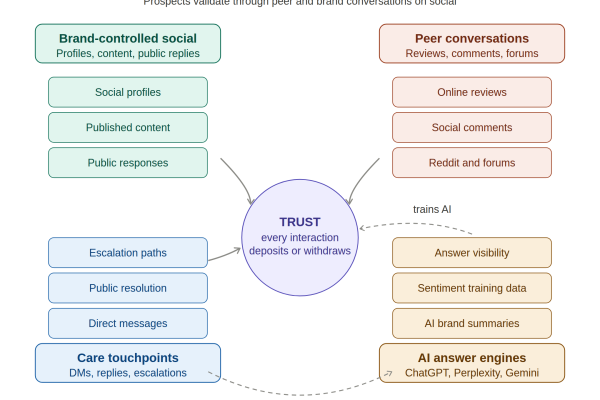
At the center of all four is trust.
As Brooke explains:
“Every interaction is either a deposit or a withdrawal in the bank of trust.”
Think of trust like a bank account. A helpful response, resolved complaint, or positive customer experience can make a deposit. An unanswered question, ignored review, or repeated customer service failure can create a withdrawal.
The problem is that many brands concentrate on the deposits they make intentionally through marketing campaigns and published content. Meanwhile, withdrawals may be happening in comment sections, review sites, and customer conversations that nobody is monitoring.
Understanding the four parts of the loop helps reveal where those withdrawals occur.
Why Do Public Social Media Responses Matter More Than Published Content?
Public responses give prospective customers evidence of how a brand treats people, especially when something goes wrong. While polished content communicates what a company wants customers to believe, customer interactions demonstrate how the company behaves.
Brooke puts it this way:
“Prospects give your content less weight than you’d hope, and your public responses more weight than you would expect.”
Brand-controlled social includes everything you publish, from your profiles and promotional content to the responses your team leaves beneath posts.
A thoughtful reply to an unhappy customer can build confidence when it provides a specific, human response and explains what happens next.
By contrast, a beautiful social media feed filled with unanswered complaints may create doubts about the brand’s commitment to customer service.
Even when complaints receive responses, the same issue appearing repeatedly can raise questions about whether the underlying problem is being addressed.
Put it into practice: Open your three most recent social media posts. Read the comments before the captions. Would a prospective customer feel confident about how your company treats people?
How Do Reviews, Reddit, and Peer Conversations Influence Brand Trust?
Peer conversations influence customer trust because they reveal experiences and opinions from people outside the brand. Online reviews, social comments, Reddit discussions, and public forums allow prospective customers to evaluate what other people say about a company.
Unlike brand-controlled content, these conversations aren’t something your marketing team can write or direct.
However, brands can participate.
Responding thoughtfully to positive and negative reviews demonstrates that your company is listening. Participating in a Reddit discussion to genuinely help someone, without turning the conversation into a sales pitch, can also build credibility.
Ignoring these conversations leaves others to shape the narrative without your participation.
For example, a one-star review sitting unanswered for six months may influence a potential customer who is researching your business today.
Put it into practice: Search Reddit for your brand name and “customer service.” Read the top three relevant threads. What are customers saying about their experiences, and is your brand participating in those conversations?
Why Isn’t Resolving Customer Complaints in DMs Enough?
Resolving a complaint privately may solve the customer’s immediate problem, but it doesn’t necessarily show other people that the brand followed through. When an issue begins publicly, closing the loop publicly can help demonstrate that the company takes customer concerns seriously.
Moving a complaint into direct messages is often the right decision, especially when personal or account information is involved.
But consider what a prospective customer sees.
Someone posts a complaint. Your brand responds, “Please DM us.” The conversation ends.
Did the company resolve the issue? Did the customer receive help? Nobody reading that public thread knows.
Meanwhile, customers may share screenshots or return to the original conversation to explain whether their issue was resolved.
That’s why Brooke emphasizes closing the loop.
When appropriate, and with the customer’s permission, return to the original public conversation to acknowledge that the issue has been handled. Never disclose account details or sensitive customer information.
The result is a visible example of your team’s follow-through.
Put it into practice: Find five public complaints your team moved into DMs. How many received a public follow-up after resolution?
If the answer is zero, your team may be making trust deposits that prospective customers never get to see.
How Do AI Answer Engines Influence Brand Reputation?
AI answer engines can influence brand reputation by summarizing information about a company from publicly available sources, including reviews, online discussions, and customer experiences. Those answers can become another source prospective customers consult before making a purchasing decision.
Tools like ChatGPT, Perplexity, Claude, and Gemini allow consumers to ask questions about a company’s customer service, reliability, or reputation.
The information these tools surface can be influenced by the public conversations surrounding a brand.
This is where The Social Trust Loop comes full circle.
Customer experiences contribute to public conversations. Those conversations can influence AI-generated answers. And those answers may shape how future customers perceive the brand.
A pattern of unresolved complaints or negative customer experiences can therefore have implications beyond the original interactions.
Put it into practice: Ask an AI tool, “How is [your brand’s] customer service?”
Screenshot the response. Repeat the exercise in 90 days and compare the results.
This provides a starting point for observing how your brand is represented in AI-generated answers over time.
Why Should Business Leaders Measure Social Media Customer Trust?
Business leaders should consider customer trust alongside traditional social media metrics because content performance and response times don’t fully capture the value of customer interactions. The Social Trust Loop connects marketing activity and customer care to the broader reputation customers encounter when researching a brand.
Most organizations measure what their social media teams publish and how quickly their customer care teams respond.
Those metrics matter, but they don’t always reveal whether customer issues are being resolved, whether complaints are repeating, or whether public interactions are strengthening confidence in the brand.
A social care team may resolve difficult complaints, prevent further frustration, or help customers who might otherwise leave.
Yet much of that work may never appear in a traditional marketing dashboard.
The Social Trust Loop gives leaders another way to evaluate those activities.
When teams can demonstrate where unanswered complaints, unresolved issues, and poor follow-through create trust withdrawals, they can make a stronger case for investing in social media customer care.
It also creates an opportunity to recognize the trust deposits care teams are making every day.
How Can You Audit Your Brand’s Social Trust Loop?
You can begin evaluating your Social Trust Loop with a 15-minute audit of one area of your social media customer experience. Identify interactions that build trust and those that may weaken it, then look for patterns your team can address.
You don’t need to evaluate all four parts at once.
Choose the area your organization may be overlooking:
- Review recent public comments for unanswered questions or recurring complaints.
- Examine online reviews and peer conversations for unresolved customer concerns.
- Check whether complaints moved into DMs received appropriate public follow-up.
- Review what AI answer engines say about your customer service.
Spend 15 minutes tallying the deposits and withdrawals you find.
The purpose isn’t to produce a perfect measurement of customer trust. It’s to identify where your team may be missing opportunities to build confidence.
Those findings can help you determine where to focus your attention next.
How Can You Strengthen Your Social Media Customer Care?
Once you’ve identified gaps in your social care touchpoints, the next step is improving how your team responds to customers, handles escalations, and follows through on issues.
Recognizing a trust withdrawal is useful. Understanding how to prevent it from happening again is where the work begins.
Brooke’s Social Care Playbook: The CARE Method brings the methods she teaches enterprise social care teams into a course organizations can work through at their own pace.
If your audit reveals that customer interactions are creating unnecessary trust withdrawals, the course offers a practical next step toward strengthening your social media customer service.
Quick Recap
What is the Social Trust Loop? A framework created by Brooke Sellas of B Squared Media that shows how prospects decide whether to trust a brand through four sources on social: brand-controlled social, peer conversations, care touchpoints, and AI answer engines. At the center, every interaction is either a deposit into or a withdrawal from trust.
What is brand-controlled social? The brand’s profiles, published content, and public responses. Prospects often weigh how a brand responds to complaints more heavily than the content it publishes.
What are peer conversations on social media? Online reviews, social comments, and Reddit and forum threads. Brands can’t control them but can participate helpfully and respond to reviews.
What are social care touchpoints? DMs, public replies, and escalations. Trust grows when brands close the loop publicly after resolving an issue in private, without sharing account details.
How do AI answer engines fit into social media and social care? Tools like ChatGPT, Perplexity, and Gemini build brand summaries from public conversations, so a brand’s replies, reviews, and forum presence shape what AI tells future customers.
What’s a quick first step? Pick one part of the Social Trust Loop and spend 15 minutes tallying the deposits and withdrawals you find there.
Read the Transcript
Brands Are Watching Creators
[00:00:00]
[00:00:00] Introducing The Social Trust Loop
Prospects give your content less weight than you’d hope, and your public responses more weight than you would expect.
A polished post is something you made. A thoughtful reply to an angry customer is proof of how you behave when it counts.
Hey, hey. Welcome back to the Social Media CX Podcast. I’m your host, Brooke Sellas, CEO of B Squared Media, author of Conversations That Connect, and today I’m introducing a framework I’ve been building for a while now. It’s called The Social Trust Loop, and it explains where your customers are deciding whether or not they’re going to trust you long before they ever pick up the phone.
Last week, Danny showed us how closely brands are watching creators. Today, we’re flipping the camera around because your customers and your prospects are watching you just as closely. Let’s get into it.
[00:01:08] How customers research brands
Picture someone deciding whether or not to move their money to a new bank. They don’t start by calling the bank. They start by checking it out. They scroll the bank’s Instagram. They read the comments under a few posts to see how people are being treated. They search Reddit for “Is bank legit?” and read threads probably from three years ago about this bank.
They’re looking at reviews online and social. And more and more, they’re opening a tool, an AI tool, like ChatGPT, and asking, “Is this bank good at customer service?” By the time that person reaches out to your bank or that bank, they’ve already formed an opinion, and almost none of that research happened on that bank’s website.
This is what I mean when I say prospects validate through conversations. They’re reading what your brand says, what other people say about you, and how you treat people when something goes wrong. That’s how they decide. Then that’s how they decide, is what I should say.
So when we talk about The Social Trust Loop, what is it?
It’s a framework that I’m working on, not official yet. But it has four parts all feeding into one thing in the center, which is trust.
On one side, you have brand-controlled social, which is everything you publish, and care touchpoints, which is how you show up when your customers need help on social.
On the other side, you have peer conversations, which is what people say about you and your brand. And you have AI answer engines, which is what tools like ChatGPT, Perplexity, Claude, and Gemini say about you when someone asks. And in the middle is the rule that makes everything work.
Every interaction is either a deposit or a withdrawal in the bank of trust.
Think of trust like an account balance at a bank. That’s why I use the bank example, y’all, okay? But if you think about it like a bank. Every reply, every review, every unanswered complaint either adds to it or takes away from it.
Most brands only watch the deposits they make on purpose, like a great campaign or a nice post or brand love. The withdrawals, however, usually happen quietly in comment sections where no one’s monitoring or no one’s taking that information and moving it up the chain. So let’s walk through each of these four parts.
Part one is the brand-controlled social. This is your profiles, your published content, and your public responses. It’s the part you fully control, and it’s where most brands spend most of their effort. Here’s what I want you to think about, though.
[00:04:28] Why public responses matter more than content
Prospects give your content less weight than you’d hope, and your public responses more weight than you would expect.
A polished post is something you made. A thoughtful reply to an angry customer is proof of how you behave when it counts. The deposit here is a public reply that’s specific, human, and tells the customer exactly what happens next; what to expect. A withdraw might be a profile full of beautiful content with complaints sitting unanswered underneath it.
Or even if somebody is responding to those complaints, you’re seeing that same complaint over and over and over again.
I want you to do this on Monday. Open your three most recent posts and look at them the way a prospect would. Read the comments before the caption. Would a stranger feel confident about how you treat people?
Would they make that deposit, or do you think they would make a withdraw?
[00:05:39] How peer conversations influence trust
Part two is the peer conversations. This is online reviews, social comments, and Reddit, and forums. This is the part that you don’t control, and it’s often the part that protects trust the most because it’s coming from people like them. It’s coming from their peers.
You cannot write these conversations, but you can absolutely be a part of them. A brand that shows up in a Reddit thread to genuinely help without a sales pitch earns a kind of credibility that no ad can buy. So the deposit here is responding to reviews, good and bad, with real answers and real follow-through.
The withdrawal might be a one-star review from six months ago with no response sitting at the top of your review page. Do this. Search Reddit for your brand’s name plus customer service. Read the top three threads. You’ll learn more about your brand reputation in 15 minutes than in most quarterly reports.
No lie.
[00:06:51] Why private customer care affects public reputation
Part three are the care touchpoints, and this is the heart of what we do here at B Squared Media. These are your DMs, your replies, your escalations, specifically your escalation paths, meaning how do you handle that public resolution, and what happens inside of direct messages?
Here’s the thing about care touchpoints.
A lot of them happen in private. They’re in the DMs, but the trust they build or break doesn’t stay private. Customers screenshot. I know we’ve all seen this. They post updates. They come back to the original comment and write something like, “Update, they fixed it,” or, “Update, still waiting. This company doesn’t care about me.”
So the deposit here is closing the loop in public. When an issue that started in your comments gets resolved in the DMs, go back and let people know it’s been handled. We call this closing the loop, with the customer’s okay, obviously, and without any account details, obviously, especially if you’re in financial services.
The withdrawal here could be, “Please DM us,” followed by silence. Everyone reading that thread saw you promise to help, and nobody saw you follow through. You’ve got to close the loop on social when something is resolved The homework that you can do is find five public complaints from the last few months that you ended up moving to a direct message, which is a smart thing to do.
But then check how many of those had a public follow-up showing that the issue was resolved. Did you close the loop? If the answer is zero, you’ve been making deposits that no one can see.
[00:08:42] How AI tools influence brand perception
Finally, part four is the AI answer engines. This is ChatGPT, Claude, Perplexity, Gemini, and whatever is going to come next. It covers your answer visibility, the sentiment those tools are learning from, and the brand summaries they hand to people who ask about you or ask about your industry; ask for a recommendation.
I’ve talked about this on the show before, so I’ll keep it tight. Those AI summaries are built from the same public conversations we just covered; your replies, your reviews, your Reddit threads. Which means the loop really does loop. Your public conversations shape the AI answers, and those AI answers shape how the next prospect walks in your door.
So the deposit here is lots of visible, helpful, resolved conversations for those AI tools to learn from. And heck yeah, y’all, satisfied customers. Okay? And the withdrawal is a public record of all unanswered complaints, which becomes the story AI tells about you.
[00:10:01] A simple audit to identify trust gaps
Your homework here, ask ChatGPT or Perplexity, Claude, whatever you use, “How is,” insert your brand name here.
How is brand’s customer service? So for me, it’d be like, “How is B Squared’s customer service?” would be the question I would ask. Screenshot the answer, then do it again in 90 days and compare.
Now why does all of this matter, and why does it matter to leadership? Well, if it were me, here’s how I’d bring it to my leadership team.
Most organizations measure social by what they publish, content, and measure social media customer care by how fast they respond to people. The Social Trust Loop shows you that those two things are connected and that the connection is where trust truly gets built or lost. Your care team is making deposits into your brand’s trust account every single day, and right now most of the value is probably not even showing up in your reports or your dashboard, the anecdotes that you’re giving, nothing.
When you can show leadership that unanswered complaints are withdrawals that prospects, peers, and AI tools alike can all see, the conversation about staffing and investment in social care gets a lot easier. If you do one thing from this week’s episode, run a quick audit on yourself. Pick one quadrant of the loop, whichever one you’ve been ignoring, and spend 15 minutes tallying deposits versus withdrawals.
You’ll know exactly where your balance is running low.
[00:11:56] The Social Care Playbook
And if today’s episode made you realize that your care touchpoints need some work, I built a course for exactly this. It’s called the Social Care Playbook. It’s all about the CARE Method, which we’ve also talked about on this show, and it takes everything I teach enterprise care teams, billion-dollar brands, and packages it so that anyone, small, medium, or big, can work through it at your own pace with your own team starting today.
You can find it at bsquared.media, run over to Courses and look for the Social Care Playbook. I will also include the link in the show notes for today.
I would love to hear from you and have you tell me which part of The Social Trust Loop your team has the hardest time keeping up with.
Drop it in the comments on this episode, find me on LinkedIn, give me a shout, email me, DM me, whatever.
And speaking of withdrawals, next week is Halloween, and I’m bringing you a horror story about what happens when someone else starts making withdrawals from your trust account on your behalf. Ooh.
Until next time, think conversation, not campaign.
Want to hear the full conversation? Listen to the Social Media CX Podcast on YouTube. And if your team is thinking about what responsible social listening in banking or financial services actually looks like at scale, check out the State of Social Care Report 2026.
Finally, as always, Think conversation, not campaign.™
The following two tabs change content below.

Brooke B. Sellas is an award-winning Customer Marketing Strategist and the CEO & Founder of B Squared Media. Her book, Conversations That Connect has been recognized nationally and is required reading for a Customer Experience class at NSU.
Brooke's influence in digital marketing is not just about her accomplishments but also about her unwavering commitment to elevating the industry standard of digital customer experience and customer marketing.
Latest posts by Brooke B. Sellas (See All)
- The Social Trust Loop: How Every Social Media Interaction Shapes Customer Trust - October 21, 2026
- Brands Are Watching You: What Creators Don’t Know About Social Listening with Danny Gardner - October 14, 2026
- Meta Changed the Rules. Is Your Social Media Strategy Ready? - October 7, 2026


Written by award-winning strategist Brooke Sellas, this weekly 5-minute power-up will help you turn social interactions into loyalty, retention, and revenue.
Tags: The Social Trust Loop
Written by award-winning strategist Brooke Sellas, this weekly 5-minute power-up will help you turn social interactions into loyalty, retention, and revenue.
Share this article: