Blog » Social Strategy »
The Social Trust Loop vs. 7 Million AI Citations: What Social Media Teaches AI
Table of Contents
Does social media influence what AI says about your brand? Yes, but the relationship is more complicated than simply publishing more social content.
In an analysis of 7 million citations across eight generative AI platforms, Meltwater found that social media accounted for 7.2% of cited sources. Earned media and news accounted for 29.4%, while reviews represented just 1.3%.
Those findings challenge a common assumption: that more social media activity automatically leads to greater visibility in AI-generated answers.
But they don’t mean social media, customer conversations, or social care have stopped influencing brand trust. Instead, the research raises an important distinction between the sources AI cites and the experiences that shape how customers evaluate a brand.
For marketing and customer experience leaders, that distinction could change how they approach answer engine optimization (AEO).
Where Does AI Get Its Information About Brands?
The Digital 2027 Global Overview Report from We Are Social and Meltwater includes an analysis of 7 million citations across eight generative AI platforms in August 2026.
The study examined prompts about consumer categories that did not include specific brand names.
Here’s how the citations were distributed:
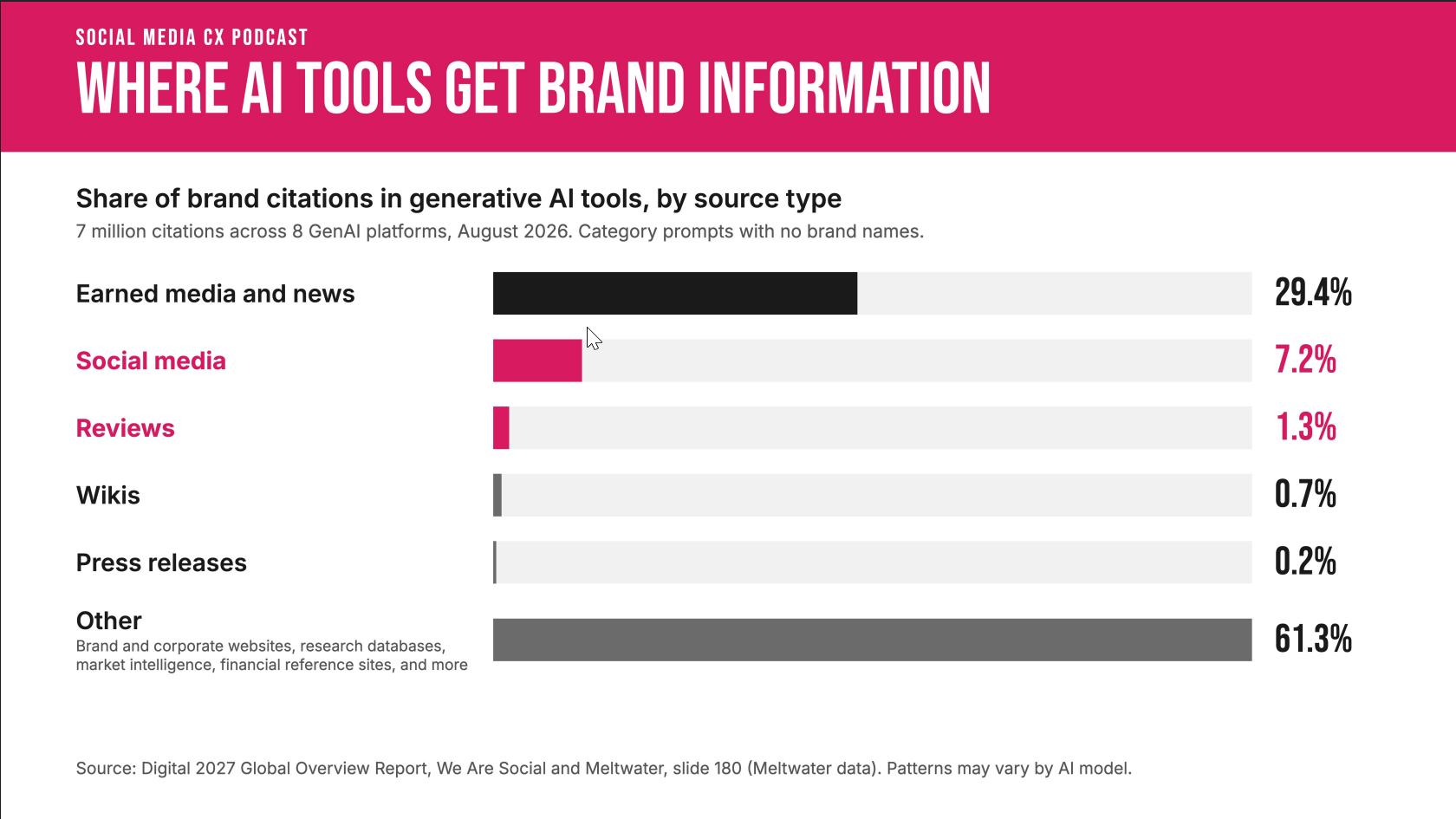
The difference between earned media and social media is striking. Among the categories identified separately, AI cited news and earned media more than four times as often as social media.
That creates a challenge for brands relying on their social media publishing calendars to improve AI visibility.
As Brooke Sellas explains:
“If your plan for showing up in AI answers is to post more on your brand’s social media channels, this data gives that plan very little support.”
But there’s another number leaders need to understand before drawing conclusions.
Why the 61.3% “Other” Category Matters
The largest category in the study is also the broadest.
The 61.3% classified as other sources includes brand and corporate websites, research databases, market intelligence platforms, financial reference sites, and more.
That means the data does not establish that AI ignores brand-owned information.
Brooke makes that limitation explicit:
“I can’t stand here and tell you that AI ignores what brands say about themselves.”
The research measures which sources AI tools cite in their answers. It does not provide a complete picture of every source that may have influenced those answers.
It also doesn’t tell us whether the same citation patterns would appear when someone asks a question about a specific company.
Both limitations matter when deciding how to invest in AI visibility.
Does the Social Trust Loop Still Hold Up?
The new findings don’t eliminate the importance of the Social Trust Loop. They help clarify how its components may influence customer trust and AI answers differently.
Brooke originally developed the Social Trust Loop to explain how prospects validate brands through conversations and experiences on social media.
The framework includes four connected elements:
- Brand-controlled social: Company profiles, published content, and public replies.
- Peer conversations: Reviews, comments, Reddit discussions, and forums.
- Care touchpoints: Direct messages, public resolutions, and customer service escalations.
- AI answer engines: Tools such as ChatGPT, Perplexity, and Gemini that summarize information about brands.
At the center is trust. Every interaction can either strengthen or weaken it.
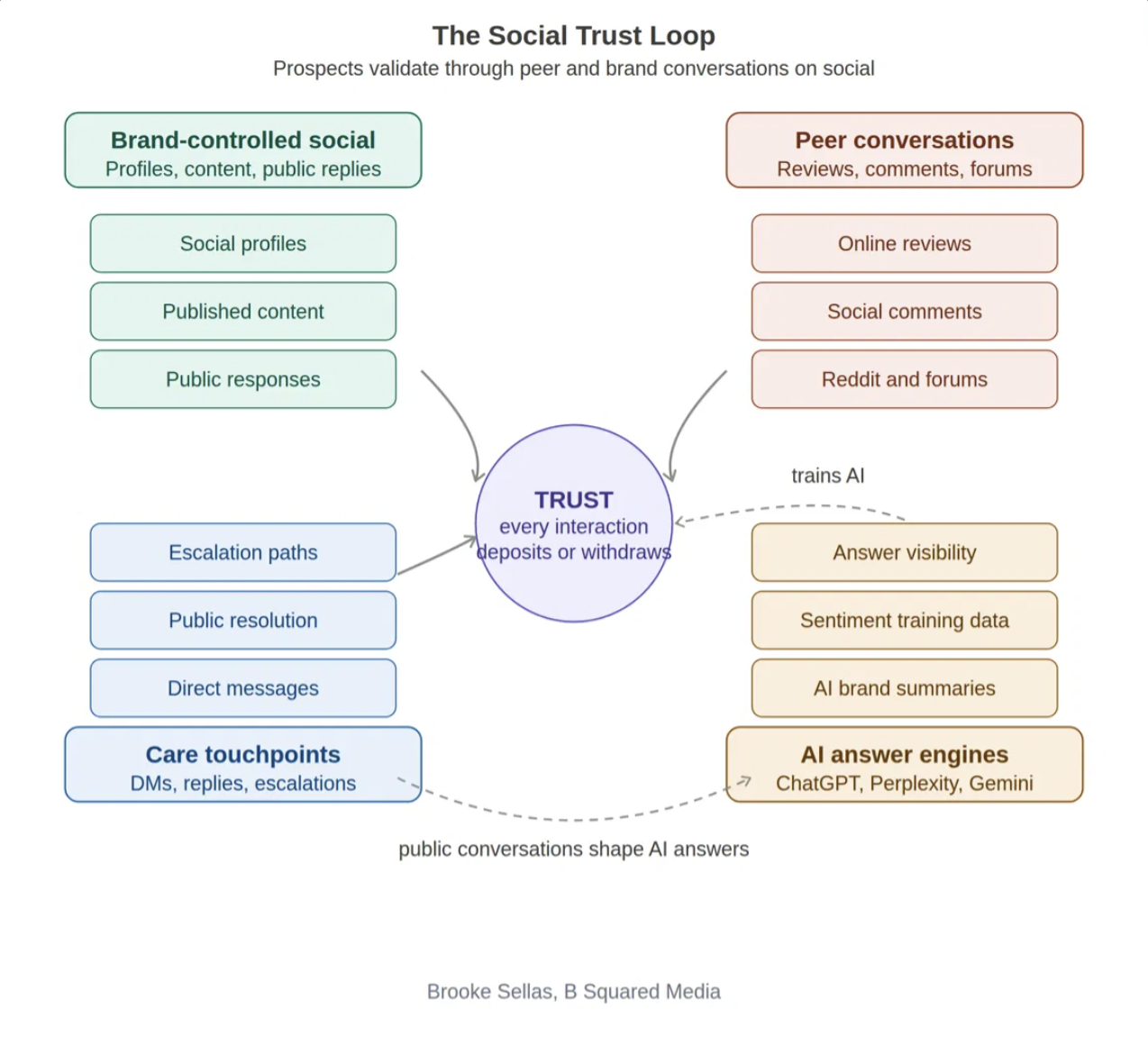
The Meltwater findings raise a more specific question: How directly does each of these elements influence what AI says?
Brand-Controlled Social Media Builds Trust, but May Have Limited Direct AI Visibility
A company’s social profiles, posts, and public replies remain important places for customers to interact with the brand.
However, the 7.2% social media citation figure provides little support for assuming that increasing branded social posts will significantly increase AI citations.
That doesn’t make publishing irrelevant. It means leaders should distinguish between content that serves customers directly and content that AI tools are likely to cite.
Peer Conversations and Social Care May Influence AI Indirectly
Customer conversations can have consequences beyond the original social interaction.
A public complaint may attract attention, generate discussion, or become part of a news story. That coverage may then become information an AI tool cites.
Brooke’s revised interpretation is that social care and peer conversations may influence AI through these secondary effects, even when the original social interaction is not cited directly.
This is a plausible explanation, not a causal relationship established by the Meltwater study.
Still, it creates an important strategic connection between social care, communications, public relations, and AEO.
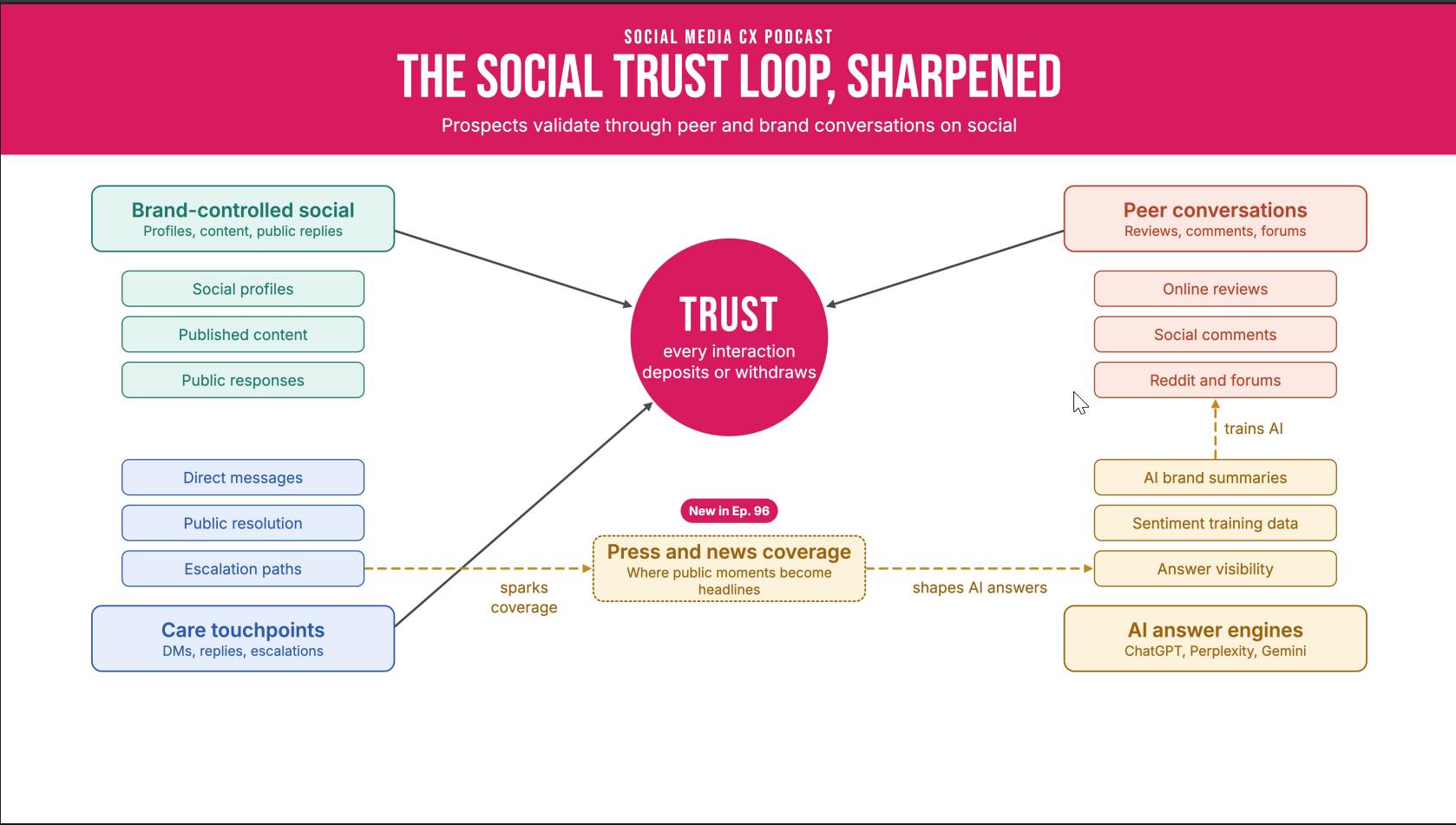
The updated diagram illustrates this possible path from customer interactions to press and news coverage, and ultimately to AI answers.
For leaders, the implication is that social care shouldn’t be treated solely as an operational function. Public customer experiences can also become part of the information environment surrounding a brand.
Why Do Reviews Account for Only 1.3% of AI Citations?
Reviews represented just 1.3% of citations in the Meltwater analysis.
That may seem surprisingly low for a source customers frequently use to evaluate businesses.
But the study doesn’t establish why the figure is so small.
One possible explanation is the research methodology. Because the prompts did not include brand names, they may have favored broad recommendations and roundup content rather than detailed reviews of specific companies.
Another limitation is that citations reveal what AI links to, not necessarily every piece of information that contributed to an answer.
Citation patterns can also vary by AI model.
The important takeaway is that a low citation share is not evidence that customer reviews have little influence on purchasing decisions or brand trust.
Leaders should avoid treating citation frequency as a complete measure of customer influence.
Why AI Discovery Questions Are Different From Brand Trust Questions
One of the most useful distinctions in the episode is the difference between discovery and evaluation.
Consider two questions someone might ask an AI tool:
- Discovery: “What’s the best bank for small businesses?”
- Evaluation: “Is Bank of America safe?” or “What are Bank of America’s customer service complaints?”
The first asks AI to recommend options.
The second asks AI to evaluate a specific company’s trustworthiness, service, or reputation.
The Meltwater study examined the first type of question.
It did not measure the second.
That distinction is particularly important in financial services, where customers may be concerned about security, reliability, fraud, and the quality of customer support.
Brooke argues that brand-specific evaluation questions are where peer conversations and social care touchpoints may matter most.
That remains her strategic interpretation rather than a conclusion proven by the study.
For marketing and CX leaders, the practical question becomes:
Are we measuring whether AI recommends our brand, or what AI says when customers are deciding whether to trust us?
Those are different business questions, and they may require different approaches to measurement.
What Does LinkedIn Citation Data Tell Us About People Versus Company Pages?
Another Meltwater analysis, presented as partner content in the same report, examined 9.5 million AI citations.
Within the LinkedIn content cited by AI, the analysis found:
- 75% came from individual member profiles.
- 25% came from company pages.
The finding suggests that individual voices may play a significant role in the LinkedIn information AI tools cite.
For organizations investing in executive visibility, employee expertise, and thought leadership, that’s worth examining.
It doesn’t prove that personal profiles always outperform company pages or that publishing from an individual account guarantees AI visibility.
But it does raise a useful question about whether a brand’s social strategy relies too heavily on corporate publishing while overlooking the people who represent its expertise.
How Can You Check What AI Says About Your Brand?
You don’t need a complicated measurement system to begin investigating your brand’s presence in AI-generated answers.
Brooke recommends starting with a 15-minute brand-name check.
Open two or three AI tools, such as ChatGPT, Gemini, or Perplexity, and ask each one three questions:
- Is [your brand] trustworthy?
- What do customers complain about with [your brand]?
- [Your brand] versus [your top competitor].
For each response, record which sources the AI tool cites.
Repeat the exercise monthly and look for patterns.
Are certain complaints appearing repeatedly? Which publications, forums, or other sources are cited? Do different AI tools rely on different information?
The goal isn’t to treat a handful of prompts as a complete measurement of your AI reputation. Answers can vary between tools and over time.
Instead, use the exercise to identify questions worth investigating and information your organization may be overlooking.
Share what you learn with your communications and PR teams. Those findings may help connect customer conversations, brand reputation, and AEO planning.
What Should Marketing and CX Leaders Do Differently?
The Meltwater research doesn’t justify abandoning social media or social care. It challenges the assumption that more publishing is the primary path to greater AI visibility.
Three strategic considerations emerge:
First, separate customer trust from citation volume. Social content and customer service interactions can matter to customers even when AI doesn’t cite them directly.
Second, pay attention to what customer conversations set in motion. Public experiences can lead to wider discussions and news coverage that may become part of the sources AI cites.
Third, examine brand-specific AI questions. Discovery research alone cannot tell you what AI says when a customer is evaluating your company’s trustworthiness.
As Brooke puts it:
“Think conversation, not campaign. Now with receipts.”
That idea connects the research back to the Social Trust Loop. Brand trust isn’t created by publishing volume alone. It’s shaped through interactions, conversations, and the information people encounter when deciding whether to do business with you.
Connect Social Care to Your AEO Strategy
If you’re responsible for social care, customer experience, or brand visibility, AI adds another reason to understand how customer conversations influence your reputation.
B Squared Media helps enterprise and financial services brands connect social care with answer engine optimization so their teams can make more informed decisions about trust and visibility.
Book a call with B Squared Media to talk about AEO and social care.
Quick Recap
What is the Social Trust Loop?
The Social Trust Loop is a framework created by Brooke Sellas of B Squared Media. It shows how people decide whether to trust a brand through four sources on social media: brand-controlled social, peer conversations, care touchpoints, and AI answer engines. At the center, every interaction is either a deposit into trust or a withdrawal from it.
How much does social media influence what AI says about brands?
According to Meltwater data in the Digital 2027 Global Overview Report from We Are Social and Meltwater (slide 180), social media accounted for 7.2% of brand citations in generative AI tools. Earned media and news accounted for 29.4%.
Where do AI tools get their information about brands?
In Meltwater’s analysis of 7 million citations across 8 generative AI platforms in August 2026, citations came from earned media and news (29.4%), social media (7.2%), reviews (1.3%), wikis (0.7%), press releases (0.2%), and other sources (61.3%). The “other” category includes brand and corporate websites, research databases, market intelligence platforms, and financial reference sites. The prompts covered consumer categories and did not include brand names, and Meltwater notes that patterns may vary by AI model.
Why do Reddit and YouTube rank among the most-cited domains if social media is only 7.2% of AI citations?
The two findings come from different studies and measure different things. Semrush data ranks individual websites by how often AI cites them, while the Meltwater data in the Digital 2027 Global Overview Report measures content categories. A single website can be one of the most-cited domains even when its category is a minority of total citations.
Why do reviews make up only 1.3% of AI brand citations?
The data doesn’t say. Possible explanations include the study’s use of prompts without brand names, which favor roundup and news content; the fact that citations show what AI links to, which may not capture everything that shaped an answer; and differences between AI models.
How does social care affect what AI says about a brand?
Brooke Sellas’s sharpened view of the Social Trust Loop is that brand-controlled social media builds customer trust directly but feeds AI only a little. Peer conversations and social care touchpoints appear to reach AI mostly through what they set in motion, such as press coverage, forum threads, and questions people ask about a brand by name.
Do AI tools cite LinkedIn company pages or individual members more often?
According to Meltwater’s analysis of 9.5 million AI citations (Digital 2027 Global Overview Report, slide 484, Meltwater partner content), 75% of LinkedIn content cited by AI comes from individual members and 25% comes from company pages.
How can social care teams see what AI says about their brand?
Once a month, ask two or three AI tools questions that include your brand’s name, such as “Is [brand] trustworthy?”, “What do customers complain about with [brand]?”, and “[Brand] vs. [competitor].” Record which sources each answer cites and share the patterns with your comms and PR teams.
How can brands get help with AEO and social care?
B Squared Media helps enterprise and financial services brands connect social care to answer engine optimization (AEO). Book a call at bsquared.media/contact.
Read the Transcript
[00:00:00] New AI Data Challenges the Social Trust Loop
Two weeks ago, I handed you a framework that I’m genuinely proud of. It’s called the Social Trust Loop, and it’s one of my big ideas about what happens on social media and how social media shapes what AI tells people about your brand. Then, a brand-new report landed on my desk with data on 7 million AI citations.
Social media accounted for 7.2% of those, and reviews came in at 1.3%. What? This is very humbling for me, and it’s excellent timing for a podcast about trust. So today, I’m doing the thing that most people with a framework never do, and I’m gonna try to break mine right here on air with you and tell you exactly what held up and exactly what I’m changing or sharpening.
Hey, hey, and welcome back to the Social Media CX Podcast. I’m your host, Brooke Sellas, CEO of B Squared Media, author of Conversations That Connect, and someone who just spent a week trying to poke holes in her own framework. Occupational hazard, I guess.
A quick catch-up if you are new here. Two episodes ago, I introduced the Social Trust Loop, which is my framework that I’m figuring out for how people decide whether to trust a brand on social media.
It has four parts, brand-controlled social, peer conversations, care touchpoints, and AI answer engines, and at the center of the framework is one idea, which is that every interaction is either a deposit into trust or a withdrawal from it. Last week for Halloween, we talked about social media impersonators, the scammers who make withdrawals from your trust account without asking permission.
This week we’re auditing the ledger, so to speak. Let’s get into it. The data comes from the Digital 2027 Global Overview Report from We Are Social and Meltwater.
If you wanna follow along, it’s slide 180 that we’re gonna be talking about inside of that full report deck. It’s not in the article summary, so you’ll need to actually open the deck itself, which means you’ll have to go download it. I know, it’s 900 pages. I’ll wait.
Here’s how Meltwater ran the study.
They looked at seven million citations across eight generative AI platforms in August of this year, which is 2026. The prompts covered consumer categories like retail, banking, AI, automotive, fast food, streaming, apparel, and fashion. And here’s an important detail that we’ll come back to. None of those prompts included a brand name.
We’ll come back to that.
[00:03:01] Where AI Gets Its Information
When those AI tools in this study cited a source, here’s where the citations came from. Earned media and news took a whopping 29.4% of the citations. Next was social media at 7.2%. Behind that was reviews at 1.3%. Behind that were wikis at 0.7%. Press releases were 0.2%, and literally everything else was 61.3%.
That everything else bucket matters, so let’s be really careful with it. It includes brand and corporate websites, research databases, market intelligence platforms, financial reference sites, and more. That means I can’t stand here and tell you that AI ignores what brands say about themselves.
Brand websites are sitting inside the biggest bucket that lives on that chart. Here’s what I can tell you. Of the categories we actually see, earned media and news beats social media nearly four to one. If your plan for showing up in AI answers is to post more on your brand’s social media channels, this data gives that plan very little support. Which if you’ve listened to this show for more than five minutes, you already know how I feel about that.
It’s think conversation, not campaign. Now with receipts. If you read the Social Care Weekly, which is our newsletter, I’ll have a link for you to sign up in the show notes if you wanna do that, you might be squinting at your phone right now because on October 13th in the newsletter, I shared Semrush data showing that YouTube and Reddit rank among the most cited domains in AI answers.
Now I’m telling you social media is only 7.2% of brand citations. So which is it? Both are true because they measure different things. The SEMrush data ranked individual websites, while the Meltwater data in this report measures categories of content. A single website can top the leaderboard while its whole category is still a small share of the total.
Think of a blockbuster movie that wins the weekend box office, even though movies are a tiny slice of everything people watched that weekend. There are also two different companies’ studies using different methods, so I’d never compare these numbers as if they came from the same experiment.
Reddit can be one of the single most cited sources in AI answers, and social media can still be a minority of brand citations. There’s no real contradiction here, just two very different questions and methodologies. Okay, I will admit, though, that my stomach dropped for a second when I started reading this report and was like, “Wait a minute. What?”
[00:06:14] What the Social Trust Loop Gets Right
So let’s start with what holds up. The Social Trust Loop was always about trust. And AI answer engines are only one of its four parts. Customers still read your replies on social. They still watch how you handle a complaint in public. They still ask their friends and scroll forums before moving their money or making a big purchase.
Nothing in this report changes any of that. Now for the sharpening. I’ve got four quick updates that I wanted to be honest with you about, how I’m thinking about this Social Trust Loop framework, which I’m still working on. It just needs some sharpening now.
The place I want to sharpen first is brand-controlled social is a weak direct input to AI.
[00:07:06] How Social Media Influences AI
So what I’m saying here is your brand’s posts do help customers decide whether or not to trust you. Based on this data, they do very little to shape what AI says about you. I used to treat these as a package deal, but going forward, I want to make sure I separate them.
The place that I want to look at second is the path from social media to AI may run through earned media.
Remember, if you listened to last week’s Halloween episode, the Eli Lilly story. I talked about how an impersonator’s post on social media turned into news coverage around Eli Lilly. That’s a social moment becoming earned media, and earned media is the single biggest citation category in this Meltwater report.
To be clear, this data doesn’t prove that path. It’s a plausible mechanism, and I’ve watched it happen enough times to take it seriously. Because when a care failure goes viral, it rarely stays on social media, as we all know. It gets picked up, it gets written about, it gets shared, and that coverage is exactly what AI tools love to cite.
[00:08:29] AI Discovery vs. Brand Evaluation
Number three, reviews at 1.3% is really uncomfortable, and I’m not going to try to explain that away. I’ll be honest, I expected reviews to be a lot higher. Here are a few possible explanations, and I want to be clear that they are possibilities, not findings. First, remember that none of the prompts in this Meltwater study included a brand name.
It used questions like, “What’s the best bank for a small business?” And then when that kind of question is asked, the AI tended to pull from roundup articles and press coverage. So reviews might show up a lot more when someone asks about a specific brand. Second, a citation shows what an AI tool linked to.
It may not capture everything that helped shape that answer. And third, Meltwater itself notes that these patterns can vary by AI model. Maybe it’s one of those, maybe it’s all three. I don’t know yet, and I’d rather tell you that than pretend otherwise.
The fourth place I want to sharpen is that this study measured discovery, and trust gets decided at evaluation.
This is a big one for my financial service friends who are listening. There are two very different kinds of questions that people ask AI. “What’s the best bank for small business?” is a discovery question. “Is,” insert bank brand here, “safe?” Or insert bank name here customer service complaint. So I could say, “Is Bank of America safe?”
Give me Bank of America customer service complaints. Those are evaluation questions. So the study, this Meltwater study, measured that first kind, not evaluation questions. So trust in financial services gets decided in the second kind, in my opinion, and that’s exactly where I would expect peer conversations and care touch points to matter the most.
I want to see that data next, quite honestly. If you’ve got it, call me. I’m for real serious.
[00:10:53] Why AI Cites Personal LinkedIn Profiles
One bonus piece of color from LinkedIn is that Meltwater also shared an analysis of 9.5 million AI citations. They found that 75% of the LinkedIn content that AI cites comes from individual members, so personal profiles, not brand pages, and 25% comes from the actual company pages.
That’s in slide 484 of the same deck, by the way. If you are going to download this deck, again, we’ll have the link in the show notes, the transcript. Quick grain of salt with that, it’s partner content, so it’s Meltwater talking about Meltwater’s own analysis. It’s still interesting because it suggests that even within social media, AI pays more attention to people than brand pages.
So here is my sharpened Social Trust Loop. Brand-controlled social builds trust with your customers directly and feeds AI only a little. Peer conversations and care touch points also build trust directly, and they appear to reach AI mostly through what they set in motion, so things like press coverage, forum threads, and the questions people ask about you by name.
Every interaction is still a deposit or a withdrawal. We just have a clearer picture of where the money travels.
[00:12:34] The 15-Minute AI Brand Audit
Let’s make this practical. I’ve got one thing that you can do this week and then bring upstream to leadership. I want you to try to run a 15-minute brand name check. So open one or two or three AI tools, like ChatGPT, Gemini, Perplexity, whatever.
Ask each one three questions. Number one is, insert your brand here, trustworthy? Is B Squared Media trustworthy? Number two, what do customers complain about with, enter your brand here. So again, it would be like, what do customers complain about when it comes to B Squared Media? And then number three, your brand versus your top competitor.
So it might be B Squared Media versus insert top competitor here. Write down which sources each answer cites. That’s it. You don’t have to worry about tools or approvals or crazy spreadsheets or budgets. You’re just collecting that evaluation stage data that this study that I’m talking about, the Meltwater study, didn’t measure, and I think you’ll learn more about what AI says about your brand than any other dashboard will tell you.
Do it once a month and watch for pattern changes. Then, if you want to bring this upstream or bring it to comms and PR, let’s say you find out earned media is the biggest citation category, then your highest risk public moments are going to matter even more. So fraud reports, outages, billing disputes, anything that’s going viral in a negative way are the moments most likely to turn into press coverage.
If you ran through this check through that I’m giving you in your head while I was talking and felt a little nervous about what you might find, there’s no judgment.
We’ve been here. We see it every day. But I do wanna talk with you. At B Squared Media, we help enterprise and financial brands connect social care to what AI answer engines say about them, whether it’s the replies your customers see to the conversations that end up shaping your brand in AI.
If you wanna talk through AEO, answer engine optimization, and how social care fits into it, just book a call with me and my team at bsquaredmedia/contact.
Thank you for sticking with me while I stress tested my own framework in public. I’d rather sharpen the Social Trust Loop with real data than defend it with wishful thinking, and I hope that makes you trust me just a little bit more.
Until next time, think conversation, not campaign.
Want to hear the full conversation? Listen to the Social Media CX Podcast on YouTube. And if your team is thinking about what responsible social listening in banking or financial services actually looks like at scale, check out the State of Social Care Report 2026.
Finally, as always, Think conversation, not campaign.™
The following two tabs change content below.

Brooke B. Sellas is an award-winning Customer Marketing Strategist and the CEO & Founder of B Squared Media. Her book, Conversations That Connect has been recognized nationally and is required reading for a Customer Experience class at NSU.
Brooke's influence in digital marketing is not just about her accomplishments but also about her unwavering commitment to elevating the industry standard of digital customer experience and customer marketing.
Latest posts by Brooke B. Sellas (See All)

Written by award-winning strategist Brooke Sellas, this weekly 5-minute power-up will help you turn social interactions into loyalty, retention, and revenue.
Category: Social Strategy
Tags: The Social Trust Loop
Written by award-winning strategist Brooke Sellas, this weekly 5-minute power-up will help you turn social interactions into loyalty, retention, and revenue.
Share this article: