Blog » Best Practices »
How a Credit Union Cut Negative Social Media Comments by 80%
Table of Contents
A customer posts on LinkedIn that your outage made their vendor payments fail. Fourteen reactions, six comments, 5:47 on a Friday. Who owns the reply?
At MarketingProfs B2B Forum 2026, Brooke Sellas of B Squared Media asked a room full of B2B marketers that exact question. In this solo episode of the Social Media CX Podcast, she turns her presentation, “Public Conversations, Private Risk,” into a practical framework for managing social media customer care in regulated industries, including financial services, fintech, and healthcare.
Brooke explains why B2B buyers evaluate public customer complaints, how the three quiet failures of social care (unanswered, delayed, and misrouted conversations) create business risk, and how organizations can respond using a four-step process that balances speed, visibility, and compliance. She also introduces the Three Rs of Social Care—Revenue, Retention, and Risk—to help organizations identify the business signals within customer conversations.
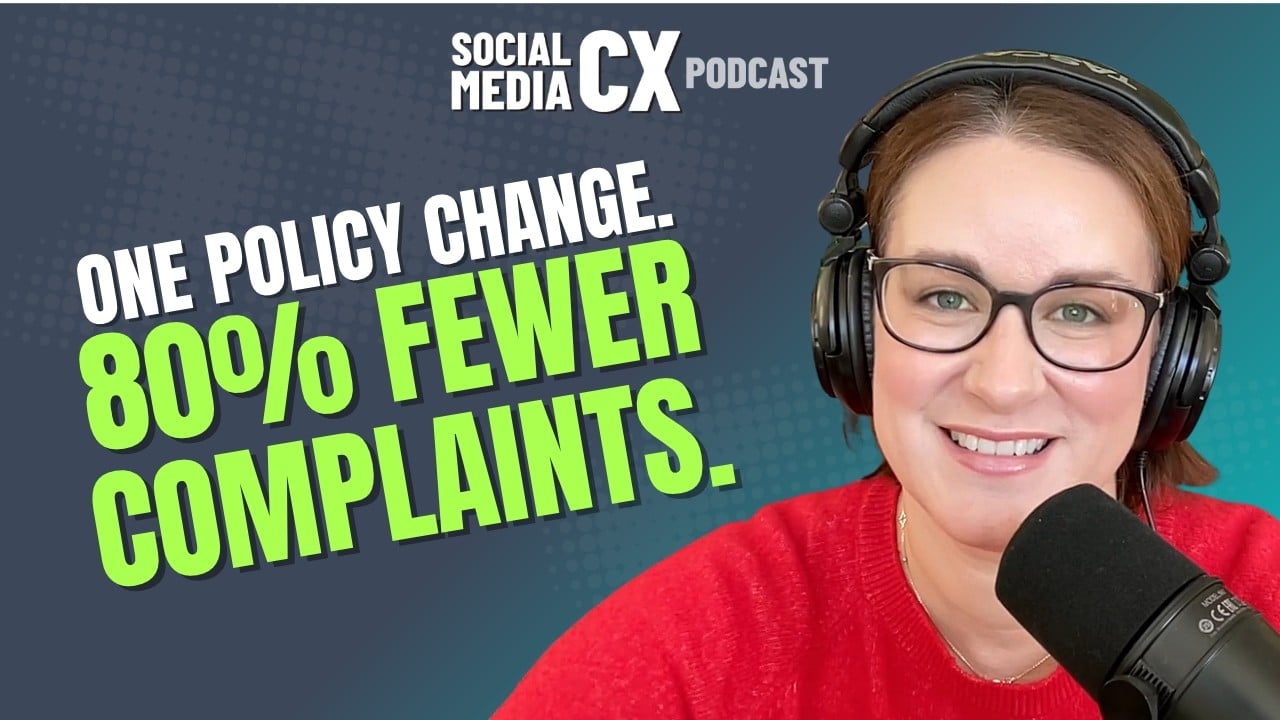
The episode features a case study of BCU, a large credit union that reduced negative social media conversations by 80%. B Squared Media discovered that 80% of BCU’s negative member conversations were related to its overdraft protection policy. After leadership overhauled that policy, negative conversations dropped by 80%.
The case study demonstrates how analyzing social media customer feedback can uncover operational problems, inform leadership decisions, and improve customer experience.
A credit union reduced negative social media comments by 80% after discovering that most complaints were connected to its overdraft protection policy.
When B Squared Media began managing social care for BCU, a large credit union, the team categorized member conversations to identify recurring issues. The analysis revealed that 80% of negative conversations involved the overdraft protection policy, including complaints about declined cards, unexpected service restrictions, and a lack of transparency.
BCU’s leadership used those findings to overhaul the policy. Following the change, negative member conversations declined by 80%.
The results demonstrate how analyzing social media customer feedback can help organizations identify operational problems, improve customer experience, and make more informed business decisions.
How Did One Customer Complaint Expose a Gap in BCU’s Social Care?
On July 4, 2018, BCU published a social media post about member safety. Underneath the post, a member complained that their debit card had been shut off without warning during the holiday.
Imagine standing at the grocery store with everything you need for your Fourth of July celebration, only to discover your card doesn’t work.
The complaint was sitting in BCU’s social inbox, labeled “unclassified.” Without a clear process for identifying, routing, and escalating member concerns, the issue wasn’t handled appropriately.
The incident exposed weaknesses in BCU’s social care operations, particularly during holidays and other periods when staffing was limited.
BCU’s leadership recognized the need for a dedicated social care program and brought in B Squared Media to help establish one.
How Did Social Listening Reduce Negative Comments by 80%?
B Squared Media began categorizing every member conversation to understand the issues generating complaints.
The analysis revealed that 80% of negative conversations were related to BCU’s overdraft protection policy.
Members expressed frustration about declined cards, limited transparency, and overdraft services becoming unavailable without warning. Some compared BCU’s policies with those offered by competing financial institutions.
These recurring complaints provided evidence of a widespread problem with the policy.
B Squared Media shared its findings with BCU’s leadership, which overhauled the overdraft protection policy. After the change, negative member conversations declined by 80%.
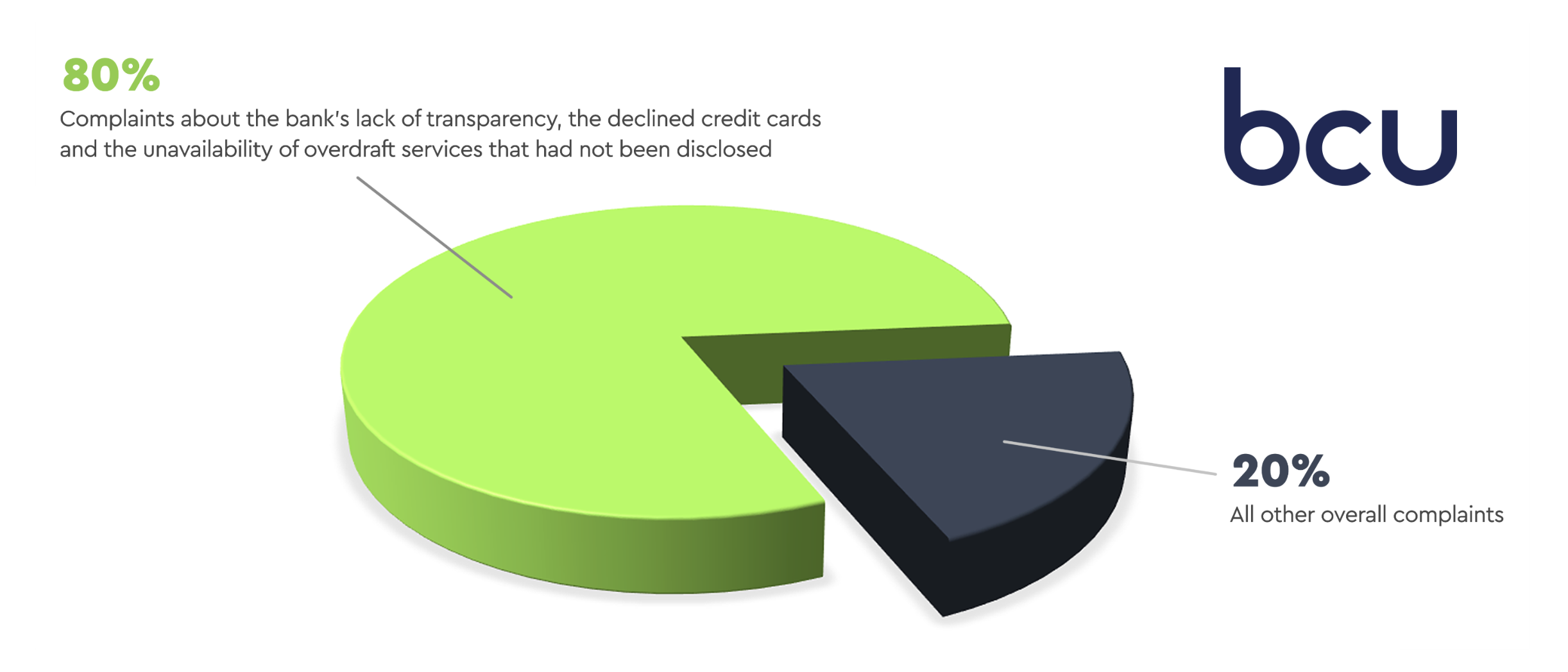
The chart shows the distribution of complaints before the policy change. The subsequent 80% reduction reflects the improvement reported after BCU revised its policy.
The social care team was able to identify the problem because it consistently categorized and analyzed member feedback. Leadership then had the information needed to address a recurring source of frustration.
Why Do Public Social Media Complaints Matter to B2B Buyers?
Public social media conversations can influence how prospective buyers evaluate a company before contacting its sales team.
Research from SurveyMonkey and Reddit, published in March 2026, found that approximately 70% of U.S. B2B decision-makers had used social media to research a business purchase. The research also found that 83% conduct their own research before speaking with sales.
Peer recommendations carry significant influence. According to the same research, 73% of respondents trust peer recommendations, compared with 55% who trust vendor websites.
The 6sense 2026 Global B2B Buyer Experience Report also found that the vendor a buying group favors before its first sales conversation wins 82% of the time.
These findings reinforce the importance of what prospective buyers can discover about a company through public conversations.
A prospective customer might visit a company’s LinkedIn page, read complaints from existing customers, and observe how the organization responds.
Are questions being answered? Are concerns acknowledged? Does the company appear capable of resolving problems?
As Brooke Sellas explains:
Every public reply is a promise made in front of your next buyer.
For regulated B2B organizations, public responses must also account for privacy, security, and compliance requirements.
What Are the Three Quiet Failures of Social Care?
Brooke identifies three common social care failures that can go unnoticed in traditional reporting: unanswered, delayed, and misrouted conversations.
She introduced these failures during her presentation, Public Conversations, Private Risk, at MarketingProfs B2B Forum 2026.
- Unanswered: A customer leaves a question or complaint and receives no response. The organization may not even realize the conversation was missed.
- Delayed: The company eventually responds, but the delay has already frustrated the customer and may affect how others perceive the organization.
- Misrouted: Someone acknowledges the issue, but the conversation never reaches the person or department responsible for resolving it.
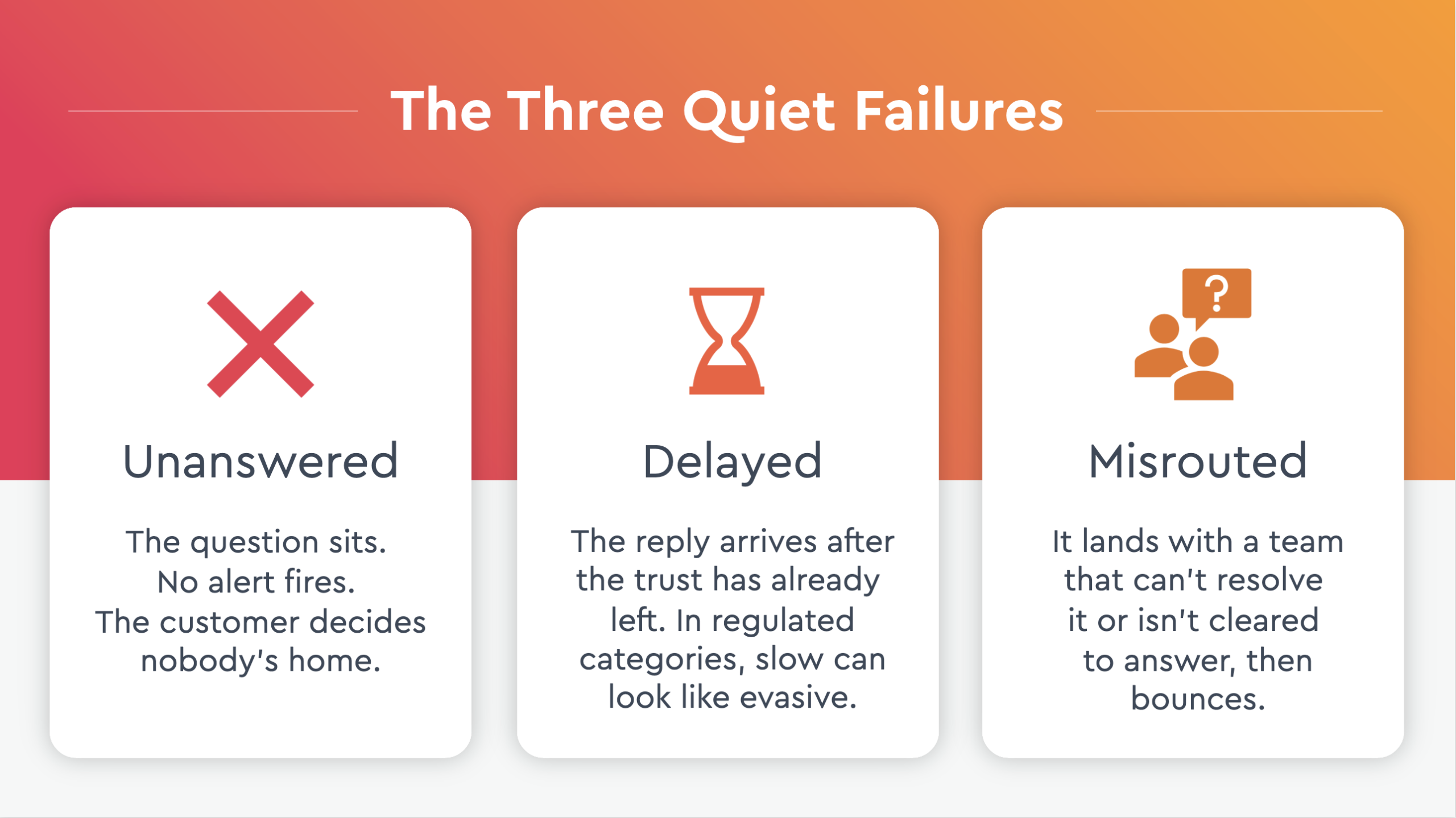
Misrouted conversations are particularly difficult to detect through response-time reporting.
A social media team might acknowledge a complaint within minutes. That response appears in the dashboard as a successful interaction, even if the customer never receives a resolution.
Organizations need documented escalation procedures, clear ownership, and a way to track whether issues have been resolved.
How Can Brands Identify Social Care Coverage Gaps?
Brands can identify social care coverage gaps by comparing when customer conversations arrive with when employees are available to respond.
During a 2026 social care audit for a large asset manager, B Squared Media discovered that more than 40% of inbound conversations were arriving outside staffed hours.
The organization had an experienced team and leadership that valued customer experience. However, its staffing schedule didn’t align with the times customers were contacting the business.
Brooke recommends a simple exercise that organizations can complete using their existing conversation data.
- Pull seven days of inbound social media conversations.
- Compare conversation timestamps with the team’s coverage schedule.
- Identify which types of inquiries arrive outside staffed hours.
- Review whether urgent inquiries have appropriate escalation procedures.
Pay particular attention to account access problems, fraud concerns, outages, and other issues that may require a timely response.
The findings can help organizations adjust staffing, establish backup coverage, or improve escalation procedures based on actual customer behavior.
How Should Regulated Brands Respond to Social Media Complaints?
Regulated brands should use a documented response process that allows employees to acknowledge complaints promptly while protecting sensitive information and following applicable compliance requirements.
Brooke describes three considerations that influence every public response:
- Speed: Customers expect timely acknowledgment and assistance.
- Visibility: Public responses can be seen, shared, and evaluated by other customers and prospective buyers.
- Compliance: Responses must respect privacy, security, and regulatory requirements.
What Are the Four Steps of Compliant Social Care?
Brooke recommends a four-step process for managing sensitive customer complaints.
- Acknowledge publicly
Let the customer know their concern has been received. Keep the response empathetic and avoid discussing account-specific information.
For example, a company might acknowledge the issue and offer to connect the customer with the appropriate support team.
- Move to a secure channel
Account verification, personal information, and sensitive details should be handled through an approved private channel.
A public comment thread isn’t an appropriate place to discuss account balances, medical records, or other protected information.
- Route to a named owner
Every inquiry type should have a designated person or team responsible for handling it, along with a backup when that person is unavailable.
Brooke warns against escalation processes that end with vague commitments such as “someone will look into it.”
The team needs to know who is responsible for taking the next action.
- Log the resolution
Document the issue, its escalation path, the actions taken, and the outcome.
These records support audits, improve accountability, and make recurring problems easier to identify.
What Should Regulated Brands Avoid Saying Publicly?
Public responses should never disclose protected information, promise outcomes the organization cannot guarantee, or dismiss a customer’s concerns.
Brooke highlights several common mistakes, including:
- Discussing private account information in a public comment.
- Referencing protected medical or financial details.
- Making guarantees before an issue has been investigated.
- Blaming the customer for the problem.
- Relying on silence because the team is uncertain what it can say.
Preapproved response language can help employees acknowledge concerns without waiting for individual compliance approval on every routine interaction.
Organizations should develop that language with their compliance and customer care teams, then establish clear procedures for situations that require additional review.
What Are the Three Rs of Social Care?
The Three Rs of Social Care are Revenue, Retention, and Risk. Brooke uses these categories to help organizations identify business signals within social media customer conversations.
Revenue: Identify Buying Signals
Revenue conversations may include questions about pricing, product features, integrations, availability, or purchasing options.
These inquiries can reveal prospective customers who are evaluating the business or preparing to make a purchase.
Retention: Recognize Customer Frustration
Retention conversations include signals that a customer may be considering leaving.
Examples include repeated complaints, comparisons with competitors, or expressions of dissatisfaction with a product or service.
Categorizing these conversations can help organizations identify recurring issues that may contribute to customer churn.
Risk: Identify Issues That Require Attention
Risk conversations involve concerns such as fraud, phishing, service outages, identity verification, or compliance.
These inquiries may require specialized handling or urgent escalation.
Conversations that don’t fit Revenue, Retention, or Risk can be labeled as general or none.
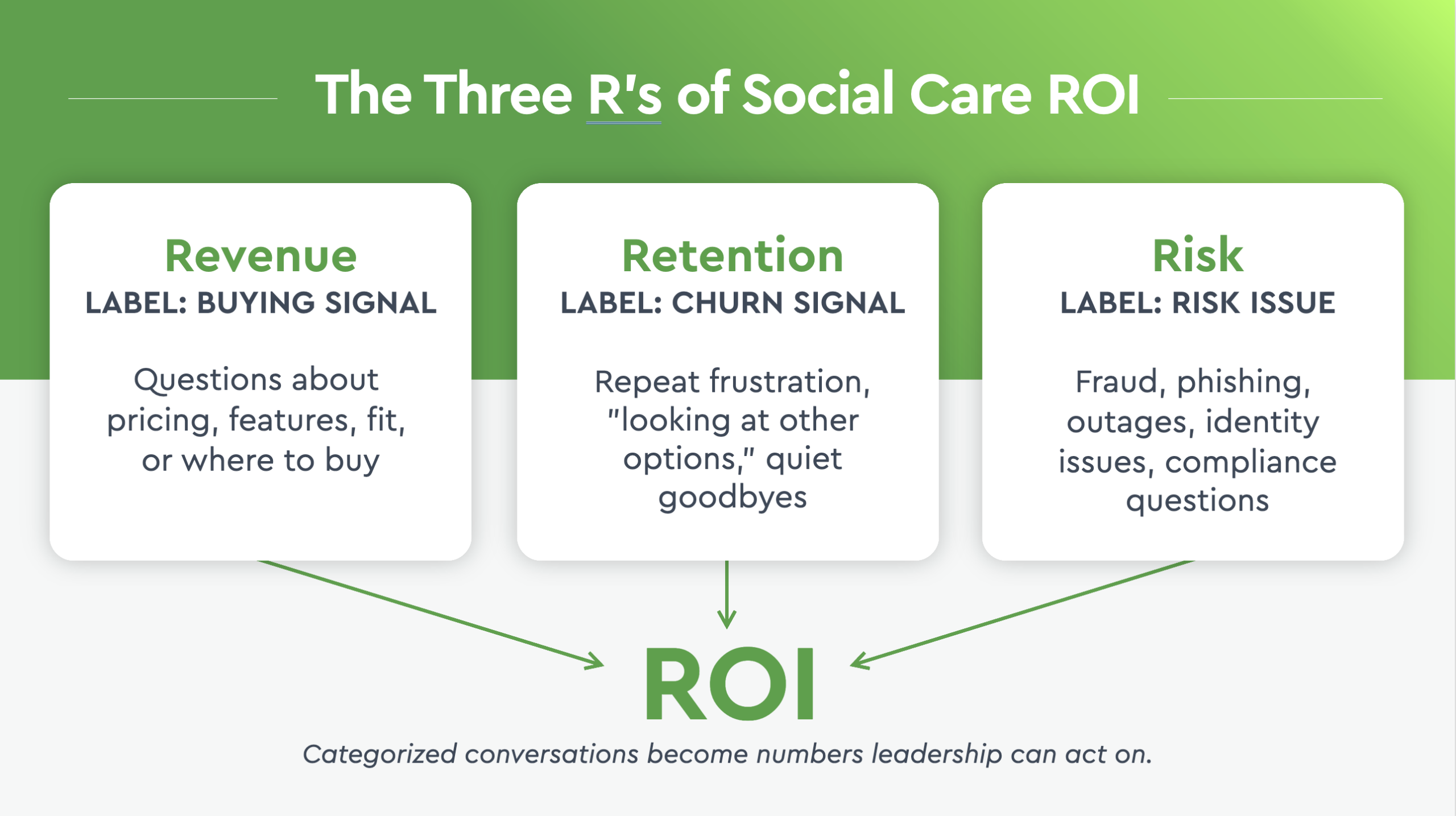
Consistent categorization makes it easier to identify patterns across large volumes of conversations.
At BCU, analyzing categorized member feedback revealed the recurring overdraft protection complaints that ultimately led to a policy change.
Organizations can apply the same approach to identify frequently reported service problems, emerging customer concerns, or questions that suggest unmet demand.
Why Can Average Social Care Response Time Be Misleading?
Average response time can hide significant differences in how quickly organizations handle different types of customer inquiries.
Consider a team that responds to compliments in five minutes but takes five hours to address fraud concerns.
The overall average may appear reasonable, even though customers with potentially urgent problems are waiting much longer.
Brooke recommends reporting response times by inquiry type so leadership can see how quickly different categories of conversations are being handled.
This includes examining response times for account access issues, fraud concerns, service complaints, and other inquiries that may carry greater customer or business risk.
When combined with the Three Rs, response-time reporting can help organizations identify which problems require additional staffing, better escalation procedures, or changes to existing workflows.
What Is a 30-Day Plan for Improving Social Care?
Organizations can begin identifying gaps in their social care programs with a focused 30-day review.
Week 1: Compare conversation timestamps with coverage hours.
Review when customers are contacting the business and identify periods when no one is available to respond.
Week 2: Categorize conversations using the Three Rs.
Label conversations as Revenue, Retention, Risk, or none to begin identifying recurring patterns.
Week 3: Document and test an escalation path.
Select one type of customer inquiry, document who owns the response, and conduct a 30-minute tabletop exercise to test the process.
Week 4: Prepare a leadership report.
Create a one-page summary showing the Three Rs and response times by inquiry type.
The report should identify patterns, coverage gaps, and operational issues that require further attention.
What Can Your Social Care Data Tell You About Your Business?
BCU’s experience shows what organizations can learn when they consistently categorize and analyze customer conversations.
A holiday complaint initially exposed a gap in the credit union’s social care process. Once B Squared Media began tracking member feedback, the team discovered that 80% of negative conversations involved the overdraft protection policy.
BCU’s leadership used that information to revise the policy, and negative member conversations declined by 80%.
Your organization’s social media conversations may reveal similar patterns. Customers might repeatedly report problems with a particular service, ask questions that your website doesn’t answer, or express frustrations that suggest they’re considering a competitor.
The challenge is making sure those conversations are categorized, reported, and shared with the people responsible for addressing the underlying issues.
How much of that information is your organization currently capturing?
B Squared Media’s Social Care Audit examines coverage hours, response times, inquiry categories, escalation procedures, and potential risks. It can help identify gaps in your current social care program and opportunities to improve how customer concerns are handled.
QUICK RECAP
Who owns the social media reply in a regulated B2B brand?
Every inquiry type needs a named owner for every hour of the day. Brooke Sellas of B Squared Media puts it this way: if an escalation path ends with “someone will look into it,” it ends with a shrug.
Why do public social media replies matter to B2B buyers?
According to SurveyMonkey and Reddit research (The Hidden B2B Journey, March 2026), about 70% of B2B decision-makers have used social media to research a business purchase, and 73% trust peer recommendations compared with 55% for vendor websites. The 6sense 2026 Global B2B Buyer Experience Report found that the vendor a buying group favors before first contact wins 82% of the time.
What are the three weights of a public reply?
Speed, visibility, and compliance. Most teams optimize for one and quietly lose the other two.
What are the three quiet failures in social care?
Unanswered, delayed, and misrouted conversations. None of them trigger an alert, which is what makes them dangerous for regulated brands.
What are the four steps of compliant social care?
Acknowledge publicly, move to a secure channel, route to a named owner, and log the resolution.
What are the Three R’s of social care?
The Three R’s are a labeling system: every social media conversation is labeled Revenue (a buying signal), Retention (a churn signal), or Risk (fraud, phishing, outages, identity, or compliance questions), or a clear “none,” before it’s closed.
How should social care response time be reported?
By inquiry type. A single average can hide slow responses to fraud and risk questions behind fast responses to compliments.
What is a 30-day plan for improving social care?
Week 1, map inbound timestamps against coverage hours. Week 2, label conversations with the Three R’s. Week 3, document one escalation path and test it with a 30-minute tabletop exercise. Week 4, send leadership a one-page report with the Three R’s and response time by inquiry type.
How can brands find the gaps in their social care program?
A Social Care Audit from B Squared Media evaluates response times, coverage gaps, inquiry mix, escalation paths, and risk exposure across a brand’s social media conversations. Learn more at bsquared.media/social-care-audit.
Read the Transcript
[00:00:00] Who Owns the Reply?
Brooke Sellas: I’m going to read you a LinkedIn post, and I want you to pretend like it just landed on your own company page. It’s a fictional company, it’s a fictional post, but it’s a very real stomachache if you live in social. Here’s the post.
“Our payment file failed during your outage this afternoon. Three of our vendors didn’t get paid. Is anyone at Northbridge Pay actually monitoring this?”
Again, fictional post, fictional company. But let’s pretend this had 14 reactions and six comments, and the clock on your laptop says 5:47 PM on a Friday. Last week, I stood on stage at MarketingProfs B2B Forum in a room full of B2B marketers and read that exact post out loud.
Then I asked for a show of hands, who owns that reply? Marketing hands, they went up. Support hands, they went up. Compliance hands, couple of those went up. And then when I said, “Okay, keep your hand up if the answer is nobody, really,” and that’s what most people did. They kept their hand up. There’s no judgment here.
This is very common, but it’s also what leads to a PR crisis. That moment is basically this whole episode in one show of hands. The post itself is a pretty normal customer problem. What makes it scary or turn into that PR crisis is that a customer asked a very public question in front of their peers, in front of your future buyers, and the org chart within the organization collectively gave a shrug.
Hey, hey. Welcome back to the Social Media CX Podcast. I’m your host, Brooke Sellas, CEO of B Squared Media, author of Conversations That Connect, and the woman who just spent a week asking marketers who owns the reply at 5:47 on a Friday. Spoiler, the answer is usually pretty awkward. Today I’m turning my MarketingProfs B2B Forum 2026 talk, Public Conversations, Private Risk: The New Rules of Social Care for Regulated B2B Brands, into an episode.
So if you work in financial services, fintech, healthcare, or any regulated or B2B business where one wrong reply turns into a compliance meeting or nightmare for you, pull up a chair. We’re gonna cover why your buyers are reading your replies, the three quiet failures that never trigger an alert, and the exact words that keep you fast but safe, and how to turn social media comments into decisions your leadership actually cares about.
Let’s get into it.
[00:02:55] Why B2B Buyers Are Reading Your Comments
Brooke Sellas: Let’s start with who’s watching because when that post goes up, that post on your LinkedIn page or wherever it may be, the customer is not the only person waiting to see what you do or how you reply. SurveyMonkey and Reddit Research, surveyed about 1,200 US business decision-makers, and about 70% of those people had used social media at least once to research a business purchase.
So when you picture your buyer doing their homework, picture them also scrolling your social media comments, including the comments you were really hoping nobody would see. The same research found that 83% of decision makers self-research before they ever talk to sales. And when they were asked which sources they trust, peer recommendations came out on top at 73%, compared to 55% for vendors’ websites.
Yes, your beautiful website, the one you paid a lot of money for, is losing a trust contest to a stranger’s opinion. Now layer research from 6sense on top of that. Their Global 2026 B2B Buyer Experience Report came out on November 2nd, which was literally the day before my talk. The timing gods were feeling generous.
And they surveyed about 5,000 B2B buyers, And they found that the vendor a buying group favored before first contact with a seller won the deal 82% of the time, y’all. 82%. Whoa. And if you weren’t on that initial shortlist, you had less than a 10% chance of winning. So put all of those together, and what we have is the fact that your buyers decide early, they decide quietly, and they trust their peers more than they trust you.
Here’s how I want you to think about every public reply. It carries three weights at the same time. Weight number one is speed.
Customers expect a response in minutes on social, and silence reads as risk. So when a question about money sits there unanswered, people fill that gap with the worst case version of the story. That is just what we do as humans.
Weight number two is visibility. Public replies are permanent and screenshot ready.
People will say, “No, they’re not. I can delete it.” Uh, It’s already been screenshotted by the time you delete it. I hate to break it to you, but, like, come on, We’re all on social. We see these screenshots all the time. People love receipts. So when you’re writing for the customer, you’re also writing for every single person who reads that thread for the next three years, including the reporter who’s gonna write about this if it turns into a PR crisis.
Hi, reporter.
And the last weight is compliance. In a regulated industry, your reply carries regulatory and reputational weight. Say too much, and you’ve disclosed something you shouldn’t have. Promise too much, and you’ve made a commitment that legal will never sign off on.
[00:06:06] 3 Quiet Failures of Social Care
Brooke Sellas: Here’s what I see over and over again.
Most teams optimize for one of those weights and quietly lose the other two. The speed first team fires off something casual, and then they make compliance break out in hives.
The compliance team routes every comment through like three layers of approvals and then doesn’t get back to people until Tuesday or days later. And the brand voice team writes something gorgeous that says absolutely nothing. Sorry, brand. You want all three weights handled at once, and you don’t get there by being more, more careful in the moment, unfortunately.
But you do get there with infrastructure, which brings me to the failures you can’t see. There are three ways social care fails in regulated brands, and I call them quiet failures because none of them trigger an alert. They are unanswered, delayed, and misrouted. Unanswered means the comment never got a reply at all.
Yes, in the year 2026, we are still seeing this happen on brand pages. I really just can’t believe it. Delayed means it got one answer eventually, but probably after the customer and everyone watching already decided that you didn’t care or you took too long. And misrouted is a sneaky one because it means someone answered politely, on time, but the issue never reached the person who could actually fix it.
[00:07:34] The BCU Holiday Complaint
Brooke Sellas: So like, say your front line can’t issue a refund, so you’ve got to route it internally, and then that takes forever, and then it gets dropped somewhere internally. We never close the loop on social, and that customer never gets helped. None of these are gonna set off any kind of alarm bells or sirens.
Your dashboard is going to remain green. Nobody’s going to get paged. Paged? Is that still a thing? I’m so old, y’all. And the weekly report will look fine. That’s exactly what makes all of these things so dangerous. Let me give you a loud version of this. It’s July 4th, 2018, and BCU, a large credit union, publishes a post about member safety.
Reasonable post, responsible post, exactly what a credit union should be saying on social. And underneath it, a member replies publicly that their debit card was shut off with no notice, on a holiday. Picture standing at the grocery store with a cart full of hot dogs and buns, and your card gets declined on the Fourth of July.
That comment was sitting in their system, their social inbox, if you will, labeled as unclassified. I want to be really clear about this part because this matters. That team cared. Nobody was being careless or lazy. What they didn’t have yet was a system to catch that comment, route it to the right person, and answer it on a holiday weekend.
That is a infrastructure gap, and the infrastructure gaps get fixed with system. That moment, by the way, is when BCU’s leadership decided the risk of not having a social care program was bigger than the effort of building one, and that’s when they called us.
Now, here’s the quiet version.
We did a social care audit for a large asset manager this year in 2026. Strong program, capable team, leadership was absolutely paying attention and invested. It’s the kind of client where you walk in a little nervous because you’re not sure you’ll find anything wrong during these audits. One of the things we do in an audit is map inbound conversation against coverage hours.
It’s super unglamorous because it’s just a bunch of timestamps on one side and a bunch of like shift coverage on the other. But what we found was more than 40% of their conversations were landing outside of business hours, outside of when they had people on shift to help. Nobody was ignoring anything.
No one was asleep at the wheel. Customers just showed up and asked questions when no one was on shift. And that’s the thing about quiet failures. From the inside, they don’t look like failures at all. They look like a normal Friday afternoon and then a normal Saturday and then a normal holiday weekend.
So this week, I want you to map your timestamps. Pull one week of inbound timestamps from whatever tool you use and lay them over your coverage hours. That’s it. This will take no time at all. A spreadsheet will work just fine. Look at what lands after hours or on weekends or on holidays, and then look at what kind of questions land there.
If the busiest window for fraud or account access questions or sales questions or retention questions happen to be when your team’s commuting home, congratulations, you just found your first fix. You’re welcome.
Okay, so how do you actually answer this fictitious Northbridge post and every post like it without either panicking or waiting for like three different rounds of approvals?
I’ve got four steps for you. Number one, always acknowledge publicly, fast and human, and no specifics. You’re telling the customer and everyone watching that a real person saw this issue. Step two is move it to a secure channel, whether it’s direct messages, a secure message, phone, whatever your compliance team has approved.
It could be a bot, I don’t care. Whatever’s approved. Verification and account details never, ever, ever happen in public. They always happen on that secure channel. Step three is to route to a named owner. So for every kind of inquiry you get, and for every hour of the day that you’re available, you need to have a named owner, which means a person or a role with a backup.
I say this to every team we work with, if your escalation paths end with someone will look into it, that path will end in a shrug. It will become one of those three quiet failures. Step four, and the final step, is to log the resolution. So what happened, who handled it, how long it took, and how it ended.
This is what makes the whole system auditable. And it’s what makes the next segment of this episode possible.
[00:12:40] What Regulated Brands Should Never Say
Brooke Sellas: Now, let’s talk about the words, because in regulated industry, the words are where good intentions go to get you into trouble. These are replies that I’ve actually seen out in the wild on social, names withheld to protect the well-meaning.
So reply number one, an actual reply that I’ve seen, “Your account is fine. The charge was reversed this morning.” So helpful, super kind, and you just confirmed account activity in public about a specific person. So don’t do this. Instead, you could say something like, “We want to look into this with you.
Please send us a DM so we can verify a few details securely.” And that gives the same warmth with zero disclosures. Reply two: “This will never happen again.” Oh, honey, that’s a promise you can’t keep, made in writing in public. No, we can’t do that. So instead, you could say something like, “We’re reviewing what happened, and we’ll share updates here as we have them.”
You’re committing to transparency, but you can actually deliver on this without making a promise that you can’t keep. Reply number three: “That’s an issue with your bank, not us.” Even when it’s technically true, the customer hears, “Not my problem,” and so does everyone else reading that thread. So instead, you should say something like, “We understand how frustrating this is.
Let’s sort it out together in the DMs.” You can figure out whose fault it is in private. Reply number four, silence. Yeah, this is the most common one. No reply at all because nobody was sure who should answer or what they were allowed to say, or they just don’t care about social, although they’re using it to broadcast.
Hmm. Anyways, what I would do here is say something like, “We see this, and we’re on it. Watch for a DM from our team.” 10 words that will buy you some time and tell every buyer scrolling past that somebody is home and somebody cares. And then number five for my healthcare friends, “We’ve checked your records, and your appointment was rescheduled.”
I know it sounds innocuous, but that’s mentioning records in public. We don’t wanna do that. So instead, you would say something like, “We’d like to help. Please DM us, and please don’t share any personal or medical details here.” Notice that last part? You’re protecting the customer from over-sharing, too, which happens constantly.
I’ve seen credit card numbers, Social Security numbers, phone numbers, addresses all out there on public, on social, so you kind of have to remind people like, “Hey, this isn’t secure.” This matters so much for speed because when the guardrails and the language are built in upfront, compliance reviews your playbook once instead of having to review every single comment forever.
Your team doesn’t have to wait for approval on each reply because the approved language already exists. This is how you get to speed without the risk, and honestly, compliance usually likes this version better, too, because they wrote half of it. So far, we’ve talked about protecting trust.
[00:15:57] The 3 Rs of Social Care
Brooke Sellas: Now let’s talk about what social care can tell your business if you let it.
This is the part of the talk, by the way, where I could feel the room lean in. I saw the phones going up. It’s called the three Rs. So before any conversation gets closed, somebody labels it as one of three things: revenue, which is a buying signal. So this is someone asking about pricing, integrations, whether you can handle their volume.
Do you ship here? Does this come in my size? Those types of things. Retention would be a churn signal. Frustrated customers, comparisons to a competitor, we’re reconsidering, or the classic, “Is anyone even listening to me?” And then the final R is risk. So we’re looking for fraud, phishing, outages, identity issues, compliance questions, the stuff that needs to reach a specific person fast.
And if it’s none of those, you label it as a clear none or general. That’s fine.
[00:16:55] How BCU Reduced Negative Comments by 80%
Brooke Sellas: What you can’t have is that label that BCU had in the comment back in 2018, which was unclassified.
Now, let me tell you what happens when you label everything because this is my favorite story to tell. After that July 4th comment, our team took over BCU social care. We labeled every member conversation, every single one, and when we looked at the negative conversations, a pattern jumped out pretty quickly, and that was that 80% of those negative conversations traced back to one thing, which was the overdraft protection policy.
Members were frustrated by the lack of transparency, by declined cards, and by overdraft services being unavailable without notice, and also happened to mention that competitors’ overdraft protection programs were better. So we took all of this to BCU’s leadership, and the leadership overhauled the entire overdraft protection policy. And then 80% of their negative conversations went away. That’s what labeling gets you.
It’s a single pattern pulled out of everyday member comments, and it changed a policy, and changing the policy changed the conversation. There was no clever post. There was no campaign. We didn’t spend a bunch of money on ads. We didn’t spend any money, right? We were just looking at the conversations that were happening around the brand and found that 80% of them involved this one thing.
One more piece and it’s about reporting. Most teams report one number for response time, which is the average, average response time. Please, I am begging you, break that out by inquiry type. Here’s why. If compliments get answered in five minutes and fraud questions get answered in five hours, your average looks perfectly fine, but you have real risk exposure hiding inside a nice looking number.
Averages are like the Spanx of social care reporting. Everything looks super smooth until you take them off. And that’s how I feel about that.
If you’re wondering where your own program sits right now, those two questions will help you a lot. Are you labeling every conversation, and can you see response time by inquiry type?
If you loved this overdraft story, and it gets me every time, it’s such a great story, you can read the entire story. We have a case study with BCU on our website that will walk you through how labeling every member conversation surfaced these patterns behind most of their negative sentiment, negative comments, negative conversation online, and what happened after leadership fixed it.
Let me leave you with one last thing. Every public reply is a promise made in front of your next buyer.
Until next time, think conversation, not campaign.
Want to hear the full conversation? Listen to the Social Media CX Podcast on YouTube. And if your team is thinking about what responsible social listening in banking or financial services actually looks like at scale, check out the State of Social Care Report 2026.
Finally, as always, Think conversation, not campaign.™
The following two tabs change content below.

Brooke B. Sellas is an award-winning Customer Marketing Strategist and the CEO & Founder of B Squared Media. Her book, Conversations That Connect has been recognized nationally and is required reading for a Customer Experience class at NSU.
Brooke's influence in digital marketing is not just about her accomplishments but also about her unwavering commitment to elevating the industry standard of digital customer experience and customer marketing.
Latest posts by Brooke B. Sellas (See All)
- How a Credit Union Cut Negative Social Media Comments by 80% - November 18, 2026
- The ROI of “Thank You”: Why Gratitude Is Your Cheapest Retention Strategy - November 11, 2026
- The Social Trust Loop vs. 7 Million AI Citations: What Social Media Teaches AI - November 4, 2026


Written by award-winning strategist Brooke Sellas, this weekly 5-minute power-up will help you turn social interactions into loyalty, retention, and revenue.
Tags: social media response
Written by award-winning strategist Brooke Sellas, this weekly 5-minute power-up will help you turn social interactions into loyalty, retention, and revenue.

Share this article: