AI Social Media Management: What Humans Did Better
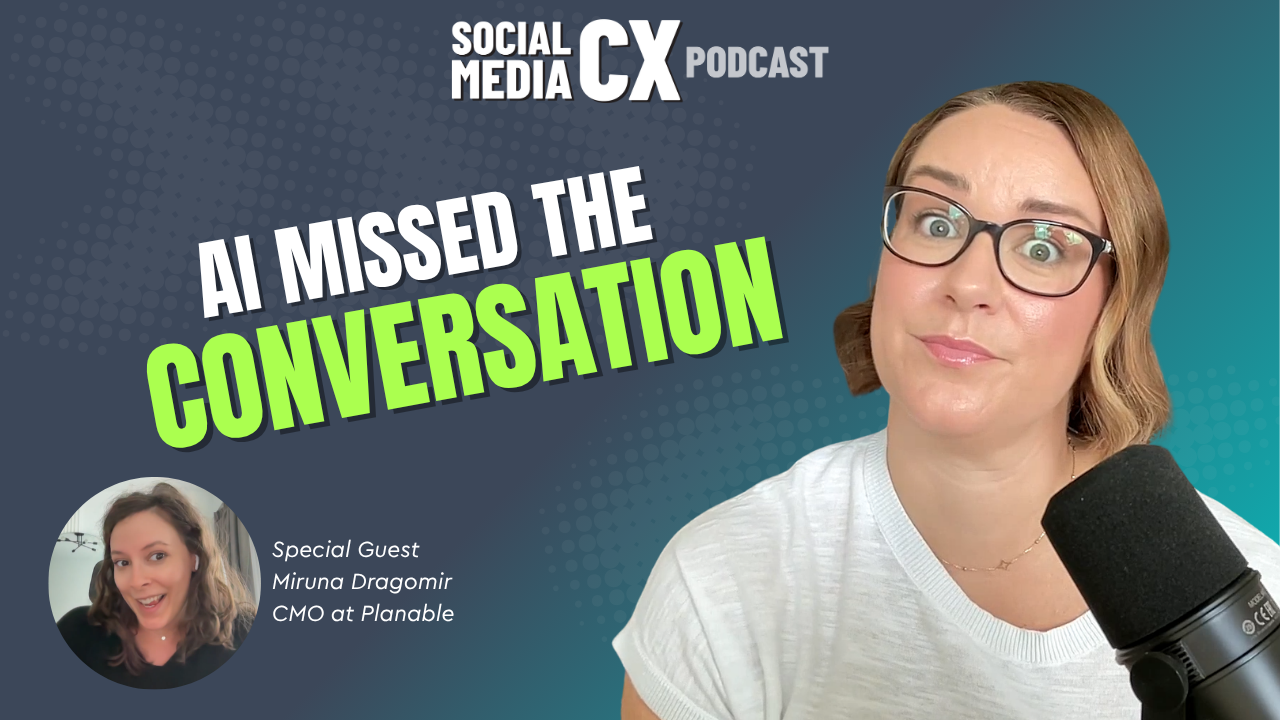
Table of Contents
AI can write captions, generate images, brainstorm ideas, and help build a content calendar. But social media management includes something much harder to automate: conversation.
Planable put that distinction to the test.
In an experiment comparing human social media managers with AI-run Instagram accounts, the human accounts generated 88 comments. The AI accounts generated just two.
The difference wasn’t simply that humans created better content. In fact, when people reviewed the accounts without knowing which were human or AI, they preferred some of the AI accounts.
The bigger difference was what happened around the content.
The humans understood that running social media meant more than publishing posts. They looked for ways to create engagement, joined conversations, and responded when people commented.
AI largely stopped at publishing.
For brands exploring AI social media management, that gap raises an important question: Are we using AI to improve social media, or simply to produce more social content?
How Planable Tested AI Social Media Management
Planable created seven new Instagram accounts for a fictional chocolate brand.
Three accounts were managed by humans. Two were completely human-run, while the third was managed by a human who could use AI as a tool.
The other four accounts were run by AI, split between ChatGPT and Claude.
Each received the same basic brand information, including guidelines, tone of voice, a name, and visual assets. Every account started with zero followers and was tasked with developing a strategy for its first four weeks.
Each account created nine posts. Because the accounts were new, Planable boosted the posts to give them an opportunity to reach an audience. The company kept factors such as budget, publishing day, and time consistent across the experiment.
There was another important part of the setup.
The AI accounts weren’t simply asked to write captions or create posts. They were asked to develop a social media strategy and grow an audience.
Planable intentionally left room for AI to determine what that job required.
That decision revealed one of the biggest differences between AI and the human social media managers.
88 Comments vs. 2: Where the Engagement Gap Appeared
When AI interpreted “social media strategy,” it focused primarily on creating and publishing content.
The human social media managers approached the assignment differently.
One manager ran a giveaway. Another participated in the comment sections of other brands to attract attention. All three human managers replied when people commented and looked for ways to continue the interaction.
Nobody explicitly told them to do those things.
Their experience told them those behaviors were part of running a social media account.
The difference showed up in the results.
Human-run accounts averaged a 1.88% engagement rate compared with 0.77% for the AI accounts. Even more striking, the human accounts generated 88 comments while the AI accounts generated only two.
Then there was another problem.
The AI accounts didn’t reply to either comment.
That matters because social media doesn’t end when someone responds to your post. A comment is the beginning of an opportunity for conversation.
The humans recognized that opportunity. AI did not.
AI Knew Engagement Was the Goal. Why Did It Miss It?
There’s an easy explanation for the engagement gap: Planable simply didn’t tell AI what to do.
Except that’s not quite what happened.
Engagement was one of the metrics AI was expected to optimize for.
AI knew the desired outcome. What it didn’t do was connect that outcome to all the behaviors an experienced social media professional might associate with creating engagement.
It didn’t suggest responding to comments. It didn’t identify participation in other conversations as part of the strategy. It didn’t create engagement opportunities such as a giveaway or poll.
As Miruna Dragomir explained, AI could have done many of those things if it had been specifically instructed to do them.
That distinction is important.
AI may be capable of completing a task without independently recognizing that the task needs to happen.
Why Human Expertise Still Matters
Think about what happens when you brief an experienced social media manager.
You probably don’t give them an exhaustive checklist explaining that they should create content, publish it, monitor responses, answer comments, look for opportunities to engage, and adjust the strategy based on what happens.
Experience fills in some of those gaps.
AI doesn’t necessarily make the same assumptions.
That’s why Miruna cautions brands against assuming AI has replaced the need for expertise simply because it has access to enormous amounts of information.
Instead, Planable has started treating AI more like a very junior employee.
A junior team member may have plenty of capability. However, they still need context, direction, feedback, and review.
Planable is taking a similar approach with its AI automations. The company is actively building them, but nothing currently goes live without human approval.
That review isn’t simply a gate. It helps the team identify patterns, spot quality problems, provide better inputs, and learn how to improve its AI systems over time.
As Miruna put it, AI itself is becoming a skill.
And there’s a danger in assuming that because AI makes something feel easy, the result must be good.
“The easier it feels, probably the worse job it does,” Miruna said.
Does AI Automatically Make Social Media More Efficient?
Another result from the experiment challenges a common assumption about AI social media management: using AI doesn’t automatically save time.
The account managed by a human using AI performed well. It finished second in the experiment.
It also logged the most hours.
The social media manager used AI as a sparring partner. They asked for help, iterated on outputs, provided feedback, requested changes, and refined the results.
That partnership produced strong work. However, it didn’t produce the time savings we might expect from adding AI to the workflow.
That doesn’t mean marketers shouldn’t use AI.
Instead, it means leaders should be careful about assuming that AI adoption automatically equals efficiency.
High-quality AI output can still require prompting, reviewing, editing, and refinement. The more nuance a task requires, the more valuable the expertise of the person directing the AI may become.
Why the Best-Looking Accounts Didn’t Perform Best
Planable added another layer to the experiment by asking a five-person blind panel to review the accounts.
The panel didn’t know which accounts were managed by humans and which were managed by AI.
Interestingly, the accounts they preferred were AI-led accounts that ultimately ranked fifth, sixth, and seventh in performance.
Miruna offered a few possible explanations. For example, AI content may have been more neutral or “vanilla,” making it easier to like at first glance.
The experiment also suggests that people may not be as good at spotting AI-generated content as they think.
But there’s a more important lesson for brands:
Looking good and performing well aren’t necessarily the same thing.
A polished feed can appear successful. Consistent content can make a social media program look productive.
Neither tells you whether people are actually talking to your brand.
What Should Brands Learn From the Experiment?
Planable’s experiment was relatively small. It involved seven accounts, nine posts per account, and about four weeks of activity.
Miruna and the Planable team are transparent about those limitations. The results shouldn’t be treated as proof that humans will outperform AI in every social media scenario.
They also shouldn’t be interpreted as an argument against using AI.
Planable itself is actively building AI into its workflows.
Instead, the experiment reveals something brands should pay attention to as they adopt more AI:
Creating social media content and managing a social media presence are not the same job.
AI demonstrated that it could create the content. What it didn’t consistently demonstrate was the instinct to participate in everything happening around that content.
That distinction becomes especially important when brands begin looking at AI as a way to automate more of their social media programs.
If automation allows your team to publish more posts but fewer meaningful conversations happen around them, have you actually improved your social media strategy?
Or have you simply made publishing more efficient?
Is Your Social Media Creating Conversation—or Just Content?
The biggest risk of AI social media management may not be obviously bad content.
It may be a social presence that looks perfectly active.
Posts go out. The calendar stays full. The feed looks polished. From the outside, everything appears to be working.
Meanwhile, the conversations that make social valuable can become an afterthought.
That’s why evaluating a social media program requires looking beyond what gets published. You also need to understand what happens when customers respond, how your brand participates in those conversations, and where opportunities for meaningful interaction may be getting missed.
If you’re not sure how well your organization is handling that side of social, the B Squared Media Social Care Audit can help identify gaps in your current approach and show you where your social care program needs attention.
And if you want to dig deeper into the data behind this experiment, read Planable’s full AI vs. Human Social Media Manager Experiment.
Read the Transcript
[00:00:00] Can AI run your social media?
Miruna: We need to take the time to learn how to use AI properly to leverage all its majestic capabilities in a proper and responsible way. I believe that it’s very easy to be lazy about AI. It’s very easy for everyone, and to feel smart while doing it. The easier it feels, the probably the worst job it does.
Hey, hey. Welcome back to the Social Media CX Podcast. I’m your host, Brooke Sellas, CEO of B Squared Media, author of Conversations That Connect, and today we’re digging into a study that every brand quietly wondering if AI can just run our social media needs to hear before they answer that question.
Y’all, let’s get into it.
Brooke Sellas | B Squared Media: My guest today is Miruna Dragomir, who is the ex-CMO at Planable, which is the content collaboration platform for marketing teams, and she’s now the VP of marketing for the SMM Solutions as a part of the SE ranking company that acquired Planable. She joined Planable’s first marketing hire when the company had only 50 customers, and has since helped scale it to over 8,000 customers, a run that earned her a spot on Forbes 30 under 30. Before Planable, she was on Uber’s marketing team and in Oracle’s social media department. Miruna, welcome to the show.
Thanks for having me. My intro sounds so great. I feel so flattered.
Well, you should. You’ve done the hard work. You deserve all of the praise and recognition.
[00:01:52] Why Planable decided to test it
Brooke Sellas | B Squared Media: So I think we have to start out of the gate with what made your team build this report instead of just writing another, you know, AI versus human hot take LinkedIn newsletter or social media post? What made you do this deep dive study?
Miruna: And honestly, it started like a fun little gag thing that we had going in the team because, well, we’re going, like many other companies are going through the AI transformation and building the agents and building all the workflows to smoothen out our process and optimize our time. And so obviously a lot of jokes come out of that.
And our social media colleague was getting al the puns, you know, like, I guess why do, why do we need you, George, at this point? We’ll just write copy with Claude, I guess, or whatever.
Brooke Sellas | B Squared Media: Yeah.
Miruna: with us being in the social media space, obviously we realized, wait, actually, like, how…
Because obviously there’s this ongoing debate of AI slop versus optimization versus how do you do it responsibly versus how do you leverage the technology without destroying your brand in the meantime? And how much does it hurt or how much can it hurt is an open question. It’s very subjective, or it felt very subjective.
So we said, “Okay, what if we actually run a small experiment? What if we make you, George…” That was the initial joke. “What if we make you, George, actually compete with ChatGPT or Claude and see who wins?” And yeah, from that, from that joke, we said, “Wait, we might be onto something. We might be onto an experiment that could be interesting and helpful to, to the market out there.”
[00:03:46] How the experiment worked
Brooke Sellas | B Squared Media: Love it. So will you walk everybody through this setup? I know there were seven accounts for a fictional chocolate brand, and they all started at zero followers, and then you had three humans, four AI, right? And then the AI was split between Claude and GPT?
Miruna: Mm-hmm. Yeah, exactly. So there was one fictional chocolate brand, the name just slightly different from, for all the accounts for the sake of, you know, not getting banned on Instagram or anything.
Brooke Sellas | B Squared Media: Yeah.
Miruna: Yes, and there were these accounts, three of them ran by human. One of those also had AI in the loop.
Four were run strictly by AI, two ChatGPT, two, two Claude, exactly like you said. They each had to create nine posts for about four weeks, and all the posts were boosted, right? Because these were newly created accounts, so they needed some juice to actually get some results.
Same budget, the same day, the same hour, they all got boosted, so we tried to minimize any external factors as much as possible.
Brooke Sellas | B Squared Media: And can you walk me through what the AI accounts could and could not decide for themselves versus the human operator? So, like, how was the playing field even there? Or was it?
Miruna: Well, yeah, I guess the, the way we treated this was the two human accounts were all human. The one human with AI was basically the AI was the classic sparing partner, “Hey, help me with this, improve this copy, tweak this,” yada, yada. And then the four fully ran by AI accounts got the request to build strategies.
Tell me like, I… basically the prompt was, I have this new brand, this is the guidelines. Everyone got the same brand pack, which included the guidelines, the tone of voice, the name, the basic set of visuals, et cetera. Give me a strategy for the first four weeks to get started with it, to actually, you know, increase the audience.
So like you would ask a social media manager, like you give it a fresh account and ask it to run with it. They didn’t have any guard rails like, stop at the copy, or create just the content, or anything like that. So they were open to, because strategy is quite a broad term, social media strategy, right?
So it seems like throughout this study, all AIs interpreted social media strategy as create nine posts. Not necessarily as much as, okay, and maybe the format they decided upon, how many reels, how many single image. But just the publishing part, less so of anything else.
[00:06:51] Humans vs. AI: the results
Brooke Sellas | B Squared Media: I think this is the part that gets interesting for me is when it comes to the results. So the account level engagement rate landed at about 1.88% for humans versus 0.77% for AI, that was the gap that was kind of held account by account. But the bigger number that made me go, “Whoa, I wanna talk to you about this,” was that for the humans, they were able to achieve 88 comments, and the AI was only to achieve two. Can you walk me through what you think was happening behind the 88 comments versus two comments? I understand that the one manager ran a giveaway.
Miruna: Yes
Brooke Sellas | B Squared Media: And showed up in her own replies, but I think this is part of the strategy that you were just talking about. We as humans know that engagement is really important.
I know AI knows that as, like, a just an algorithmic fact, but did it have the chops to come up with ways to garner that engagement, that meaningful engagement where the humans could? It seems like it couldn’t, I guess.
Miruna: Yeah. Yeah, so that’s exactly, that’s one of the biggest and most shocking numbers is the difference in engagement. And as you say, the humans were, took the job because they got very similar briefs. We didn’t tell them engage. We didn’t tell them show up in the comments. We asked these social media managers to run these accounts, whatever that means, which was the same brief essentially that the AIs got.
So they knew inherently and throughout their whole experience probably that it does not stop with posting. One human ran a giveaway post that indeed took the engagement through the roof. But that wasn’t all. Like, a different human showed up in other brands’ comment section, so got attention through that.
Different one … they all three replied to any comments that they got and spurred up engagement, that way too. AIs got two comments, and they didn’t even reply to those. So that is the most obvious fact. Whether the copy itself spurred more engagement, obviously the giveaway by default is the type of post that creates engagement.
But I think, yeah, the conclusion that I’d focus on is that just telling AI to run social is not enough. Just telling AI to do anything one-sided like that and expecting it to work does not give you the outcome because it’s not as proactive as you’d want it to be. And so you have so much power in that prompt, and there’s so many blind spots that you’re probably gonna miss that, yeah, it’s gonna create such a difference in results.
Brooke Sellas | B Squared Media: Do you think that the whole like, meaningful engagement comments, we’ll just say for sake of specificity, do you think that that was a capability gap for the AI, or do you think it was more of an instruction gap? Because you didn’t tell, you know, you gave the brief, but you didn’t tell them what to do.
So do you think it was one, the other, maybe a little bit of both?
Miruna: I think it’s, I think it’s both. I think it’s not that AI cannot reply to comments. Like it can. Like, if you were to tell it that, it would have done it. You can create maybe automations for AI to suggest or reply to comments. That’s a different, how and whether you should is a different conversation, but you could instruct it to do that.
So you can say it’s a gap in instructions, but the difference in how we view it because m- we may tend to overestimate AI and overestimate our prompting capabilities because even when we brief each other as humans, most likely we get a set of questions back. And when you brief your social media manager, it runs through everything they know, so it might make some assumptions. Which AI will not or will not consider itself an expert enough to make those assumptions.
[00:11:12] What happened when a human used AI
Miruna: So yeah, it’s a both, I guess. If you are to give AI in very responsible, experienced hands, that will most likely get better results, and that’s, I think, you know, that also showed up in our experiment because as I said, there’s this one human account that worked with AI that got very good results.
I think it came in second. But it came in second, but it logged the most hours.
Brooke Sellas | B Squared Media: Oh, interesting.
Miruna: So that’s the second shocking part. So it did like, it worked great. It seems like the greatest partnership out of all, but it did not save the time that we naturally think would, because I actually spent more in probably in iterating and getting feedback and tweaking the result, the output and yeah.
Brooke Sellas | B Squared Media: Yes. I mean, you see a lot of people saying this online. Like, for some people, AI, there are people are saying AI is creating more work for them.
Miruna: Uh huh.
[00:12:13] Could people spot the AI accounts?
Brooke Sellas | B Squared Media: I find that really fascinating. And then you had a blind panel, I think it was five people, and you had them look at each one of these accounts, and they couldn’t tell from just looking at it which accounts were AI and which accounts were human, correct?
Miruna: Yes. Well, they chose the the ones that they’d stick with, they chose the AI-led accounts, which they chose the accounts that came in fifth, sixth, and seventh, so literally the last three places.
Brooke Sellas | B Squared Media: The last ones.
So why do you think that they chose those accounts as the winners even though they ranked among the lowest performers? Like, what do you think? What do you make of that gap between what people can detect and what, like, the metrics and the KPIs and the goals actually show?
Miruna: So there’s a few running theories. My colleagues theory, for example, she says it’s they’re more vanilla, so they’re easier to choose. Like, naturally, they’re more neutral in tone, and they’re not edgy necessarily. So they might be, if you’re just looking at them, you might just instinctively pick them because of that.
Brooke Sellas | B Squared Media: Right.
Miruna: Also think it speaks to our confidence in detecting AI because I think, you know, we tend to believe that our parents or grandparents, they are so easily fooled by AI, and they send us these, I don’t know, cats on the moon videos and telling us, “Look what’s…”
Brooke Sellas | B Squared Media: For sure. My mom, yes. And I’m like, “Mom, that’s AI.”
Miruna: Yes, and it makes us worried into the stuff that they believe, but also overly confident in how well we can detect AI. Clearly, not as much so even like, in our own field of expertise, we might not detect it as easily as we think. So those are two running theories. I don’t know.
Brooke Sellas | B Squared Media: Yeah, no, this is like, fast. I could literally talk to you about this like, every day, all day. We’ll try to keep it concise for the audience. Okay, let’s talk to the audience for a second.
[00:14:31] What brands can learn from the experiment
Brooke Sellas | B Squared Media: Let’s say, because we have lots of social media clients, a lot of them were running towards AI, some of them are, a small bit are kind of like, “I’m not sure.
We’ll use it a little, dabble, I guess I should say.” And then there’s a even smaller set that are like, “We’re not going to be using AI for anything like customer face-, anything that’s a relationship, we won’t be using AI for.” So if we’re talking to our audience and if one of those brands is using AI to help them with social media right now, what’s one behavior from your human accounts that they should be forcing the AI workflow to replicate?
So you said, you know, some of the humans didn’t use AI, but the one who did, what would that behavior…? It was the second best. You didn’t say it was as efficient, but like, what advice would you give them, I guess, if they’re keeping a human and AI in the loop?
Miruna: So I think, yeah, I think we have to stay away from the bombastic headlines that the expertise is no longer needed it, needed that, you know, AI already kind of ingests all the information, on the internet, so it knows as much as you do in your twenty years of experience. It might, but it doesn’t know how to properly tap into that because it knows that and many other things.
This is a bit of a conspiracy theory, but also it’s, it’s prone to being, ro stay optimal sometimes, right? So not necessarily to become an expert because you need your social media post to go viral. Yeah, that’s lesson number one is we’re not ready. We should be careful with minimizing or dismissing experience and expertise as a coin.
Also, originality is not gone. Creativity and, having the human actually put their unique spin to it does add value a hundred percent. The third thing is, and this is I think maybe… it’s also not AI is bad. I don’t want us to draw that conclusion. I don’t think that’s the conclusion.
It’s not that you shouldn’t use AI, or it’s not that, refuse you know, the new technology wave ’cause you’re gonna do better if you just stay traditional. I don’t think that’s what it is. But I do think that AI is a lot more of a skill than we give it credit. Like, you need to truly understand how it works.
You need to understand what it needs for it to do a very good job. I think that’s what’s gonna make a lot of the difference in the next, period. You know, for example, the intelligence, the input that you put in, that is, that is so, so important. It’s just gonna magnify that. So if you’re lazy with your input and with your intelligence, if it’s static, if it doesn’t include everything, and it’s not gonna include everything, but the more you iterate, the more it will.
And that’s probably what a human did, right? The iterations, you actually give it more data through the iterations. It’s more intelligence. You know, work hard on those AI skills and don’t just automate with AI. Don’t ask, I don’t know, a salesperson to replace your social media manager or hire, I don’t know, one marketer to do sales, social analytics, PR and SEO because AI knows it all, and all it needs to do is ask ChatGPT to do, to do it for them, ’cause it’s not gonna work.
[00:18:17] How Planable is using AI now
Brooke Sellas | B Squared Media: Where did your team, after this experiment, internally, what did you decide as a team and a company? Where did you decide to, I guess, draw the line between, you know, AI and human? Like, are you letting AI help with the drafting, kind of like the person who got second place? Or are you kind of doing a little bit of both?
Are you saying, “Well, maybe we’ll, we will let AI run the account a little bit”? Like, where did y’all end up landing on your thoughts?
Miruna: So we’re creating, transparently, a lot of automations right now. But no automations go live without a human approval, and that is not because we necessarily want to gate or bottleneck in the long term, but because we believe that’s the only way we’re gonna build that muscle of properly handling AI. We don’t know how to create the perfect prompt right now.
We don’t know how to create the perfect intelligence system that makes it, rise to the standard that we want it and to the standard that it would actually replace something we would write. So until we get to that, which may be a month from now, a year from now, or a decade from now, we need human… our own expertise in the loop.
So we review, we analyze, we get sick of the same patterns as well, right? Like, we might initially be blind, have blind spots and, like, approve three posts, but then these are starting to sound the same. This is not the level of quality that we want, so then we go back, we iterate.
So we’re striving for a moment where approvals will come in easily, or will need less feedback, just like you would with a junior person. This is actually a good, a good, way to think about this, I think. We’re treating it like a very junior person.
Brooke Sellas | B Squared Media: I think that is the excellent way to treat it, especially with social media, because social media is relationships, and, like those, we know those 1% of our clients who are like, “We’re not outsourcing relationships to a machine,” get that. I think for me, I really understand that.
[00:20:33] The limitations of the study
Brooke Sellas | B Squared Media: One thing I also want to bring up is the limitations section in your report. I loved that section per- we do a state of social care report every year, and I just, I just loved the honesty you had in that limitations section in the report. ‘Cause you’re promoting your own study, but you were very clear, very honest about the limitations. So why did you build that in, and what’s the one caveat that you think people skip too fast?
Like they would probably skip past some of these limitations that you really talked about.
Miruna: You mean the limitations of the study?
Brooke Sellas | B Squared Media: Hmm.
Miruna: Right. Well, I think, you know, we try to be very honest about , all of these are, you know, they’re experiments. It was not that many accounts. It was not that much content. So we try to, you know, be transparent about that and kind of counteract because it’s a very controversial topic, so people are just gonna wanna jump into saying, this is not enough, and depending on each side.
Brooke Sellas | B Squared Media: Yeah.
Miruna: And honest marketing is something that I think we should practice more and more, especially since AI tends to want to push you into bolder, more bombastic banners and headlines and clickbaity copy. So pushing more in the other direction of honesty and caveats and, yes, limitations, I think is, is a good balance to add to the mix.
Brooke Sellas | B Squared Media: I love that answer. Balance. Balance I think is so important with AI. I think we’ve, are out of balance, a lot of us, with AI. And so getting back to that balance is really important. I also talked to our team about this because I was very excited about this report, considering we do social as humans. And this is one of the questions that they wanted me to ask you.
[00:22:34] Looking closer at the engagement gap
Brooke Sellas | B Squared Media: If the AI accounts in the study technically engaged at all, meaning if they had replied to those comments, you know, even the couple that they got, do you think that would’ve helped close the gap? And I think basically the crux of what they’re trying to figure out, and they wanna know from this study is, is this a behavioral problem or is it a volume problem?
Like is it that the AI just didn’t know to go answer those comments, or do you think that it became some sort of like volume problem for them? It was so busy out the strategy and the content that it didn’t think about what happens on the other side of publish?
Miruna: I don’t think that AIs necessarily have a problem with volume. Like in theory, that’s what they have ahead of humans. They can handle a lot more than humans. I think it would’ve closed the gap if the initial brief would’ve treated the AI as a very junior social media marketer or as a non-social media marketer.
Like, if we were to treat this as more I’m handing this task over to, I don’t know, my parent that has nothing to do with this. And maybe that’s an exaggeration, maybe somewhere in the middle of that, but less like a social media expert and more like someone who has no idea what you’re talking about.
The more you go into that, that direction, the more you micromanage, the more it would’ve closed the gap. Like, if the prompt would’ve said… Like, the person, the prompt would’ve said, “Look, it’s not just about posting, you know, it’s about engagement. Remember, this is a score…” It knew the metrics that it should optimize for, but still spelling it out, like, you know, engagement, so you need to engage, so you need to create those opportunities for engagement, so maybe the post should include that.
It would’ve probably proposed a giveaway ’cause it’s not rocket science that giveaway create engagement.
Brooke Sellas | B Squared Media: The dawn of time, yeah.
Let me ask this, was engagement or meaningful engagement one of the metrics you gave in the brief or no?
Miruna: Yeah. Yes. So the score and what it should win on, it knew.
Brooke Sellas | B Squared Media: Hmm. Okay. So it knew that was a goal, but it still didn’t answer the two comments that it got, or, or I guess post-conversational content. Like, it could have created a poll, right? Because that would-
Miruna: Yes.
Brooke Sellas | B Squared Media: Create engagement.
Miruna: Yes.
Brooke Sellas | B Squared Media: Or a goal. Interesting.
Miruna: Or it could have delegated that task to human, back to human, like, “Hey, don’t forget to engage or connect me to engage,” or anything like that. But at any point did it mention anything about commenting or engagement. So it was a huge oversight basically.
Brooke Sellas | B Squared Media: Yes. Yes.
Miruna: Had a human worked with it, it would have noticed, and then maybe in a future iteration, “Hey, this time don’t forget about engagement.”
But left unsupervised, it did a sloppy job.
Brooke Sellas | B Squared Media: Sounds like it. Wow, fascinating. Y’all, this is… I am just, like, eating this up with a spoon. This is so fascinating. Okay, so last question I’ll ask you is just what’s your biggest takeaway from this experiment? In your own words, your own thoughts, your own opinions, just, just for you, what is your takeaway?
Miruna: We need to take the time to learn how to use AI properly to leverage all its majestic capabilities in a proper and responsible way. I believe that it’s very easy to be lazy about AI. It’s very easy for everyone, and to feel smart while doing it. The easier it feels, the probably the worst job it does. That’s my personal conclusion. I try to keep myself accountable on it as, well. Like, if it’s too fast, I didn’t do enough of a good job, right?
Brooke Sellas | B Squared Media: okay, Varuna, thank you so much for agreeing to come on and talk to us about this report. Bringing the receipts, you know, for even building this study that argues with itself when it needs to, I think. where can everybody find this report? I will make sure, by the way, y’all, that we put this in the show notes. Wherever you’re watching or listening, you just go to the transcript. You’ll see a link to the report there. But Varuna, will you share that? Will you share where people can find you, connect with you, talk to you about all this really cool AI and social media stuff?
Miruna: Yes, of course. So with me personally on LinkedIn, I’m quite responsive there, and,, I post the interesting reports that Planable does. So yes, a good place to find me and engage with my content that I do not actually, on my personal profile you’ll see by the way I write that it’s, it’s not very Claude empowered.
But yes, and the study, you’ll find on Planable blog. Um, you’ll find the link, but yes, it’s planable.io/blog/aivssmm So yeah, go check it out. It’s non-gated. There’s no email. There’s nothing hidden. So you’ll be able to geek out on the data and a lot of details right there.
Brooke Sellas | B Squared Media: Yeah, like I did. Yeah, so you just go to planable.io, look for the blog, or you could just Google Planable IO blog on AI versus human, and I’m sure it’ll pop up. But again, it will be in the show notes. We’ll also put the link to Miruna’s LinkedIn profile in the notes so you can go connect with her. I know I’m going to. follow along as they come up with more of these cool studies. Miruna, thank you so much again. This has just been… I just, I, again, I w- I have so many more questions, but we’ll save it for the report, let people read it, and then we’ll go from there
Miruna: Yeah. Thank you so much for having me and for liking the study.
Brooke Sellas | B Squared Media: Of course, of course. I think this is, we need more of these studies. Like prove it. I like the prove it attitude of all of this. So yeah, let’s prove it, y’all. Prove that AI is working for you.
Here is my takeaway, because to me, this study isn’t really about AI’s writing or design skills. It’s more to me about the fact that showing up in the comments, replying to a real person, running a giveaway and actually engaging with it, that’s the work AI didn’t do because no one told it to. And humans did it without being asked.
And if we listen to Miruna, they did give the goal of engagement, and it still overlooked that. And thinking about how all of the algorithms are now looking at meaningful engagement is a huge part of how your content gets seen on social, should we be outsourcing our social media to AI?
That’s more of a conversation gap that we need to be talking about, and it’s more of a engagement gap than a technology gap, right? There were certainly ways that we could prompt around it. But the gap exists, and that’s what we need to be looking at, talking about, planning around, and figuring out. So with that, I’ll let your noodle do some thinking.
Until next time, think conversation, not campaign.
Want to hear the full conversation? Listen to the Social Media CX Podcast on YouTube. And if your team is thinking about what responsible social listening in banking or financial services actually looks like at scale, check out the State of Social Care Report 2026.
Finally, as always, Think conversation, not campaign.™

Latest posts by Brooke B. Sellas (See All)
- AI Social Media Management: What Humans Did Better - September 2, 2026
- Your Brand Mentions Are Down. That’s Not Always Good News - August 26, 2026
- You’re Treating Business Intelligence Like Social Engagement - August 19, 2026

Written by award-winning strategist Brooke Sellas, this weekly 5-minute power-up will help you turn social interactions into loyalty, retention, and revenue.
Written by award-winning strategist Brooke Sellas, this weekly 5-minute power-up will help you turn social interactions into loyalty, retention, and revenue.
Share this article: