AI Doesn’t Know What Makes Your Brand Different
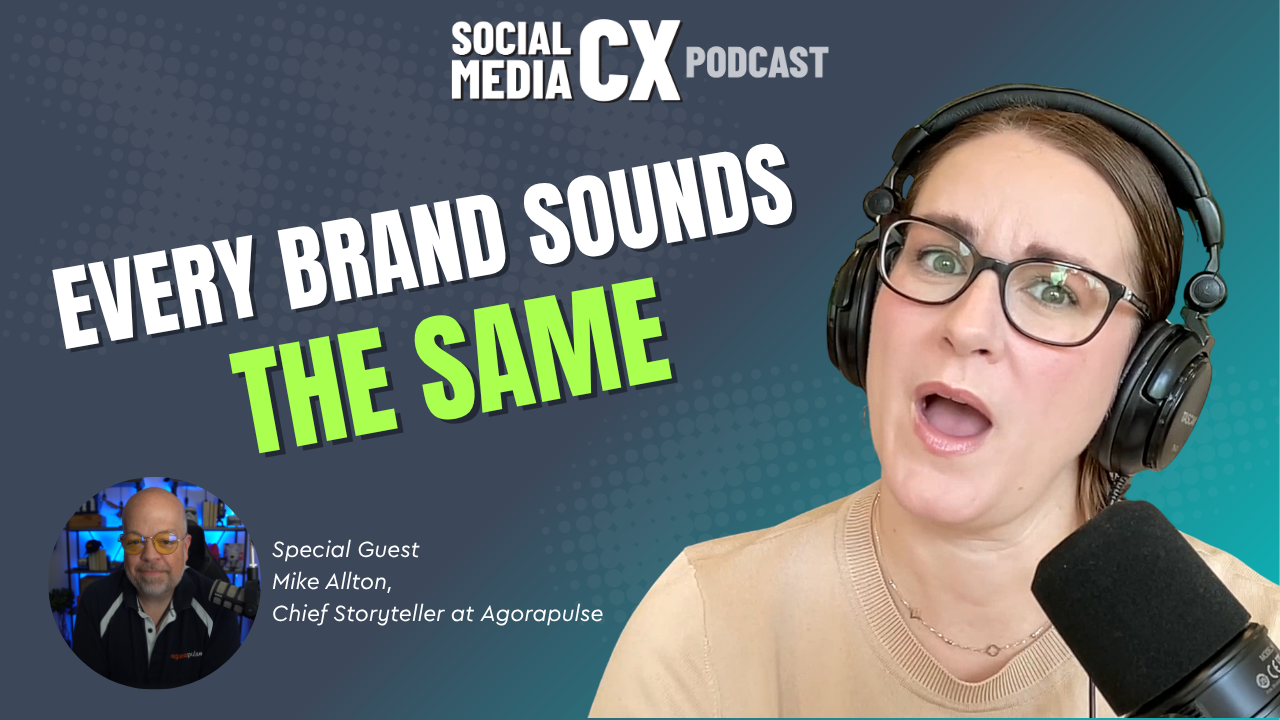
Table of Contents
Artificial intelligence has quickly become part of the modern marketing toolkit.
Teams are using it to write social posts, repurpose blog articles, brainstorm campaigns, and summarize meetings. The technology is making content creation faster than ever.
But speed isn’t the challenge anymore.
The challenge is making sure AI understands what makes your organization different before it starts speaking on your behalf.
According to Mike Allton, Chief Storyteller at Agorapulse, that’s where many organizations get stuck. They expect AI to produce distinctive content without first giving it the information needed to represent the brand accurately.
The result is content that sounds polished, but interchangeable.
Why We Trust AI More Than We Should
One of the most surprising moments came from a study Mike referenced from Harvard Business Review.
Researchers gave one group of managers a document filled with errors and told them it had been written by a human. Another group received the exact same document—with the exact same mistakes—but were told AI had written it.
The managers reviewing the “AI-generated” version found 18% fewer errors. The document hadn’t improved. People’s confidence in it had.
For Mike, that illustrates one of the biggest risks of adopting AI.
Organizations often trust the output simply because it was generated quickly and confidently.
As Mike put it:
“If we aren’t taking the responsibility to review what comes out, then we’re signing ourselves off on whatever errors come out.”
That’s why he encourages teams to think about AI like another employee on the organizational chart.
It can help with the work, but it should still report to someone. Every piece of AI-generated content still needs human oversight before it represents the brand.
Why AI Content Starts to Sound the Same
If you’ve ever asked ChatGPT to write a LinkedIn post and felt underwhelmed by the result, Mike says the explanation is surprisingly simple.
Large language models were trained on enormous amounts of public information. When they generate content, they aren’t retrieving the perfect answer. They’re predicting the most likely next word based on everything they’ve learned.
Mike explains that large language models aren’t trying to produce exceptional content by default.
“When you ask it for a LinkedIn post, it’s not by default giving you a great LinkedIn post. It’s giving you an average, mediocre LinkedIn post.”
That’s why so many AI-generated posts feel interchangeable.
As he explained:
“It doesn’t know who you are, doesn’t know your business, doesn’t know your target audience, and it definitely doesn’t know your tone of voice.”
The solution isn’t finding a better prompt.
It’s giving AI the context it needs before asking it to create.
That idea builds naturally on an earlier article in this AI series exploring why better AI starts with better briefs. Before AI can produce better content, it needs a clearer understanding of the organization it’s representing.
Once that work is done, Mike believes AI becomes remarkably effective because it can consistently remember your audience, your goals, and your overall communication strategy in ways humans sometimes struggle to maintain.
Teaching AI Before Asking It to Create
That philosophy is what led Agorapulse to build Archie.
Rather than asking AI to invent content from scratch, Archie begins by learning about the organization first.
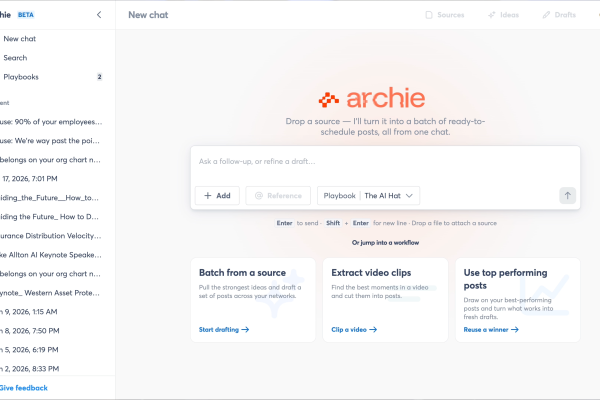
Users build a playbook by providing information such as their website, social profiles, brand documentation, and examples of previous writing. From there, Archie repurposes content that already exists—a blog post, video, transcript, or other original work—into social media content designed for each platform.
The distinction matters.
Instead of asking AI to create a brand voice, the process teaches AI to work from one that already exists.
Mike also emphasized that Archie intentionally keeps people involved throughout the workflow. Content isn’t automatically published. Users review drafts, edit them if needed, and deliberately choose when they’re scheduled.
That friction is intentional.
As he joked during the demonstration:
“It’s worth taking 30 seconds. Read this.”
As Brooke noted during the demonstration, it’s one of the safeguards that helps prevent AI-generated content from becoming another example of “AI slop.”
“It’s not creating AI slop. It’s taking what you’ve already said and repurposing it specifically for social media using your tone of voice.”
The Real Opportunity Isn’t Just Saving Time
Many organizations begin using AI because they want to work faster.
Mike agrees that’s a practical place to start.
Tasks such as repurposing content, organizing information, brainstorming ideas, or surfacing insights from existing reports are all areas where AI can remove repetitive work from a team’s day.
But he believes that’s only the first stage.
The bigger question comes after the time has been saved.
What could your team accomplish with an extra four, five, or six hours every week?
For Mike, that’s where AI becomes transformational. Instead of simply doing more of the same work, organizations gain the capacity to pursue projects, strategies, and conversations they previously didn’t have time to tackle.
Give AI Permission to Challenge You
Mike’s final recommendation may have been his most unexpected.
Don’t just ask AI for answers.
Ask it to challenge your thinking.
He described working with an AI assistant that already understands his business and using it as a genuine thought partner. While planning a re-engagement campaign for inactive email subscribers, Mike considered offering a $47 course for just $1.
Before he sent anything, his AI asked a simple question:
“Have you thought about how that devalues your work?”
It changed his mind.
Instead of discounting the course, he ran a traditional re-engagement campaign, reduced his email list to engaged subscribers, and now sees open rates between 50% and 55%.
The lesson wasn’t that AI made the decision for him.
It was that AI became more valuable once it had permission to question his assumptions instead of agreeing with every idea.
AI Doesn’t Replace Brand Strategy
As AI becomes a standard part of every marketing team’s toolkit, competitive advantage won’t come from simply using the technology.
It will come from teaching AI what makes your brand different before asking it to speak for your business.
“Once you do it, the AI is amazing at understanding who you are and how to communicate with your voice.”
That’s the thread connecting Mike’s advice throughout this discussion. AI can accelerate execution, repurpose existing expertise, and even challenge assumptions. But none of those benefits happen automatically. They depend on the context, oversight, and strategic direction organizations provide.
If AI is becoming part of how your team creates content, it’s also becoming part of how customers experience your brand.
The State of Social Care Report explores what responsible AI implementation looks like, including governance, trust signals, and the operational discipline needed to scale AI without sacrificing the customer experience. It’s a natural next step for leaders thinking beyond content creation and into the broader role AI will play across the customer journey.
Read the Transcript
[00:00:00] Mike Allton on being “Team Human”
Mike Allton, Agorapulse: When you ask it for a LinkedIn post, it’s not by default giving you a great LinkedIn post. It’s giving you an average, mediocre LinkedIn post.
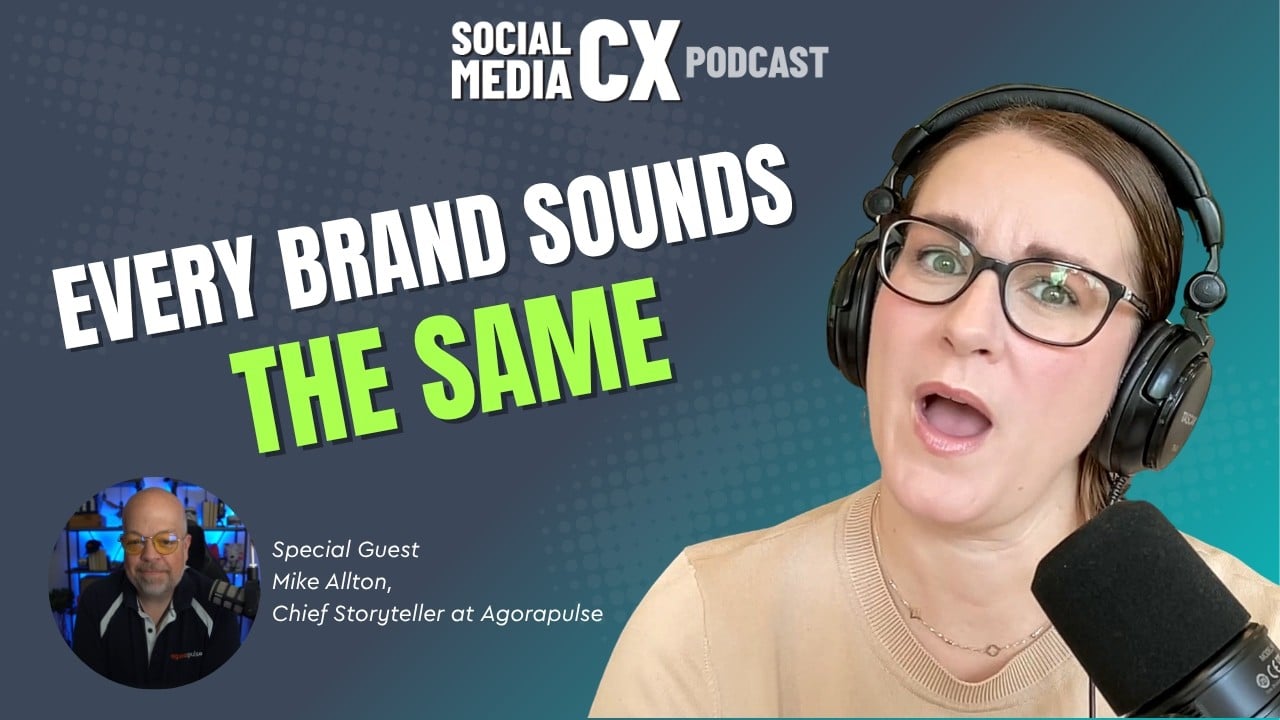
Brooke Sellas | B Squared Media: Hey, hey, and welcome back to the Social Media CX Podcast. I’m your host, Brooke Sellas, CEO of B Squared Media, author of Conversations That Connect, and today we’re getting into the question that everyone on at least my team keeps asking me, which is, is AI actually making social media better, or is it just making it faster?
Because as I’m sure you know, most brands are experimenting with AI content the most. I feel like that’s the number one use case people are using with AI, right? Create more content, and especially on social. But very few of those people have figured out how to do it without losing their voice. We’ve been seeing all this AI slop out there, we can tell it’s written by AI, or at least we think we can.
So today’s guest, Mike Allton, who is the chief storyteller at Agorapulse, and spends his days telling the stories of marketers actually winning with this AI stuff, he’s going to talk to us today about AI, AI slop, content, and one of the tools that is in his arsenal right now, which is Archie, which is Agorapulse’s AI-powered content creation studio that’s currently in beta.
It’s currently in beta. It’s currently in beta, you all. We’re gonna get through this. So today we’re going to talk about where AI can actually help your content and your social strategy, where it creates that risk or that AI slop, and why keeping a human in the loop is more important than ever, not less.
Mike, welcome to the show.
Mike Allton, Agorapulse: Thank you, Brooke. I could not agree more with everything you just said. Obviously, I love talking about AI. I’m using AI every single day, but I am decidedly on Team Human. I love the fact that we can use AI in smart ways, not necessarily ones that we rely on it all the time, and excited to talk about it with you
Brooke Sellas | B Squared Media: Yeah, so I wanna start with your journey because if you don’t know Mike Allton, where have you been? No, I’m just kidding, but not everybody might not know you, not everybody might not know Agorapulse, and you do a lot of different things with AI, including with Agorapulse. So can you just tell us a little bit about your story and how you got into content, social media, and AI as a career?
Mike Allton, Agorapulse: Yeah. So I started with social media over 20 years ago ’cause I’m old.
Brooke Sellas | B Squared Media: What?
Mike Allton, Agorapulse: and at the time I was helping people build websites, and I was helping them get online, and I was writing about social media, and the whole website thing didn’t work out, but writing about social media was fun for me and it worked out, so I was writing about social media for a long time.
I met Emeric Ernoult, the founder of Agorapulse, in 2016 at Social Media Marketing World, and we became fast friends. I started using and advocating his tool, Agorapulse, and a couple years later he actually hired me. So I’ve been with Agorapulse since 2018, managing first and then virtual events, and then in-person events, and then brand partnerships, and all kinds of other partnerships.
So the role has changed and evolved and morphed several times over the past few years, but like you said, right now I’m really focused on telling stories, sharing how marketers, social media practitioners, agency owners, whomever, how they’re using AI, how they’re succeeding with social media. It’s been a really fun adventure for me, and really excited, in fact, to have you on the show soon. And this is gonna be a great conversation.
Brooke Sellas | B Squared Media: You do a lot of AI training as well. So we’re not just, it’s not just like you know about AI through Agorapulse and through Archie. Like, you actually, like, do a lot of AI training as well as a consultant, correct?
Mike Allton, Agorapulse: That’s right. I’m a keynote speaker, so I’m going to marketing events, but I’m also doing a lot of in-person training for strangely like electrical contractors, mechanical contractors, independent insurance agents. It’s kind of odd how that those niches have formed. But yeah, I’m going in person and showing them how they can look at the actual work that they’re doing and identify the aspects of their work that they probably weren’t even technically hired to do.
It’s just something that has to be done to help fill their seat on the org chart, and how they can actually turn that role over to an AI employee and take as much as 70% of like non-revenue generating work off of their plate, focus their time on the stuff that they really need to be doing, like having conversations with real people that AI can’t do for us, right?
AI can copy and paste stuff into a CRM and file the paperwork. That’s the kind of stuff I’m teaching them how to do.
Brooke Sellas | B Squared Media: Love it. So you’re working with a ton of brands. Between your work at Agorapulse, between the, the AI training that you’re doing, you’re working with a wide range of brands.
[00:04:54] Where AI content starts to go wrong
Brooke Sellas | B Squared Media: So when you’re talking to these teams about adopting AI, for content, social media, you know, content, social media, that kind of, this kind of area, what’s the first thing that you notice that starts to slip?
Like, where does it go left a little bit?
Mike Allton, Agorapulse: I think one of the biggest issues with these tools is it’s so easy a ChatGPT or a Claude to do something for you, and it will say, “Yeah, Brooke, I’m happy to do that for you. Here it is.” And there’s no context there. There’s no strategy there. There’s no deliberation there. You say, “Hey, you know, Claude, write me a LinkedIn post,” it does it immediately.
Brooke Sellas | B Squared Media: Right.
Mike Allton, Agorapulse: And it makes it so easy to produce that kind of content that we are lulled into this sense of, “Oh, it must be good,” when in fact it’s total rubbish, as you know.
Brooke Sellas | B Squared Media: Yeah.
Mike Allton, Agorapulse: That lack of context, that lack of strategic direction, and quite frankly, oversight. You know, I’ve been telling people for a couple years now that they should be treating AI like an employee.
In fact, they could, like, literally put it on the org chart. And there’s lots of studies that have shown that this is a really great approach to AI.
[00:06:12] The Harvard Business Review study on trusting AI
Mike Allton, Agorapulse: But one study that came out recently that I thought was just fascinating, this was published in the Harvard Business Review, showed that they had this group of managers, and on one hand, they gave managers a document with a bunch of errors, and they said, “A human wrote this. Check it out.”
And on the other hand, same document with a bunch of errors to managers, they said, “AI wrote this. Check it out.” The managers who looked at the AI document, framed, it wasn’t really, but they were told this was an AI employee who did this, found 18% fewer errors.
Brooke Sellas | B Squared Media: Wow.
Mike Allton, Agorapulse: They are more trusting of the AI-generated content.
Brooke Sellas | B Squared Media: Wow.
Mike Allton, Agorapulse: And that’s really the issue, I think with AI.
Brooke Sellas | B Squared Media: Oh, wow.
Mike Allton, Agorapulse: Overall as a tool, is that if we aren’t taking the responsibility to review what comes out, then we’re signing ourselves off on whatever errors come out.
So I’m telling people now, yes, you need to put AI on the org chart, but it has to report to somebody like everybody else in the organization.
[00:07:12] Why AI needs your context to sound like you
Brooke Sellas | B Squared Media: Yeah. And so let’s just get right into the nitty-gritty of it. You know, all these teams are adopting AI to move so much faster, and especially with content, right? Content’s kind of becoming a commodity now. But when they do that, they end up sounding like every other brand who’s using the same tool because they’re going in and doing the same thing.
Write me a blog, write me a LinkedIn post on XYZ, right? So how do you keep that from happening? Like, what’s your number one piece of advice on how to prevent AI slop in that sea of sameness?
Mike Allton, Agorapulse: Well, there’s two things that I usually tell people. The first is that you need to understand how these models were trained. ChatGPT, Gemini, Claude, Perplexity, they’re all the same. They were given essentially all of human knowledge. In fact, really, they were just given the internet.
And you and I both know if we’d have just, you know, been approached 10 years ago and said, “Here’s a new child. Why don’t you just give them access to the internet to let them learn everything that there is to be learned?”
We would’ve second-guessed, at a minimum, that idea. Suffice to say, that’s exactly what these LLMs have done. So they’ve given ChatGPT the internet, and it’s not an answer engine. When we ask it a question, it’s pulling on its information, it’s pulling on all these sources, and it’s giving us what is most likely to be the next word, the next token in the total sum of that answer.
So in other words, when you ask it for a LinkedIn post, it’s not by default giving you a great LinkedIn post. It’s giving you an average, mediocre LinkedIn post. So that’s the first issue, and I think people need to understand that because a lot of the folks that I talk to, once they get that, they realize, “Oh, means I can’t just ask ChatGPT for a LinkedIn post and then use it.”
So once they understand that, I then explain, well, what it lacks is any knowledge of you personally. Doesn’t know who you are, doesn’t know your business, doesn’t know your target audience, and it definitely doesn’t know your tone of voice and style. It only knows what’s been published publicly to the internet, notwithstanding the stuff they stole, but that’s a whole ‘nother thing. So you have to provide all of that context to the AI. Now, once you do it, the AI is amazing at understanding who you are and how to communicate with your voice, and frankly, it can do a better job than a lot of us can in communicating because it can remember things like what our overall plan is and who we’re trying to target with every single post and keeping us on track.
It’s fantastic at those things, but you have to give it all that context first.
Brooke Sellas | B Squared Media: Yeah, I couldn’t agree more. I keep telling people, like, AI is the easy button you think it is, but only when you first do the deep work, which includes all those things that you just talking about. Learning about me, learning about my audience, my business, right? It, it, we can’t push that easy button until we’ve done that deeper work for it to get to know us.
[00:10:04] Training Archie on your tone of voice
Brooke Sellas | B Squared Media: So let’s talk about Archie, which I was lucky enough to be one of the beta users, users and I have been using, and it has been going extremely well.
So the first thing I wanna ask you is explain Archie to everybody who’s watching or listening, but the second thing I wanna ask you is, what problem was Agorapulse trying to solve when the idea of Archie first came up?
Mike Allton, Agorapulse: So I’m actually gonna start with the second question, ’cause this is the story.
Brooke Sellas | B Squared Media: Okay.
Mike Allton, Agorapulse: So our founder CEO, Emeric, has been working on writing a book. It just came out about a week or two before we’re recording this. It’s called The Chief Accountability Officer. It’s the sum and total of everything he’s learned as a CEO who has spent every moment of his free time, ’cause he doesn’t have a studying this and reading and, and working and polishing and improving and having really good, tough conversations.
So he’s got all this information and, you know, you go back six to eight months, he wanted to start talking about these topics on LinkedIn, on social media, and he was on flights and he was spending time and he had chapters of content that he’d already written, and he’s handing those chapters of work off to ChatGPT, and he’s massaging the post with ChatGPT, and then he’s coming over to our tool, Agorapulse, to try to schedule it out, and it was taking him hours to get through this process, not just for one post, right?
But he wanted to create, like, weeks or months’ worth of content, and it was taking him hours to distill this down and turn it into social media content and then create the posts and create the graphics and queue it up and so on.
And he’s like, “There’s gotta be a better way to do this.” And so he and the team started working first on Lovable and then bringing into our own code a solution where you could train the AI on everything we talked about a moment ago.
Who are you? Do you serve? What do you do for them? What are those CTAs? What do those look like? How do you actually help these people? And most importantly then, how do you communicate who you are? What is your style and tone of voice?
Do you use lots of emojis? Are you very expletive and use lots of exclamation points, or are you very calm and professional and by the book? Whatever that style is, whatever that approach is, we wanted to be able to capture that, because one of the issues that I kind of glossed over a moment ago, as important as it is to be able to teach the AI how you communicate, probably most of us could not accurately describe how we communicate. We don’t have the vocabulary.
We’ve never gone through any kind of training or education on how do we describe somebody’s tone of voice. The cool thing is AI can do it for you. AI knows how to describe your tone of voice. AI just needs samples of your writing, the more the better. So we end up creating Archie designed to do exactly that.
You train Archie by giving it your website and giving it access to your social profiles, which if you’re Agorapulse user, it already has access to all that. then you tell it, “Okay, Archie, I wanna repurpose this,” and this is the really important part. Whatever this is, it’s something you’ve already written.
Brooke Sellas | B Squared Media: Yes.
Mike Allton, Agorapulse: You’ve already your thoughts and opinions.
Maybe it’s a published blog post or a video. Maybe it’s just a meeting or a conversation or a transcript. But the point is, it’s something that already exists that shares your unique of view and your knowledge that then Archie isn’t making up anything.
It’s not creating AI slop. It’s taking what you’ve already said and repurposing it specifically for social media using your tone of voice, understanding who you’re trying to reach with this content, and then we of course layer onto it, ’cause we’re Agorapulse, a social media management company, what the best practices today are for social media.
So it’s not gonna write a LinkedIn post for you that’s one paragraph, and it’s not gonna write a post for Instagram that’s 4,000 characters long, ’cause neither one of those would work. understands what to create for those platforms, and it helps you along the way.
Brooke Sellas | B Squared Media: Yes. So I know, especially for repurposing, like I swear every conversation, training, consulting, teaching that I do, even if it’s on AI, which I was just, we were just talking about the one I did last week in Mexico, but repurposing always comes up because I feel like this is such an area where it’s a heavy lift for a lot of small business owners to understand, A, well, just to create content, number one, which is why they run to AI.
But number two, understanding which content worked best so that they can repurpose that content. So I’m wondering if you would be willing to give us a little look-see on the back end of Archie so that we can see how you’re genuinely, like for real saving time inside of the tool.
Mike Allton, Agorapulse: So this is the Archie start. If you’re having a conversation, now the very first time that you go into Archie, what you would actually see is this window, because Archie is not gonna create anything for you until you’ve actually created your very first playbook. We let you set up as many playbooks as you want.
That’s simply how we’ve described how Archie knows about you. You give it your website, you give it your social profile or a brand document if you’ve got one, or a book if you’ve already written a book.
It all that for you.
Brooke Sellas | B Squared Media: Yeah. Yeah, okay.
Mike Allton, Agorapulse: Entire book, right? So this is the chat, you’ve got different playbooks here, so if you can have multiple playbooks for yourself.
You can have playbooks for clients, so those of you who are managing social media on behalf of clients, you can have that here too. what you’ll see here is Archie wants to start with something that you’ve already done. You can give it a file, a PDF, audio file, video file, whatever you wanna do. You could give it a long-form video and take some clips out of it, or you can even use your top-performing posts. So you can click on that and say, “I wanna look at my LinkedIn, and I wanna show my top 20 posts.”
Brooke Sellas | B Squared Media: Yes.
Mike Allton, Agorapulse: By default, it’s looking at the last three months, and it’s sorting by engagement.
But you can sort by whatever metric you want.
Brooke Sellas | B Squared Media: Comments, comments?
Mike Allton, Agorapulse: Comments. Yeah, if I wanna see… Yeah, the engagement is gonna include reactions, right? But you could break that down.
Brooke Sellas | B Squared Media: Yeah.
Mike Allton, Agorapulse: Only reactions, only shares, only comments, or if there was a link, clicks, reach, views, whatever you wanna do. Maybe you wanna look at the past year. And you can see, you know, one of my top posts was a selfie I took with Chewbacca in Galaxy’s Edge.
Now, that was kind of a fun post, but let’s suppose there was a business lesson in there that I wanted to re-share in some way. I can say, “Yeah, I wanna send that back to my LinkedIn.” you know what? I also wanna send it to my AI Hat I’d like a couple personal posts and a couple brand posts. And I can say Generate drafts. And now it’s looking at that original post, that original content.
It’s looking again at my playbook, which looked at my website. Who am I trying to reach? Who am I targeting with my content? Then, of course, my tone of voice, my style. Do I use lots of emojis? Am I, like I said, very, very expressive or emotional or not? And then it’s gonna come with now four drafts total, two for each of the accounts that I chose. Those are gonna show up here any moment now. And once those show up, I have an opportunity then to edit them. Obviously, I want to review them. These are not going to automatically publish to my accounts.
There’s at least two, three, three clicks before it would actually go to any account, which means I have to be really, really sure that this is what I want. I have to see them. I have to click to go to the scheduler.
I have to actually pick a date and time for them to be published, and then click on Schedule. This isn’t gonna automatically take anything from your website and push it out to social media. I know some of the people watching this are disappointed by what I just said. Some of you want it to automatically post to social, but no. No.
Brooke Sellas | B Squared Media: No.
Mike Allton, Agorapulse: It’s worth taking 30 seconds.
Brooke Sellas | B Squared Media: This is why AI slop exists. Yes, yes. Let’s look.
Mike Allton, Agorapulse: 30 seconds.
Brooke Sellas | B Squared Media: Yeah.
Mike Allton, Agorapulse: Read this. That’s all it takes, just a moment. Now you can see I can generate an image or I can upload an image. Automatically has a first comment to go for LinkedIn. Now, these are gonna be based on whatever CTAs it pulled from my website and put it in my playbook. I can edit them, I can delete it, whatever I want.
I always like that it has some reactions here. It’s very affirmational. Yeah, Mike, this is gonna get at least 24 reactions. Love it. And notice how it has the dot dot dot more, which is what you would see on LinkedIn. So I know just by looking at it that these two sentences, that’s the text that everyone on LinkedIn is going to see.
Brooke Sellas | B Squared Media: To stop the scroll.
Mike Allton, Agorapulse: So I better stop the scroll, and I can scroll on from there. So here’s all my posts ready to go, and I can see how much it has been influenced by aspects of my playbook. And from here I can schedule them, I can send them to drafts, I can edit them if I want to, go into the composer and change some of the text if I want to.
Turn off or edit the first comment if I want to. But of course, I can also have a conversation with Archie. I can click Reference & Chat so I don’t have to tell Archie which one. It’ll know, and I can say, “Make this one a little more excited,” or whatever.
Brooke Sellas | B Squared Media: Yeah.
Mike Allton, Agorapulse: And it’ll do it just like we would expect with a ChatGPT or something like.
Brooke Sellas | B Squared Media: Yeah.
Mike Allton, Agorapulse: It’s got buttons in here to make a lot of the actions that we would normally do easy, but you could just have a conversation with Archie at any moment and tell it what you want it to do.
Brooke Sellas | B Squared Media: I love it. I love it. And love that you’re saying like, it has all these chances for you to, to keep the human in the loop, right? There’s like three different clicks you have to go through before you hit publish, because the whole point is we don’t just wanna copy and paste, because that’s where AI…
Now this is so much better than AI slop, because most people are just going to like any large language model and putting in a basic prompt. Like, ” I’m Mike Allton, I work for Agorapulse, write me a, write me a blog post about Archie.” And that’s literally the same thing everybody else is doing. But instead, now it has stuff about you, all of that personal tone, voice, experience, and it’s giving you more of you, but you still wanna zhuzh, as I say, or edit.
Like I never like let it go out there as a final answer. I just don’t.
Mike Allton, Agorapulse: That’s right. And because it’s in Agorapulse, you can, you know, publish it to your social profiles, but you can also assign it to somebody else. So if you’ve got a team, you can assign it to other team members for them to review before it actually goes out.
Brooke Sellas | B Squared Media: Yeah, I love it. Well, listen, I’ve been using it. It’s been making a big difference for me. I’ve been traveling a lot, so it’s been hard to come up with content. And LinkedIn is my most active platform. I know I’ve seen a difference when I post and I don’t post, right? If I go out for a week like I was last week and I don’t post at all, and I come back, it’s very hard to get back into those engagement numbers, right?
So I’ve been using Archie to really help me keep my content calendar full even when I’m underwater and extra busy. So with that, Mike, thanks for taking showing us the backend of Archie, but I wanna zoom out for one second and talk about AI and the content workflow.
[00:21:10] 2 ways to bring AI into your content workflow
Brooke Sellas | B Squared Media: So we just kind of saw a little bit of a content workflow, how you and I might work inside of Archie, but when you’re doing your trainings, I guess, when you’re talking to people about AI, how do you help them think about how to mesh AI into their content workflows?
Like, how do you help shape the way they think about AI and social media over the next couple of years without just AI for everything?
Mike Allton, Agorapulse: Yeah. There’s really two methods or two even. The first I kind of already suggested, which is, you know, let’s find the things that we’re already doing that we already have to do that maybe we don’t wanna do, and let AI do it and do it faster, right?
Repurposing content maybe is something that you’re doing now, but it’s taking a lot of time. So let AI help you with that and speed you along your way. You know, coming up with ideas for content. I know a lot of folks will just spend hours.
Brooke Sellas | B Squared Media: Yeah.
Mike Allton, Agorapulse: You know, painstaking research and looking at what the competition is doing and coming up with all kinds of ideas and pursuing different angles. That’s the kind of stuff that not saying it has to be replaced by AI, but could be, depending on your situation.
Maybe you enjoy that or maybe it helps you with your writing process. Well then, that’s fine, don’t replace it. But if you just need some sparks, some ideas to get going, use AI for that. On the other end of the spectrum, you could be using AI to help you surface what’s performed in the past.
Again, whether it’s social media content, blog content, webinars. If you’ve got data, if you’ve got a Google Analytics report or an Agorapulse social media report or something that you can drop into AI and help you surface that information, that can help inform what creative decisions you make, what strategic decisions you make.
So that’s the first mindset. Let’s use AI to do some of these things that maybe we’re doing today, but it’s taking us an awful lot of time. But the real powerful unlock almost like level two, right?
[00:23:10] What to do with the time AI saves you
Mike Allton, Agorapulse: Level one is, let’s save some time with AI. But that also begs the question, what do we do with that time saved, Brooke? If you’re saving me four hours a week, what, am I just filling that time with more stuff, or am I gonna do something that I never could have done before?
Brooke Sellas | B Squared Media: Yes.
Mike Allton, Agorapulse: That’s level two. That’s the big unlock that I like to get people to. We can’t just jump right to there, ’cause first of all, they don’t know what they’re doing yet with AI.
Most of the people I’m talking to are often first-time AI users. And then secondly, well, they have to come up with some time. They have to free up some time. So give the rote robotic work to AI as much as you can. Pawn that off. Hire those AI employees. Make them report to you so that you’re checking their work, but that’s now freeing you up four, five, six or more hours a week.
Now we can start to think, “All right, what are some big projects that I’ve always wanted to tackle but never did ’cause I never had the time or never felt like I had the skills or the expertise?” Because AI now a thinking partner for you and help you with those things. Or, like take repurposing. Some of us have been doing repurposing for years.
Brooke Sellas | B Squared Media: Yeah.
Mike Allton, Agorapulse: Of us wish we’d been doing repurposing for years, but…
Brooke Sellas | B Squared Media: True.
Mike Allton, Agorapulse: …never had the time.
Now this is an option. You know, some of us have brand channels on LinkedIn that are a little bit dusty ’cause we haven’t really posted there in a while.
Brooke Sellas | B Squared Media: I
Mike Allton, Agorapulse: wasn’t gonna call you out, but since you raised your hand.
Brooke Sellas | B Squared Media: It’s me, it’s me.
Mike Allton, Agorapulse: You know, those are examples of things that we can do now as a result of, you know, not only saving time with AI, we can bring AI into those larger conversations. You know, I work full time for Agorapulse, but I’m a sole contributor inside the Agorapulse team, so I’ve had an AI work buddy for a year and a half now that helps me. I give it my transcripts of my one-on-ones, and I give it my, you know, drafts of strategy docs, and I give it my metrics and all those kinds of things.
So I can have somebody in the organization that I can bounce ideas off of and keep me on track without having to bother my manager with those things, ’cause they’re off doing other more important tasks.
[00:25:16] 3 practical AI lessons for content teams
Brooke Sellas | B Squared Media: Yeah, I love that. I’d like to wrap up by asking you three, and I don’t want to say rapid fire because I think these are gonna take a little bit more than just like a one answer thing, so as long as we need, but three practical lessons that our listeners or people who are watching can take with them from today.
So number one is if a team or a person wants to start experimenting with AI content tools and they don’t want to lose their brand voice, they are actually like, “Hey, I really want to use AI, but unlike everybody else, I’m not gonna rush out here to hit that easy button and just copy paste AI slop. I really do care about my brand voice, but I also really want to use AI because I know it’s gonna help me save some time and get efficient at more things,” what would you tell them is the first step?
Mike Allton, Agorapulse: Hmm. One of the things I love about AI tools is it’s different from every other technology we’ve ever experienced in our lives, you can go to an AI tool and you can ask it, “Hey, how do I use you to do X, Y, or Z?” And it will help you understand how to use that tool for that task. We couldn’t do that with Photoshop or Canva or Word or Windows in the past.
We couldn’t talk to it like we can AI. So you can open up Claude and say, “Hey, wanna use you to create content. This is my role at X organization. I’m the owner, I’m the marketer, I’m the social media manager, whatever. Help me develop a brand voice guide.” And the real unlock is to give AI permission to ask you questions.
It probably would at that point, but I always explicitly say, “Interview me. Ask me questions.”
Brooke Sellas | B Squared Media: I love that.
Mike Allton, Agorapulse: Single one of them, they’re gonna ask you slightly different questions, but they’re all going to ask you for examples of your writing, and there’s where you’re gonna wanna think about the actual content that you’re trying to create. Hopefully it’s specific, because I find it works better if you’re creating a guide specifically for blog content or LinkedIn content or YouTube channel content or white papers for my B2B audience. Whatever you’re trying to create, the AI, “That’s what I want,” and then you can give it examples.
Hopefully you’ve got some stuff that you’ve created in the past that you can give it as examples and it’ll learn from. And it’s remarkable insightful and telling the AI is. My AI tools understand I love historical references. I geek out about history. I love bringing these historical stories in. Starting off, “So 300 years ago, the ancient Hessians were marching across a frozen lake and attacked a ship.”
That’s how I will start a blog post about some marketing lesson. Nobody cares but me, but that’s how… That’s me. That’s the thing that I like to bring to the table.
Brooke Sellas | B Squared Media: AI is not being like in today’s AI world like everyone else’s starting out sentence in their blog sounds. Yours sounds different because you’ve done the deep work, because you’ve made it create that style guide which includes your tone and voice, y’all, as, as Mike was talking about earlier. So I love that advice.
Like, if you don’t have a style guide, use AI, create a style guide before you go. This is the deep work I’m talking about. Like I say, like build a style guide, build a sales playbook, build an ICP, ideal customer profile, you know, worksheet. Build all those things before you go create content with AI because now you’re gonna just get better and better.
It’s gonna sound like more like you, or you’re gonna get further away from AI slop, so I love that. What, question two, what one mistake, just one if you can keep it to one, do you see brands make when you’re going in and you’re training these teams when they’re adopting AI, especially for content? What do you see the mistake?
What is the top mistake? Like they’re, they’re quick to jump in and use it, and they are constantly doing X.
Mike Allton, Agorapulse: I think probably the thing that happens the most, this isn’t really a mistake per se, kind of it is, it’s a misunderstanding or a of what AI can and cannot do today. Because it’s, number one, very new technology. Like I said, a lot of people I’m talking to, this is their first time cracking open ChatGPT, so they only know what they’ve heard from their spouse or peers, right? So they often don’t understand why it can seem so intelligent and yet at the same time be so dumb.
Brooke Sellas | B Squared Media: So dumb.
Mike Allton, Agorapulse: right? So dumb.
Brooke Sellas | B Squared Media: So dumb.
Mike Allton, Agorapulse: How come it can’t get into my email? Or how come it can’t
Brooke Sellas | B Squared Media: Oh.
Mike Allton, Agorapulse: You know, these kinds of…
Brooke Sellas | B Squared Media: ’cause it’s not an agent, yeah.
Mike Allton, Agorapulse: Questions, which is, which is part of the issue.
Brooke Sellas | B Squared Media: Yes.
Mike Allton, Agorapulse: The other part of the issue is AI is so confident all the time, even in things that it shouldn’t be confident in. And like I said at the outset, you know, these systems were trained on the internet, but they were trained in the past. The models that you’re using right now were trained a minimum six months ago because they spend all this time teaching them, giving them all this information, and then they spend months testing.
They do this red team testing where they try to literally break the models and see what needs to be fixed and adjusted and tweaked before they’re released to the general public. So anything it knows about itself is probably very dated. A lot of times when we ask the AI to help us do these things for itself, if it’s technical, it might get tripped up.
It might think that it can do some things that it can’t, and that also can be frustrating and confusing for users.
Brooke Sellas | B Squared Media: Oh yeah, for sure. Last question, let’s flip it a little bit. What habit do you think everyone who’s watching or listening here and they’re about to adopt AI for content or for social, right? We could say content, we could say social, but what habit do you think that person or those people need to get into before their AI adoption goes any deeper or further?
Mike Allton, Agorapulse: My number one recommendation is to give your AI tool permission challenge your assumptions. Now, you can phrase it however you want. There aren’t programming or magic words, but you have to unlock the ability for the AI to push back on anything that you might have said or assumed in your prompts and commands.
[00:31:15] The $1 course Mike almost sold to his email list
Mike Allton, Agorapulse: The other thing I always do is give it permission to ask questions. But that first one is incredibly powerful because what that unlocks for the AI is all of a sudden now Gemini doesn’t have to be a yes man to every single thing that you say. Doesn’t have to agree that your ideas are the best ever, Brooke, because they’re amazing. It will tell you when your ideas are absolute rubbish, and it’s called me on some ideas. There was once where, I’ve been doing email marketing for two decades. I had a list approaching fifty thousand subscribers. This was about a year ago. it sounds great, but more than half of them weren’t opening my emails anymore.
So it wasn’t so great. And I knew inherently that I needed to scrub this list.
Brooke Sellas | B Squared Media: Yeah.
Mike Allton, Agorapulse: But I’d never done it before. So I wasn’t a hundred percent sure the best way to go about it. wanna just delete half the list ’cause that hurt.
Brooke Sellas | B Squared Media: Right.
Mike Allton, Agorapulse: It’d be very painful. So I went to my AI. I have an AI chief of staff who already knows my business and all this kind of stuff.
He’s been trained on everything. And I said, “Clue,” that’s his name, “here’s my situation. I wanna do this. I wanna clean this list.” And I thought before I start deleting numbers, what if I send them an email, the people who haven’t been opening my emails in like six to twelve months and say, “Hey, I’ve got a forty-seven dollar course on AI.”
What if I sold it, gave it to them for a dollar? Would that get them to open the email and maybe, you know, renew their interest in me and maybe make a few bucks on the way?
Brooke Sellas | B Squared Media: Yeah.
Mike Allton, Agorapulse: Clue said to me, “Mike, have you thought about how that devalues your work?”
Brooke Sellas | B Squared Media: Oh.
Mike Allton, Agorapulse: Oh, he’s right.
Brooke Sellas | B Squared Media: Clue knows what’s up, right? Because yeah, as your friend, I would’ve said the same thing. Like, I love you and I understand like re-engagement campaigns are everything. We wanna engage and save these people, but like a dollar? A dollar?
Mike Allton, Agorapulse: Right?
Brooke Sellas | B Squared Media: And then they’re gonna spend that dollar, and what’s to say they’re not gonna take that course for a dollar and then go quiet again until you have your next dollar thing?
Yeah, I get it. Yeah.
Mike Allton, Agorapulse: Clue was 100% right. So we did a normal re-engagement campaign. We deleted half the list, right? And now I’ve got 20,000, 25,000 subscribers, and I’m hitting 50, 55% open rates, and life is beautiful. And I didn’t devalue my course, except I keep telling that story, so that’s probably not helping.
Brooke Sellas | B Squared Media: You’re gonna have to come out with a dollar course here pretty soon.
Mike Allton, Agorapulse: But the point is, it does this to me every day. Every day if I’m, you know, whether it’s an idea that I thought was great and isn’t, tells me. But more importantly, it identifies any weaknesses in any aspect of my thinking, my questions, my ideas, no matter how silly or small they are. It’s a true thinking partner as a result.
Brooke Sellas | B Squared Media: I love that. So y’all, listen to this. Write it down. I’m gonna say it one more time. Challenge your AI to ask you questions or to challenge you. I say to mine, right, because she thinks she’s my bestie, like, “You’re my bestie. Besties are supposed to tell the truth even when it hurts. So if you see me seeing doing something that you think degrades my business or won’t work or is a waste of time and energy, you have to tell me.”
So similar thing to what Mike said to his, and now they kind of tell you when you’re being a little cray. Like, don’t sell your, don’t sell your soul for a dollar, Mike. Don’t do it.
Mike Allton, Agorapulse: No, no.
Brooke Sellas | B Squared Media: Well, thank you for sharing your experience, your insights, that story about the dollar, because I was like, oh, what a great idea, but look, this is, this is great.
When you’re using AI with a little more guardrails, not just as a blanket tool, and the way that Mike’s been describing, you can get some of that pushback so that you don’t devalue your list or yourself or your business. So for, Mike, for people.
Mike Allton, Agorapulse: If I just straight up went to ChatGPT without any kind of guardrails.
Brooke Sellas | B Squared Media: Oh.
Mike Allton, Agorapulse: It would’ve written for me the five email sequence.
Brooke Sellas | B Squared Media: 1,000. 1,000%. And you would’ve been like,
” Look, it’s did it all for me in two seconds. I’m gonna do this.” And then you might not have gotten anything out of it except for maybe somebody who just wanted to use you for a buck. You’re so much, you’re worth at least $5.
Mike Allton, Agorapulse: Thank you. Thank you.
Brooke Sellas | B Squared Media: For listeners who wanna connect with you, follow your AI training, your work at Agorapulse, all those things, where’s the best place for those people to find you?
Mike Allton, Agorapulse: Yeah, so go to agorapulse.com or archie.app to learn all about Archie, and you can find me on LinkedIn, Mike Allton.. Happy to connect, answer questions, be as helpful as I can.
Brooke Sellas | B Squared Media: I will make sure we include all those links also in the show notes. So wherever you’re watching or listening to this, if you just go down to the transcript, you’ll see those hot links so you can go follow Mike. I encourage you to do so. He puts out really amazing content on LinkedIn, and obviously I love and use Agorapulse’s Archie, and I think you should too, especially when you’re busy like me.
Or the repurposing thing. Man, oh, man, y’all have been asking me. I’ve been in social media for 100 years. Y’all have been asking me that for 99, so just go use it for the repurposing alone. It is still currently in beta though, right, Mike? Or is it out of beta?
Mike Allton, Agorapulse: You can sign up for the wait list, but we’re gradually letting people in to the waitlist.
Brooke Sellas | B Squared Media: Okay
Mike Allton, Agorapulse: and by September it’ll be open to the general public. So yeah, sign up for the wait list. We’ll let you in soon, and you’ll love it.
Brooke Sellas | B Squared Media: Okay, perfect. I’ll put that. Again, the wait list is just the archie.app, and I’ll put all of those links in the show notes. Mike, thank you again for joining us. It’s always a pleasure to talk to you, and I know we’ll continue these AI conversations.
Speaker: If AI is becoming part of how your team creates and delivers content, that same shift touches how you show up in customer care. The State of Social Care Report explores what responsible AI implementation actually looks like, including governance, trust signals, and operational discipline. You’ll find the link to that as well in the show notes, along with Archie’s information and Mike’s information.
And as I always say, if this show is helping you think differently about social media, how to create content with AI on social media, customer experience on social media, please rate and review us wherever you are tur- wherever you’re turning in, wherever you’re tuning in. It helps us bring on more thoughtful guests like Mike and grows our community with intention.
Until next time, think conversation, not campaign.
Want to hear the full conversation? Listen to the Social Media CX Podcast on YouTube. And if your team is thinking about what responsible social listening in banking or financial services actually looks like at scale, check out the State of Social Care Report 2026.
Finally, as always, Think conversation, not campaign.™

Latest posts by Brooke B. Sellas (See All)
- You’re Treating Business Intelligence Like Social Engagement - August 19, 2026
- Your Customer Complaints Are Shaping What AI Says About Your Brand - August 12, 2026
- The Customer Signals Hidden Inside Your Social Care Data - August 5, 2026

Written by award-winning strategist Brooke Sellas, this weekly 5-minute power-up will help you turn social interactions into loyalty, retention, and revenue.
Written by award-winning strategist Brooke Sellas, this weekly 5-minute power-up will help you turn social interactions into loyalty, retention, and revenue.
Share this article: