What AI Workflows Reveal About Your Customer Experience
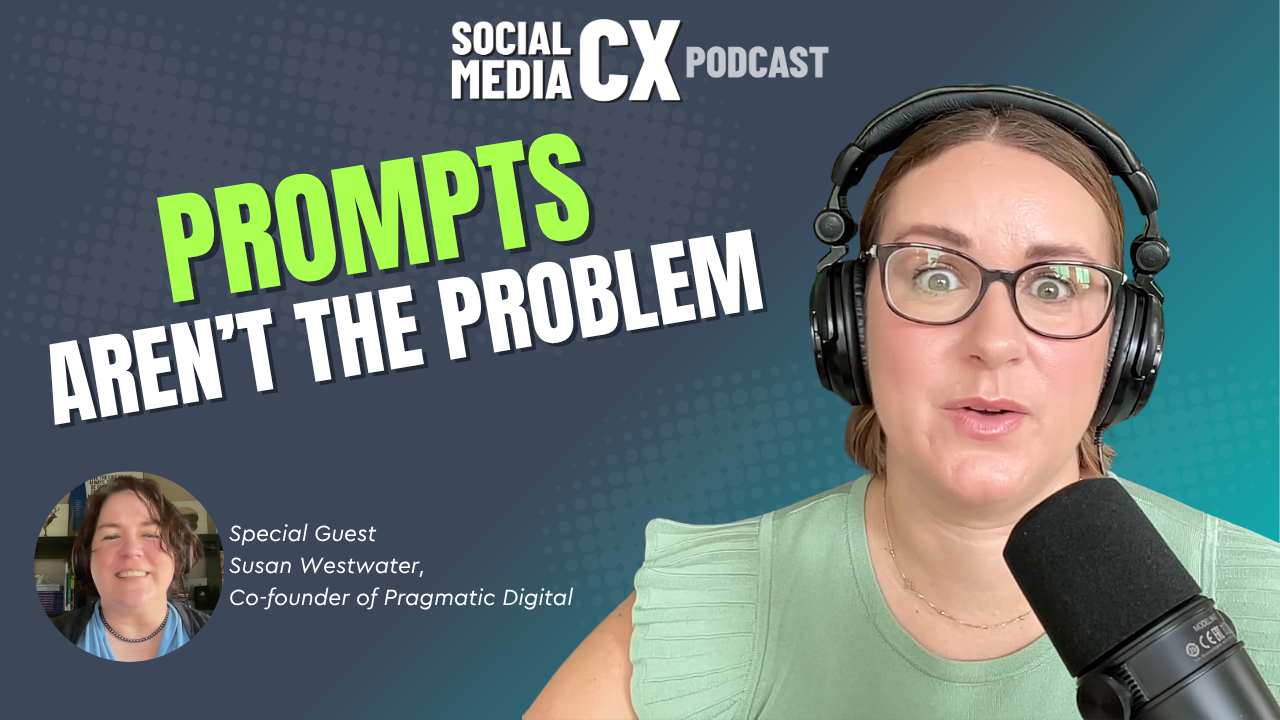
Table of Contents
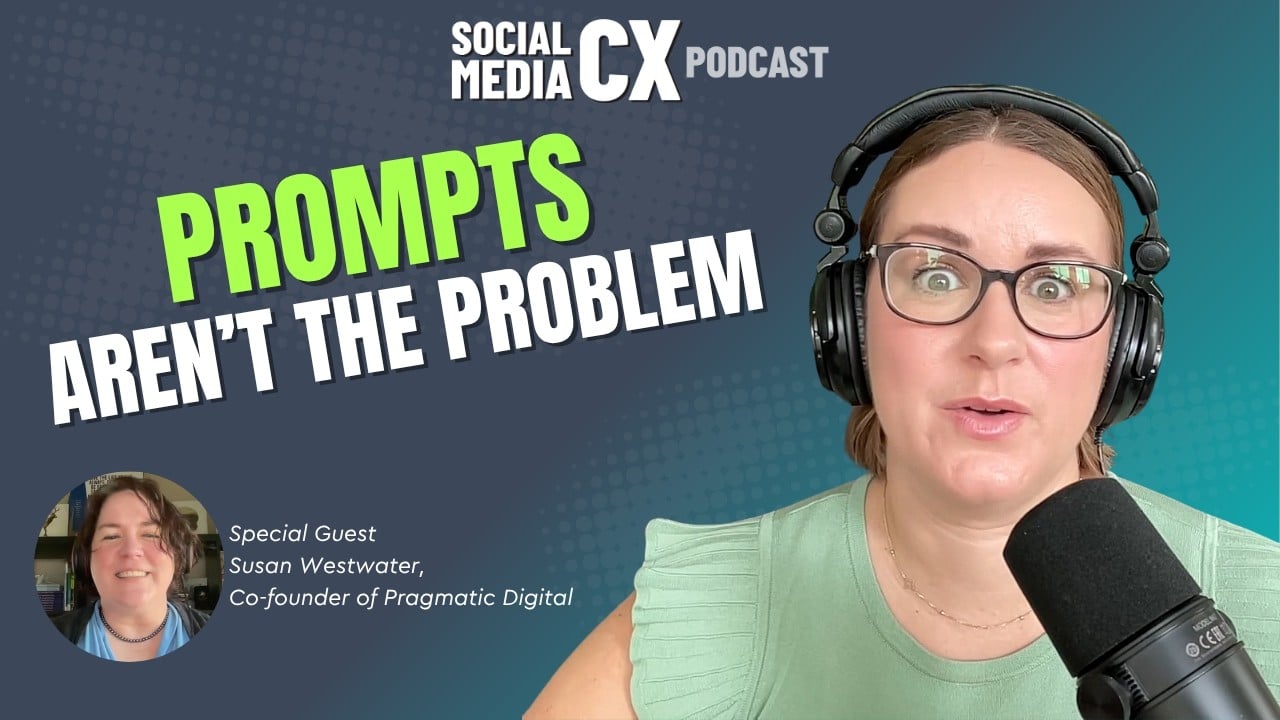
Most conversations about AI workflows start with prompts. Susan Westwater believes they should start somewhere else.
When AI-generated customer experiences sound generic or inconsistent, most organizations assume they need better prompts or better technology. According to Westwater, co-founder of Pragmatic Digital, those are often symptoms—not the underlying problem.
The quality of AI-generated customer experiences has far less to do with the prompts teams write than the systems they build around them. Workflows, governance, source material, brand guidance, and review processes all shape the quality of what AI produces.
In other words, AI doesn’t create inconsistent customer experiences. It scales the operational decisions already built into an organization.
“The ingredients are weak, the recipe is vague, and nobody’s tasting that pizza before it gets served.”
Why Better AI Workflows Begin with Better Inputs
Westwater often explains this using a simple analogy.
She points to Papa John’s long-running slogan: “Better Ingredients. Better Pizza.”
Most organizations trying to improve AI focus on the finished product. They rewrite prompts, tweak wording, and test different models, hoping the next version will produce better results.
That’s like trying to improve a pizza after it comes out of the oven.
The toppings aren’t the problem. The ingredients are.
AI works the same way. If the source material is incomplete, the brief is vague, or no one has clearly defined what success looks like, the output will reflect those weaknesses regardless of how sophisticated the prompt becomes.
Prompt engineering can improve the presentation, but it cannot compensate for poor operational inputs. If the ingredients are weak and the recipe is unclear, the result will be too.
AI Needs More Than Information
Many organizations think about AI as software. Westwater encourages leaders to think about it more like a new member of the team.
A new employee isn’t expected to understand the organization through intuition. They receive onboarding, documentation, policies, examples, and coaching. AI requires the same foundation.
As Westwater puts it:
“I’m very cautious to say team member because this is your weakest team member… we don’t let AI have judgment. That’s where humans come in.”
For customer experience teams, that means providing much more than product information. AI needs customer context, approved facts, escalation rules, examples of successful responses, and clear guidance about when human judgment is required.
Just as importantly, it needs examples of what not to do.
Organizations often train AI using their best examples. Westwater argues that showing poor examples—and explaining why they failed—is equally valuable because it establishes clear operational boundaries.
Instructions like “sound like our brand” aren’t specific enough. AI performs best when teams define exactly how the organization responds in different situations, which language reflects the brand, and when conversations should move from AI to a human.
A Prompt Solves One Task. A Workflow Solves Hundreds.
Westwater makes an important distinction:
“A prompt is a single instruction. A workflow is the repeatable path that takes you from customer message to appropriate response.”
That difference becomes especially important in customer experience.
Community managers and social care teams aren’t writing blog posts. They’re responding to billing questions, frustrated customers, product issues, and public complaints—often within response-time commitments measured in minutes rather than hours.
Those interactions require much more than good writing. They require a reliable system.
An effective AI workflow follows a consistent path:
- Classify the customer’s issue.
- Gather the appropriate context.
- Draft within approved boundaries.
- Check for accuracy and tone.
- Decide whether to send, revise, or escalate.
The goal isn’t to remove people from the process. It’s to ensure every team member starts from the same operational foundation so quality remains consistent regardless of who is responding.
Brand Voice Should Live Inside the Workflow
As AI becomes part of daily customer interactions, another challenge emerges: consistency.
Different employees naturally communicate differently, and AI can amplify those differences if organizations haven’t clearly defined their brand voice. Many companies document their brand guidelines once, store them in a presentation deck, and assume the work is finished.
Westwater believes that’s one of the biggest mistakes organizations make.
Brand guidance has to be usable while the work is happening. More importantly, organizations need to distinguish between voice and tone.
Voice represents the organization’s identity.
Tone changes depending on the customer’s situation.
A customer celebrating a successful purchase should receive a different response than someone reporting a service failure. The personality remains consistent, but the emotional delivery changes.
When those distinctions become part of the workflow instead of separate documentation, AI can produce responses that feel much more consistent across teams.
Governance Should Create Confidence
Governance often has a reputation for slowing organizations down.
Westwater sees it differently.
Well-designed governance removes uncertainty by helping employees understand what they can handle on their own and when an issue should be escalated.
Not every customer interaction deserves the same level of review. A simple thank-you message doesn’t require the same scrutiny as a public service failure or a customer sharing sensitive information.
When those decisions are made before customer conversations happen, teams move faster because they aren’t stopping to ask permission. Governance doesn’t just reduce risk. It gives employees the confidence to make the right decision in the moment.
As she explains:
“A lot of folks think governance means control. I like to think of governance as enablement.”
How AI Workflows Improve Over Time
One of the biggest mistakes organizations make is treating AI implementation as a finished project.
Deploy the tool.
Write the prompts.
Move on.
Westwater encourages organizations to think much more like product teams. Every customer interaction generates valuable feedback.
Repeated edits, recurring customer questions, common escalation patterns, and frequent revisions all point to opportunities to improve the workflow itself.
Rather than constantly rewriting prompts, organizations should continuously refine the systems supporting them.
Over time, those improvements compound, creating AI experiences that become more accurate, more consistent, and more valuable with every iteration.
The Bigger Risk Isn’t Bad AI
Poor AI content is easy to recognize.
Customers notice obvious mistakes, and organizations move quickly to correct them.
Westwater believes the greater risk is far more subtle.
Generic AI.
Responses that are polished, professional, and technically accurate—but completely forgettable.
They answer the customer’s question without strengthening trust. They sound acceptable without sounding distinctive. Over time, those interactions quietly reshape how customers experience a brand.
The future of AI in customer experience isn’t about replacing human judgment. It’s about creating stronger systems that help people apply that judgment more consistently.
Organizations that invest in better workflows, clearer governance, stronger brand guidance, and higher-quality source material won’t simply produce better AI responses.
They’ll create better customer experiences.
Westwater summarizes the role of AI in one sentence:
“We’re working with AI, not having AI do the work.”
Ready to Build Better AI Workflows?
Susan Westwater created a free AI Draft Review Checklist to help teams identify the workflow gaps that lead to generic AI content, inconsistent brand voice, and weak customer experiences. It’s a practical starting point for improving the systems behind your AI.
If you’re wondering what your own AI responses might be revealing about your customer experience, Brooke Sellas’ Social Care Audit evaluates response times, escalation paths, workflow consistency, governance, and brand voice to identify the operational gaps affecting both customer experience and AI performance.
Read the Transcript
[00:00:00] The AI Problem Most Teams Misdiagnose
Susan Westwater: I can only put so much Parmesan and crushed pepper on something to make it taste better, and that’s why we see this AI slop, right? And part of that is because the ingredients are weak, the recipe is vague, and nobody’s tasting that pizza before it gets served.
Hey hey, and welcome back to the Social Media CX Show. I’m your host, Brooke Sellas, CEO of B Squared Media, author of Conversations That Connect, and today in our July AI series, we are talking about going beyond, to infinity and beyond, beyond AI prompts and thinking about AI workflows.
Let’s get into it.
Brooke Sellas | B Squared Media: Before we get into today’s episode, I want to properly introduce today’s guest. We have really bonded over horses, but it turns out she’s a real smarty pants too. Susan Westwater is the co-founder of Pragmatic Digital, an AI strategy and implementation consultancy that helps organizations build content workflows that are actually useful, not just fast.
I feel like a lot of us use AI because we want it to be fast, and that’s great, but we also want it to be useful. Susan’s work focuses on the unglamorous stuff, but that is essential for producing content with AI. So we’re talking about, like the source material, the brief, the method, the review process.
Susan calls these the ingredients. She’s one of the clearest thinkers I know on how AI fits into content operations without erasing your voice and the expertise behind that content. I’ve had the pleasure of following Susan’s work for a while now, and I wanted to bring her on as a voice for our July AI series because she can speak practically without hype, without fear, and she is just exactly who I thought of for this series.
So Susan, welcome to the show.
Susan Westwater: Thank you so much. Again, that is an amazing introduction.
Brooke Sellas | B Squared Media: Oh, well, just put me in your pocket and take me with you. I’m happy to keep singing your praises.
[00:02:10] Why Better Prompts Won’t Fix Generic AI
Brooke Sellas | B Squared Media: I wanna start with something that you wrote that really made me kind of sit up and pay attention, and it was your newsletter, and you referenced Papa John. I mean, who doesn’t love pizza?
Susan Westwater: Right?
Brooke Sellas | B Squared Media: There’s a bigger reason.
But you referenced Papa John and their slogan, “Better ingredients, better pizza,” and then you kind of used this as a way to frame why so many AI content conversations are missing the point, why we’re getting this AI slop because everyone’s talking about outputs and prompts and models and tools, and nobody’s talking about what’s going into those tools.
So before we go anywhere else, what made you land on that metaphor, ’cause it was so good, and what are you seeing in the work that you do that tells you that most brands are skipping this piece en masse?
Susan Westwater: Yes, for sure, for sure. It’s really funny. The reason why I actually remember, they actually went to court because it used to be best ingredients, best pizza, and all the other, like, basically pizza chains took them to court, so they had to say better ingredients, better pizza.
Brooke Sellas | B Squared Media: No idea.
Susan Westwater: And that stuck in my head
Brooke Sellas | B Squared Media: Yeah.
Susan Westwater: Back in my ad land days of, like, claims and all that good stuff.
But it’s something I’ve been thinking about a lot is because a lot of what we’re hearing about with AI slop is a lot of people are trying to make the pizza better, taste better after it’s out of the oven.
Brooke Sellas | B Squared Media: Ah.
Susan Westwater: And it’s just garnish, right? There’s no way to really, it’s like, no, no, no, actually we gotta step all the way back what we put into the pizza to begin with. You know, and I think of kind of like, to keep the metaphor going, a lot of the tools are kind of like the oven.
And so as we’re like, putting these things together, you’re only gonna get like, what you put in is what you get out, right? We always talked about garbage in, garbage out. I kinda hate that one because everyone’s sick of it, but it’s more of this idea of what the, you know, the ingredients I put into this are gonna be the things that then shape that, and oh, by the way, there’s only so much I can do.
Like, I can only put so much Parmesan and crushed pepper on something to make it taste better, and that’s why we see this AI slop, right? And part of that is because the ingredients are weak, the recipe is vague, and nobody’s tasting that pizza before it gets served. So that’s where then I kind of landed in this idea of trying to make it more approachable, because it isn’t all about the technology.
It’s about what we’re putting into it.
Brooke Sellas | B Squared Media: I couldn’t agree more, and I wanna pull on that thread a little bit more because the point that you made was that AI can only work with the ingredients it’s been given, which means, I mean, yes, it can go out and search the internet, right? But if we’re really trying to make it sound like us, then you have to give it those ingredients.
So that means if your brief is vague, by the way, we were talking about this in the, in the pre-show, and I was like, “Oh my God, briefing your AI,” like you would brief a client, our client brief. Like, but yes, so if your brief is vague, if your source material is weak, or if nobody defined what good looks like, right?
Like I tell people when we do AI trainings ourselves like, don’t give it your bad emails. Like, give it your best emails with your highest open rates if to create more really good emails. Anyways, AI’s not gonna rescue you, I guess is the bottom line.
Susan Westwater: absolutely.
Brooke Sellas | B Squared Media: So for social teams specifically, that’s kind of who our audience is, you know, community managers, social care practitioners, customer experience leads, what does a good ingredient look like?
What has to exist before somebody opens that AI tool?
Susan Westwater: Sure. Yeah, so that could be your customer context, that could be your approved facts, that could be your current policy or your escalation rules. All those things that when you’re briefing someone on day one, you’re briefing again, you’re briefing this new team member, and I am, I’m very cautious to say team member because this is your like, weakest team member, I’m gonna be honest.
You know, not your human, but the judgment, because we don’t give, we don’t let AI have judgment. That’s where humans come in. So it’s also, though, examples of what good looks like, but just to build on kind of where you’re talking about your best, right? Also show what your worst and go, “Don’t go there.”
Brooke Sellas | B Squared Media: Oh, the inverse. Yeah, like guardrails, but with your bad stuff.
Susan Westwater: Is really important because we learn through trial and error. AI just thinks everything it does is great. So we have to say I’m gonna tell you, I’m gonna tell you what good looks like, and I’m gonna tell you what bad looks like ’cause I don’t wanna see that ever again.”
Brooke Sellas | B Squared Media: Mm-hmm.
Susan Westwater: And so we’re able to do that, but we also have to have that specificity because it’s like, sound like our brand. That’s not very helpful. But if we say, “Here’s how we respond when someone’s frustrated, here’s what we can say, and here’s what we cannot say, and this is when we escalate,” those give it so much, so much more rich inputs to work with that then that starts to then get you to a point of something you can use.
Brooke Sellas | B Squared Media: That makes sense. That makes total sense. Something else I wanna dig into, because I think, again, just for me personally, I think this is where your framework is most useful for our clients and our audience is you draw a very clean line between a prompt and a workflow.
Susan Westwater: Yes.
[00:07:24] The Workflow Behind Every Customer Experience
Brooke Sellas | B Squared Media: You say a prompt is one step, a workflow is a method, and you say that most organizations are stuck in searching for a better prompt when really what they need is a better system.
And, you know, from what we see with our clients, especially around social care, is that teams are often responding to hundreds of inbound messages a day, complaints, billing questions, fraud concerns, escalations. They’re not creating campaigns. They’re having conversations under pressure at volume. Does your workflow model apply to re- response content as well, not just like, published content?
And if so, what would the workflow look like when the output is a DM reply rather than, like, a post or a blog post or an article or whatever?
Susan Westwater: Yeah, absolutely. So part of that, especially when you have this volume, is AI is not about writing the reply, it’s more about helping you understand what’s happening and then helping you understand, like, how do I classify this message? Or how do I identify this urgency? And then the idea too is, yeah, it is that single.
Like a prompt is a single instruction. And by the way, helpful, important part of the workflow, but the workflow is kind of that repeatable path that takes you from customer message to appropriate response. And the reason why we want a workflow is because there’s more than one person involved. How do we make that so, you know, the word is operationalize, right?
How do we make that repeatable so that I can give that to multiple people and we all are using a similar methodology? That’s another way of getting towards consistency. So like for a DM reply, it would be, you know, how do I understand this message? Classify that issue, gather my context, draft within boundaries, but then check with accuracy and tone, send, revise, or escalate. So it gives you a path forward. And notice there’s no moment where I say give it to an agent or cut and paste.
Brooke Sellas | B Squared Media: Yeah.
Susan Westwater: It is here’s where it’s gonna help my human a better output, I mean, obviously, and you and I have talked about this as well, if the goal isn’t to replace that human involved, because they need to be responsive.
Brooke Sellas | B Squared Media: Please no.
Susan Westwater: Yeah. So the idea then is, like, the prompt’s gonna help you maybe with one reply, but that workflow is gonna help you do that over time, because you’re gonna then rinse, repeat what works really, really well. And as you socialize that, you’re going to be able to then get better prompts, better inputs, or, “Hey, this is better.” You’re able to continue, it gives you the room to iterate. But by the way, it’s on a team scale, not this one individual’s doing phenomenal.
Brooke Sellas | B Squared Media: Yes.
Susan Westwater: How do we get to do that? And then how do we extract them, stop them from what they’re doing? This is a way of kind of putting that into a way, this is how we work, this is how we share.
We have a central hymnal, but that hymnal is not just about the rules, it’s also that workflow.
Brooke Sellas | B Squared Media: talk to me about, a little bit more about consistency around, brand, we call it brand voice drift. So one of the biggest failures, I guess, that we see in social care is brand voice drift. So it means that depending who’s on shift, ’cause right, depending on the size of the company, it could be you know, 10 team members who are doing these community responses.
It could be 20. It could be more than 20. It could be one, right? It could be anything in between but when you have larger teams, those responses start sounding a little like, scripted and generic or off tone when the teams are under like, that volume pressure. One client we have has a Facebook Live that they do a demonstration for every week, and we get thousands, I’m not even exaggerating here, thousands of comments in one hour.
So there’s a lot of what we call volume pressure, and AI can help accelerate that pressure, you know, alleviate, I should say, that pressure, but it can also accelerate the drift if it’s not managed carefully. So how does a deliberate workflow like you’re describing protect against something like that?
Where does brand voice actually live in the system that you help your clients build?
Susan Westwater: So we put it up front and I’m gonna, I’m gonna give a shout-out to the team at Slack back in the, oh my gosh, early 2000s. They had one editor, and they had all these people, and I don’t know if you remember the context of Slack used to have the best release notes where they would put practically Easter eggs and things like that.
Brooke Sellas | B Squared Media: Uh-huh.
Susan Westwater: this stuff, she said, “I am completely buried. There’s no way I can look at every other piece.” So they started to look at how do we do better guidelines and Mailchimp helps with that. So brand voice very much coming from this notion of brand guidance has to be usable in the moment. It has to be specific.
So when your brand voice lives kind of like in a deck or PDF, it’s not helpful. So what we look at in a workflow what are those inputs? How do we create a brand voice guide that’s approved language, tone by situation? And that’s obviously very important when we’re dealing with customer care.
Brooke Sellas | B Squared Media: Yes.
Susan Westwater: Because if voice is, voice is who we are, tone is how we respond appropriately, and you have to break them apart. And so then that’s then when we then say escalation rule. So here’s what’s good looks like, or here’s what we’re gonna avoid.
Again, this is again where these are words we use, these are words we don’t use. Like one of the things I remember laughing at the time was Slack was like, “We will never be on fleek.” And I would laugh so hard ’cause I was like, “What does that even…” And they’re like, “Exactly. That’s not us.”
Brooke Sellas | B Squared Media: On fleek.
Susan Westwater: “That’s not who we are.”
Brooke Sellas | B Squared Media: Yeah.
Susan Westwater: Yeah. And so it was, these are the words we will use. These are the words we won’t use. That starts to empower that fabric then informs and can continue to keep AI going that way. Workflow helps you because it gives you a pattern to follow, and you have distinct moments where you’re like, “This needs to adjust now,” because let’s say we do say fleek, but now fleek’s really, we don’t say fleek anymore. We say fire.
Brooke Sellas | B Squared Media: Fire. Fire.
Susan Westwater: I was like, wow, that was, that was putting myself on the…
Brooke Sellas | B Squared Media: Go you. You really pulled that out. I’m impressed.
Susan Westwater: My son is cringing right now, going, “Oh no, she’s using slang again.” But the idea is, well, AI’s always gonna try to be helpful, but if we don’t give it that specificity, we have to give that helpfulness.
So warm and friendly, not gonna happen. We have to go to that layer of almost thinking of I’m creating my character. I’m doing my brand personality more than it is identity, and we then form that into their blip. But by the way, there are certain things that will always be true.
Like you’re always warm and friendly and positive. Those can’t change. But in a moment where you have to be firm, we may dial down the warmth a little bit, and that’s also then where tone comes into play. So that’s a very different brand guideline than a lot of brands even about.
Brooke Sellas | B Squared Media: Laid out. Yes.
Susan Westwater: And that also, by the way, what gets me excited is that also helps guide other conversational experiences. That also guides a bunch of other content that we’re creating, so you start to get that consistency Consistency, which we all are realizing while we were thinking, “Oh, brand’s not as important.”
No, because that consistency’s going to be then what’s helping fuel the element of going, “This is what this brand is all about.”
Brooke Sellas | B Squared Media: Yeah.
Susan Westwater: That’s another important opportunity that happens.
[00:14:39] How Governance Protects Brand Trust
Brooke Sellas | B Squared Media: Yeah, I totally get that. Your framework also has a section called Taste Before Serving, which I really loved, and you made the point in the newsletter that the review is not how you know that the, the workflow failed. Review is how the workflow succeeds, and I really love that frame or reframe.
Susan Westwater: Yeah.
Brooke Sellas | B Squared Media: Here’s the challenge for social that I wanna ask you about.
Responses go out in real time. Sometimes, you know, our SLAs for response time are like, under 10 minutes, under 30 minutes, under an hour for the most part, so there’s no proofing cycle that we have or editorial pass. How would you or do you build quality checks into a workflow that has to move that fast?
Like who owns the taste test when the kitchen is always in the weeds?
Susan Westwater: Right. Well, so there’s two things. One is, so sometimes though, like let’s be honest, all dishes, pizzas are equal.
Brooke Sellas | B Squared Media: Correct.
Susan Westwater: Your customers aren’t equal, right? And I hate saying that out loud, but it’s a painful truth. Like, a simple thank you reply is not gonna need the same amount of review as, say, someone who is just flaming the crap out of you publicly
Brooke Sellas | B Squared Media: Yeah.
Susan Westwater: You know, or service failure or someone sharing personal information where you’re like, “Please, I have to get you off.” Like, “Stop.” the workflow helps the team understand where they can move super quickly and don’t need, and they have that license. Again, that goes back to we thought about how we have guided and told you what you can and cannot say where we thought about voice and tone. That is, again, removing some human judgment, and then that’s giving them the guardrails of here’s where judgment gets to play, or here’s where we trust that judgment.
Here’s where we’re gonna give you support because you’re probably not comfortable making that call either. It’s all goes back to, I mean, the big G word of governance. A lot of folks who kind of think governance means control. I like to think of governance as enablement.
Brooke Sellas | B Squared Media: Yeah.
Susan Westwater: It does mitigate risk, but it also gives me the freedom to say, “I’m gonna take that decision off your shoulders, here’s a few that you can have and that are appropriate.”
So again, like, when you’re thinking about that, there are some things where you’re gonna say, “You know what? We may need to take a couple seconds to bounce that off of that more senior person,” or, “I might need to share that with someone else.” And then there’s other things where I’m like, I’m saying thank you or here’s a coupon or, or what have you. Those are simple, easy, and that’s where then the tiering and that understanding of your escalation, which you have already thought through.
Brooke Sellas | B Squared Media: Right.
Susan Westwater: How do we we communicate that? So it’s not about you’re never gonna be able to do everything fast, the whole point is, is that you’re not gonna slow everything down.
You’re gonna slow the right things down that you would’ve slowed down anyways, and giving them the op- opportunity to do that so that way then they’re feeling confident of, “No, I can do that,” and, “Yeah, I can’t.” Again, governance gives them that confidence.
Brooke Sellas | B Squared Media: Yeah. Yes well, we love governance, but we’re oddballs.
Susan Westwater: Yeah.
Brooke Sellas | B Squared Media: The last section. Yeah, exactly. Like, please let us just follow the rules. The last section of your framework is what you call notes and adjustments, and it’s the idea that every draft teaches you something, and that over time the workflow gets stronger because people are deliberately learning and refining.
You’re making those iterations as you go. And I think that’s really easy to say and hard to do in practice, especially like we’ve been talking about, like with these high volume situations, blah, blah, blah. So how do you help organizations build that improvement loop, that iteration loop, whatever you call it, without becoming a, you know, process that’s covered in red tape?
[00:18:23] Building AI Workflows That Improve Over Time
Brooke Sellas | B Squared Media: Like, what does realistic iteration look like for a social care team?
Susan Westwater: Yeah, I mean, first of all, it’s not about getting in meetings once a week and doing a postmortem. Like what is it this email could’ve been in? You know, this meeting could’ve been an email.
Brooke Sellas | B Squared Media: Yes.
Susan Westwater: There needs to be a simple way. Also, that’s a way to be able to make sure that you’re kind of catching it in the heart of the moment. So, that’s where then we give opportunities for people to start to look at those patterns and, of documenting it, the repeated questions, the heavily edited replies. What have we had to do? Part of our workflow, we actually have a what does good look like the first time I do it, and what are my milestones of how long did it take me to do it, how many rounds of review, some of those things.
What’d we get right, what do we, what needs improvement, noting that and going along. So, that’s a matter of just having a mechanism where those notes are put in, and because you’re kind of centralizing or, from that sense, those notes keep getting put within there. And then you will be able to start to see, hey, this issue keeps coming up, or this person keeps solving, this keeps getting solved from scratch.
We need to figure that out, ’cause there’s something going on in the workflow. So, it’s a matter of just making sure that you have that mechanism of capturing it, and that could just be Slack. That could be anything where we’re just putting that through, even if it’s just a shared.
Brooke Sellas | B Squared Media: Yeah.
Susan Westwater: Document of where, then notes, notes, notes, and encouraging the team to take that second to do that, and making that mechanism within there.
Because that way, then, that helps them understand it, and then you’ll start to see that pattern form in your transcripts, another way to do it is, so you’ve got your transcripts or you’ve got your recorded things of, “I sent these out. These are the inputs.” Put that through your AI really quickly and say, “Find my patterns.”
AI loves to find patterns.
Brooke Sellas | B Squared Media: So good at trends and patterns too. Like I feel like that’s one of the things it’s the best at.
Susan Westwater: Say, “What’s coming up here? What’s this thing? What’s good? What’s bad?” And that’s not something that you have to do on a weekly. That’s one person who is that managerial role who hopefully has had some time freed up because the team’s able to do some things.
Brooke Sellas | B Squared Media: Let’s hope. Yeah.
Susan Westwater: At that, and that’s that iteration. The important thing is that it’s knowing that done is not launched. Like, launched is not done. Sorry, flip that. Reverse it. Strike that. But it is that notion of I’m gonna continue to sharpen this because let’s be honest, the way that we used to tell people how to use AI eight years ago, different about how we have them interact with it today.
Brooke Sellas | B Squared Media: It’s so true.
Susan Westwater: So it’s kind of making sure that you’re keeping that along of where what’s understood or what is kinda now everyone’s bugaboo. It helps keep that patterning, and then you have a moment, and you do need to do that quarterly or however much that, with that volume of what feels appropriate to you for your client of let’s take a moment though and let’s make sure we aren’t drifting.
Brooke Sellas | B Squared Media: Yeah.
Susan Westwater: And that’s also when you’re doing your personality. One of the things I encourage our clients to do is to talk about conversational territories. Here’s what I will talk about, here’s what I won’t talk about, and then like, here’s what’s kind of adjacent and we’re cool talking about it ’cause we’re not always selling ourselves or whatever, but here’s an area.
Like there’s this area where, yeah, we’re just going to defer or we’re going to change that conversation because, no, we’re not talking about that. And that’s also where you’re able to keep that drift from happening again.
Brooke Sellas | B Squared Media: Before we keep going, I wanna take a second to mention something. If you’re listening to my conversation with Susan and you’re thinking, “Okay, I know we need a better system, I know our AI responses don’t always sound like us, I know we have coverage gaps on social,” then the social care audit is exactly where I would tell you to start.
We go in, we look at your response times, we look at your inquiry mix, we look at your escalation paths, we look at your brand voice consistency, a lot of what Susan and I are talking about in this episode, and we tell you specifically what’s working, what’s missing, and what’s costing you. There’s no fluff.
It’s just a clear diagnostic that you can actually take to leadership. You can learn more about the social care audit at bsquared.media/social-care-audit, or we’ll have the link in the transcript for you for today’s episode.
I wanna close out with something actionable because I know that the people who listen to the podcast and our clients and our team who listens is they’re in the trenches, right? They’re community managers, they are social care leads, they are CX practitioners who are trying to figure out how to use AI without making it sound like AI.
And you have this line that I loved. You say, you said, “Don’t start by searching for another prompt. Review your ingredients, review the workflow, review the draft.”
So if someone is listening right now and they wanna start using AI more intentionally in their social work, where do they actually start? Like where can they start, like today.
Susan Westwater: Yeah.
Brooke Sellas | B Squared Media: In getting this figured out?
[00:23:20] Where Every CX Team Should Start
Susan Westwater: So the first thing is, and I didn’t think I mentioned it in the workflow, I mean, in the newsletter, was there is this great content strategist, she was the leader of it, where we would go to these conferences, and she’d get us all excited. And you’re like, “I’m gonna go back.”
And she’s like, “All right, stop. Polish one tooth. And as you polish each, start with one.” So don’t start with like, how are you gonna use AI for social and change everything? It’s start with one workflow. And is that your, that thing that’s already eating time or creating inconsistency? Is it like, how we handle delayed orders or is it billing confusion?
Pick one of those. Or the other side of that is, what’s the thing you haven’t been able to get to that you really want to get to? Because we’ve been working so hard on this, like I had one client who’s like, ” We need to handle troubleshooting, but we’ve been dealing with billing explanation because obviously people get really angry, but there’s a bunch of troubleshooting stuff that we’re dying.
Can you help us?” those things that then are that, that opportunity that’s also measurable, and then, you know, start with that, then use AI to draft, review, improve, response against that one thing. You know, get your real examples. Define what good is. But start with that one piece, because I like to think of workflows as part of a bigger process.
Like we have our social process, but there are workflows underneath that allow me to break it down so I can make like, basically one instance at a time, so that way then you can shine that, pull from there. Now, the nice thing is some of these things we’re talking about, source material.
Brooke Sellas | B Squared Media: Yeah.
Susan Westwater: Voice, you can keep reusing that.
Once you’ve got that fine, then you can start to scale. And you should scale from one piece. You shouldn’t have every team obviously create one. helps you also then get to the point where then that content brief comes into play, where you can start to change that content brief.
But get one, understand what it took to get to there, measure that, then you can start to roll out and move a little bit faster as everyone comes along on that path.
Brooke Sellas | B Squared Media: I like that, right? It’s breaking it down into manageable chunks, which I love. But it’s also like taking the biggest thing, the biggest headache, the biggest threat, whatever you wanna call it, and getting that off your plate, which frees up more time, which then allows you to focus on like standard workflows, not just like the fires.
Yeah, I really like that. Before I let you go, Susan is a very nice person and maybe because we talk about horses so much, she has decided to gift you all this wonderful gift of an AI draft review checklist, which I’m going to use myself. So can you tell us about it, where people can find it? Because you’ve built something that’s really practical and I think teams could use as a part of that question I just asked you, like right now to go develop the thing
Susan Westwater: yeah, so absolutely. So our website is pragmatic.digital, and then we just did write slash checklist to make life easy, one word. But what we created is… and this is actually part of our content engine, and this is in the review section of that workflow. And it’s basically something to just help folks catch the things that slip through, when AI output sounds good on the surface.
One of the things I, again, was talking to someone about today was it’s really hard to give input. Don’t really get trained on that, so this is a way of turning that into something where we’re looking at accuracy, quality, vague claims, generic, you know, drift.
All of those things that kind of contribute to when someone goes, “That’s slop,” or, “That’s AI.” is an idea of how do we make sure that it’s not just does this sound okay? It’s asking what does okay, is it accurate? Is it on brand? Is it useful? Is it right for this situation? Is that tone there? And what that does is that just allows you to then put it into, I’ll be honest, an objective way of looking at it as opposed to it getting personal.
Having worked with a creative team for like 20 years, trust me, I have the scars to show when you don’t give the input quite right or it’s not actionable. So this is an attempt of let’s show you how to review that and then make sure then that it doesn’t… Like let’s, it’s kind of like my war on AI slop.
Brooke Sellas | B Squared Media: Yes, yes. I’m going to include the link to this, even though Susan mentioned it, in the transcript in the show notes. I’ll also put their website there so you can go find everything. And I have one last question for you.
Susan Westwater: Sure.
Brooke Sellas | B Squared Media: And I ask this because I feel like it’s kind of the heartbeat of this show and what I talk about.
[00:27:42] The Bigger Risk Isn’t Bad AI—It’s Generic AI
Brooke Sellas | B Squared Media: But what is one thing you wish every social media manager or customer experience practitioner understood about AI and content quality that almost no one is getting right?
Susan Westwater: I will say this, is AI is not removing the need for judgment or even humans. It’s actually increasing the need for it because the risk isn’t obviously bad AI content. Be honest, AI does not have the corner on the bad content market.
It’s just I think people are more comfortable dunking on it ’cause they’re like, “Oh, it was a robot, not a human, so I can be mean to it.” And that’s a whole other sociological discussion you and I can have. But the bigger risk is this content that’s like, polished and plausible and generic. It’s gonna answer the question, but it’s not building trust. So it’s not about automating the most words. It’s not about faster, like you said. It’s about knowing what good looks like, knowing how to use AI as that partner or that augmenter that’s gonna give me better context. I’m gonna be able to put that inner, into that workflow and then keep improving it as a system.
Brooke Sellas | B Squared Media: Yeah.
Susan Westwater: How you make that good judgment repeatable and how you can put it in the right places so that you’re applying judgment at the right time. That’s where AI is going to work really, really well because we’re not talking about using agents. That’s not appropriate. We’re looking at ways of because these are specific like, it’s not a repeatable single every time it’s the same way.
Brooke Sellas | B Squared Media: Right.
Susan Westwater: of a workflow’s gonna help me be able to have the flex I need so that I can tailor that, but I’m not having to flex, like, completely or rebuild something. It’s about how do we make that part of how we work, not work, you know, we’re working with AI, not having AI do the work.
Brooke Sellas | B Squared Media: Yes. We’re working with AI, not having AI do the work. I think we should like, put that on T-shirts.
Susan Westwater: That’s right. I like doing T-shirts, yeah.
Brooke Sellas | B Squared Media: Susan, this has been amazing. I can’t believe that 30 minutes went by that quickly, but this is a fascinating topic.
You’ve got a lot of work done about the processes, the workflows, so I really hope everybody goes and checks out that link to the checklist. Again, it’ll be in the show notes, but thank you so much for sharing your wisdom and continuing to solve these problems, and then lay out the processes for us.
You’ve created our SOPs, our standard operating procedures for us, so I mean, that’s great.
Brooke Sellas | B Squared Media: As you heard in my conversation with Susan, AI doesn’t make content better on its own. Maybe that’s not new for you, but maybe it is. AI simply amplifies whatever you give it, whether it’s your brief, your source material, your brand voice. If you feed it weak ingredients, you get weak content at scale. If you feed it strong ones, like with a deliberate process and a real review, you’ll get something that actually sounds like your best human instead of your most average one, or like AI slop.
And as always, if this show is helping you think differently about customer experience, social media, social media ROI, AI for CX, please rate and review us anywhere you’re listening or watching this podcast. It helps us bring on more brilliant voices like Susan and keeps our community growing with intention.
Until next time, think conversation, not campaign.
Want to hear the full conversation? Listen to the Social Media CX Podcast on YouTube. And if your team is thinking about what responsible social listening in banking or financial services actually looks like at scale, check out the State of Social Care Report 2026.
Finally, as always, Think conversation, not campaign.™

Latest posts by Brooke B. Sellas (See All)
- You’re Treating Business Intelligence Like Social Engagement - August 19, 2026
- Your Customer Complaints Are Shaping What AI Says About Your Brand - August 12, 2026
- The Customer Signals Hidden Inside Your Social Care Data - August 5, 2026


Written by award-winning strategist Brooke Sellas, this weekly 5-minute power-up will help you turn social interactions into loyalty, retention, and revenue.
Written by award-winning strategist Brooke Sellas, this weekly 5-minute power-up will help you turn social interactions into loyalty, retention, and revenue.

Share this article: