Blog » Social ROI »
You’re Treating Business Intelligence Like Social Engagement
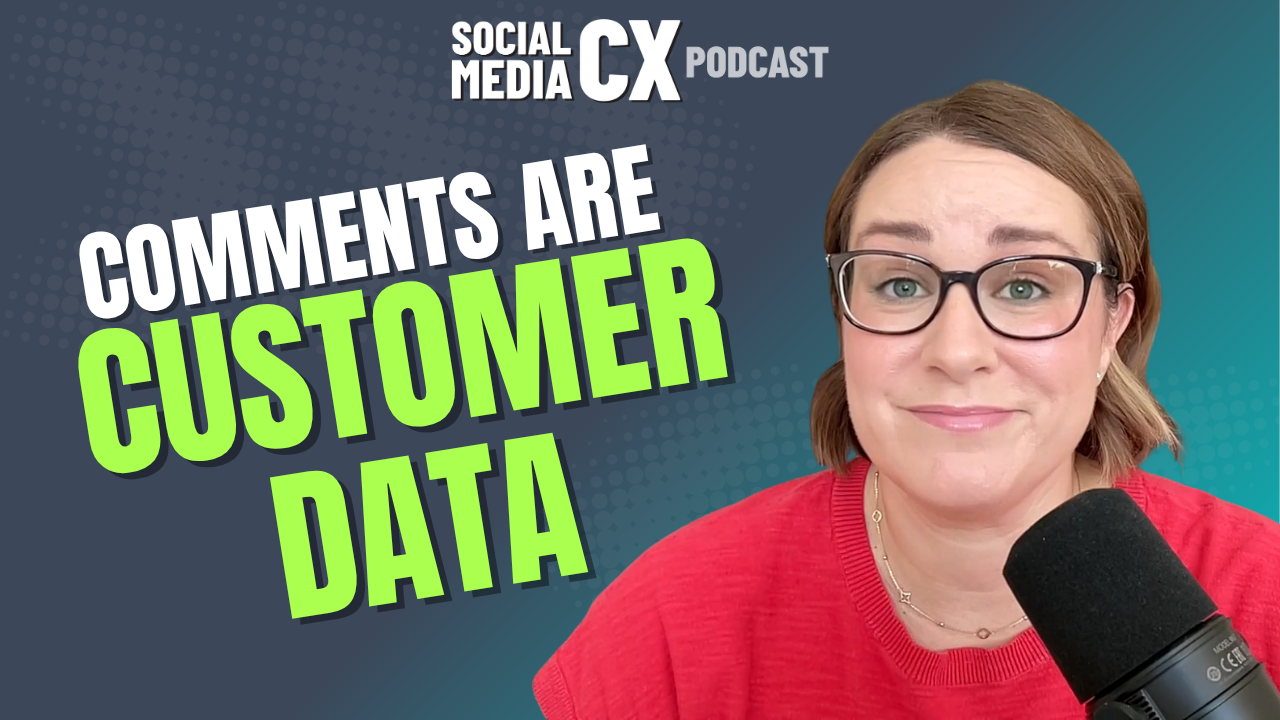
Table of Contents
Your comments and DMs are more than engagement metrics. They can reveal churn risk, purchase intent, loyalty, advocacy, and other customer signals your organization may never capture elsewhere. Return on Conversation helps social teams connect those conversations to the business outcomes leadership already cares about.
Leadership sees comments, replies, and DMs on a social media report and calls them engagement.
But that’s not all they are.
A complaint can be an early warning that a customer is at risk of leaving. A product question can reveal purchase intent. Public praise can provide evidence of loyalty and advocacy.
Your social team may be seeing valuable customer intelligence every day that never reaches your CRM, sales team, or the people making decisions about the business.
That’s why I think we need to start talking about Return on Conversation (ROC): the measurable value generated when a brand treats every comment, reply, or DM as a data point rather than decoration.
For years, we’ve gotten very good at counting engagement. Return on Conversation asks a more important question:
What did that engagement actually produce?
Why Social Media Comments Matter More Than Likes
Social platforms want meaningful engagement. A like takes almost no effort. Someone taps a button and keeps scrolling.
A conversation requires more.
Someone comments. Your brand responds. The customer replies. Your team asks a follow-up question. That back-and-forth extends the interaction and gives the platform more evidence that people find the content worth engaging with.
Shares, sends, and saves can also signal value. When someone saves something for later or sends it to another person, they’re doing more than passively acknowledging the content.
That makes your comment section more than a vanity metric. Conversations can play a role in how your content gets seen.
But reach is only the beginning.
What Is Return on Conversation?
We’ve traditionally measured social engagement by counting what happened: likes, comments, shares, saves, and other interactions.
Return on Conversation asks us to look at what happened because of the interaction.
Did the conversation extend visibility?
Did your team identify a customer who was at risk of leaving?
Did a question uncover potential purchase intent?
Did an interaction deepen loyalty?
Did a happy customer publicly advocate for your company?
Those are very different outcomes, even though they might all appear as “engagement” in a traditional social media report.
At B Squared Media, our CARE Flywheel helps make this more concrete.
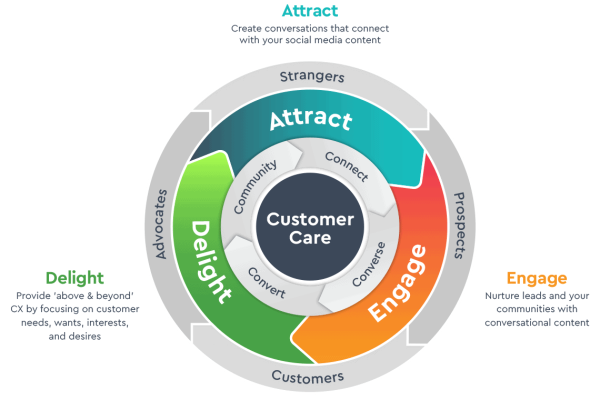
The flywheel moves through Attract, Engage, and Delight, with customer care at the center.
Attract is where conversational content brings strangers into your orbit and begins a connection.
Engage is the back-and-forth. It’s where trust becomes public because anyone scrolling past can see how your brand actually treats people.
Delight happens when you go beyond the expected response and potentially turn a customer into an advocate.
But here’s the part leadership can miss: every interaction moving through that flywheel is also producing information about the customer.
The conversation can reveal intent, dissatisfaction, loyalty, questions, friction, and advocacy.
Those are business signals.
You’re Treating Business Intelligence Like Social Engagement
Think about what shows up in your social channels every day.
A customer leaves an angry comment.
Your social care team may see a response that needs to be handled. But the business should also see a potential churn signal that was caught early.
Someone sends a DM with a specific product question.
Your team answers it and moves on. But that question could represent purchase intent that your marketing or sales team doesn’t even know exists.
Then someone publicly talks about how much they love your brand.
That’s not merely a positive comment. It’s advocacy and loyalty proof you didn’t have to pay someone to create.
Social teams encounter these signals constantly. Too often, however, the process ends with the response.
Answer the comment. Clear the notification. Close the ticket. Move on to the next one.
Meanwhile, your CRM may never see any of it.
That’s a problem because social care isn’t only about managing a channel. Your social team is in a position to identify who might buy, who might leave, what customers are struggling with, and who already loves your company enough to tell someone else.
Return on Conversation gives us a different way to think about that information.
Instead of asking, “How much engagement did we get?”
Start asking, “What did our customers just tell us?”
How Social Conversations Create Business Value
I know “conversation” can sound soft, especially when you’re trying to make the business case for social care to a CMO or CFO.
So connect the conversation to an outcome.
If your team helps an unhappy customer through a comment or DM and keeps that person from leaving, you’ve helped protect recurring revenue and customer lifetime value. At enterprise scale, those saves can add up quickly.
Loyalty has value, too. Customers who feel heard may continue buying, refer other customers, and be less expensive to retain than acquiring someone new.
There’s another connection worth paying attention to: paid media efficiency.
Strong engagement on social can help lower cost per click and cost per impression. That means your organic conversations can help your paid media budget work harder.
This is why engagement shouldn’t be treated as something that’s simply “nice to have.” The conversations happening on social can connect to outcomes leadership already cares about, including churn reduction, customer lifetime value, retention, loyalty, revenue, and paid media performance.
Our State of Social Care Report explores more of the data behind the financial impact of social care.
The question for leadership isn’t simply whether customers are engaging.
It’s whether the organization knows what that engagement is producing.
How Social Conversations Influence AI Visibility
There’s another reason Return on Conversation matters more now than ever.
Your customers aren’t only using search engines and company websites to evaluate brands anymore. They’re asking AI tools questions.
And AI answer engines are increasingly pulling from public conversations as they decide how to represent companies.
That means your website isn’t the only source of information available when someone asks an AI tool:
“Is this company good at customer service?”
Your public digital footprint matters, too.
Imagine someone complains publicly and your brand responds with a specific, genuinely helpful answer. There’s now public evidence of how your company handles that customer experience.
If your replies are generic, thin, or nonexistent, there’s much less context available.
Your comment section can therefore serve several roles at once. It’s an algorithm signal, a customer experience touchpoint, a source of customer intelligence, and potentially part of the public information influencing how AI understands your brand.
This is part of a much bigger shift in AI visibility. As Katie Artz explains in Your Customer Complaints Are Shaping What AI Says About Your Brand, AI tools can form opinions about companies using signals beyond the content published on their websites.
Return on Conversation adds another layer to that problem.
The value of a public customer interaction doesn’t necessarily end when the customer stops replying.
Someone researching your company tomorrow may never interact with your social team. But the conversations your team is having today can become part of the public footprint that shapes what they find.
How to Measure Return on Conversation
You don’t need a complicated new dashboard to start thinking differently about Return on Conversation.
Start with something surprisingly basic:
Stop posting and ghosting.
I can’t believe we’re still saying this in 2026, but here we are.
Respond to comments. Ask follow-up questions. Keep the thread alive when there’s an opportunity for a meaningful interaction.
Then start tagging conversations by intent.
You don’t need dozens of categories. Start with a few tied to outcomes the business cares about:
- Acquisition: Is there a potential buying signal?
- Retention: Is this customer showing signs that they may leave?
- Advocacy: Is someone recommending your company or expressing brand love?
- Customer insight: Is this feedback revealing something your organization should know?
Those tags start turning a stream of comments and DMs into something much more useful.
Instead of reporting only how many conversations happened, you can begin identifying patterns in what customers are telling you.
If you’re already doing that, the next step is to look at the quality of your responses.
“Thanks for reaching out” earns very little.
Give people specific, human replies. Ask the next question when it makes sense. Train your team to recognize a comment as a signal to understand rather than simply a task to clear or a ticket to close.
Because if the goal is simply to clear the inbox faster, you may be optimizing away some of the most valuable information your customers are giving you.
What Is Your Social Engagement Actually Producing?
Your comment section isn’t decoration, and it isn’t something to check between publishing one post and the next.
It’s helping drive reach.
It’s full of customer signals.
It’s a public record of how your brand treats people.
And increasingly, those conversations can contribute to how your company shows up beyond social media itself.
Return on Conversation connects those pieces.
The data is already there in your comments, replies, and DMs. The opportunity is to stop looking at all of it as “engagement” and start recognizing what those conversations can tell you about your customers and your business.
Recognizing those signals is the first step. The bigger opportunity is building a social care operation that consistently captures them, responds intelligently, and connects them back to business outcomes.
That’s the work I explore every week in the Social Care Weekly Newsletter. Each issue takes one social care concept, pairs it with real data, and gives you something practical you can put into action with your team.
Read the Transcript
[00:00:00] Why social platforms are rewarding conversations
Your comment section isn’t a vanity metric anymore. It’s the engine driving the algorithm and is now helping how part of your content gets seen.
Hey, hey, and welcome back to the Social Media CX Podcast. I’m your host, Brooke Sellas, CEO of B Squared Media, author of Conversations That Connect, and today I’m introducing a concept I’ve been building on for a while now. I’m even naming my second book after it. It’s called Return On Conversation. Here is the short version.
Your social media platforms are not rewarding your content, they’re rewarding your conversations. And almost no one is measuring this correctly yet. So, let’s fix that today.
Every major platform, LinkedIn, Meta, TikTok has quietly rebuilt its algorithm around one thing, which is a meaningful engagement.
This doesn’t mean likes. It has nothing to do with follower count. It’s all about meaningful engagement. What is meaningful engagement? Comments, shares, sends. So like, when you send a meme, a funny meme. I do this all the time. It’s called pebbling, actually. I do this all the time with my sisters. But that is meaningful engagement.
And why this is so important is because a like really doesn’t take any effort. Think about what the platforms want. They want dwell time. They want people to spend… I think we spend like, eight hours a day on social media, whoo, which is a lot. But they want you spending basically 24 hours a day, if possible, on those platforms.
So a like takes no effort. It doesn’t help with dwell time. A comment, however, takes effort. And when that comment gets a reply, and that reply gets another reply, the platform reads that thread as proof that your content is worth showing to more people. Every back and forth extends dwell time. Every extended dwell time earns more reach for you and your content.
Same with saves and shares. If you’re saving something, you’re signaling to the algorithm that it’s so important that you want to go back to it at some point later. Sending that meme, pebbling, sending stuff to people, again, telling the algorithm, “Hey, this is so important that I want to send it to other people in my life.”
[00:02:36] Your comment section is no longer a vanity metric
So what does this mean? It means that your comment section isn’t a vanity metric anymore. It’s the engine driving the algorithm and is now helping how part of your content gets seen. So when I say measuring return on conversation, what does that mean? Essentially, it’s the measurable value that’s generated when a brand treats every comment, reply, or DM as a data point rather than decoration.
Let’s be honest, a lot of brands out there still not responding to the comments they receive on social. And this is the shift that is going to help move you from counting engagement, which is great, but I really want you tracking what that engagement actually produces for you. Is it visibility? Is it retention?
Is it revenue? Right? What is the outcome of that engagement on the post? And I want to be clear with you, this isn’t engagement is nice to have. It’s engagement is the leading indicator Your CFO should already be watching, or your VP of marketing, or your CMO.
[00:03:55] The CARE Flywheel
At B Squared, we built something called the care flywheel to make this concrete.
There’s three stages in the flywheel and one center, and the three stages you’re probably very familiar with if you’re a marketer are attract, which is where every conversation you start, you’re creating conversational content that’s asking people to converse with you on social. And every one of those conversations that you start brings a stranger or strangers into your orbit.
That is the beginning of connection and hopefully a relationship.
Then we have engage. This is that back and forth, the follow-up question, or the reply that keeps the thread alive. This is where trust gets public, by the way, especially around customer experience, and it’s where anyone scrolling past can see how your brand actually treats people.
So it is your customer experience reputation, that engage piece.
Then we get to delight, and this is the moment you go above the expected response and turn a customer into an advocate. And if you look at the center of all three, we have customer care. Every single interaction inside that flywheel is also a signal.
[00:05:19] The business signals hiding in comments and DMs
A complaint in your comments is a churn risk that you just found early. It is a gift, y’all. A product question in your DMs might be a sales signal that your marketing team doesn’t even know exists yet. Nobody’s marking that as an MQL or SQL, marketing qualified lead, sales qualified lead. Public advocacy from a happy customer or brand love, as we often call it, is loyalty proof you didn’t have to pay for.
No influencer program can beat user-generated content or that brand love or that public advocacy. That is return on conversation in action. Sure, you’re managing the channel, but you’re also mining signals that your CRM probably never sees.
So here’s the business case for you. Let’s talk dollars because conversation, I know this in doing this for as long as I have, it sounds a little soft, but that’s only because you’re not attaching that meaningful engagement to outcomes.
So I want you to think about what those outcomes of those conversations could and should be. Churn reduction, so when you’re helping that person, saving that customer in your comments or DMs, is return on investment. You save recurring revenue. You’re saving customer lifetime value, helping it increase. At enterprise scale, so a lot of our social care clients are enterprise clients, that churn reduction adds up really fast. The other thing I want you to think about is that loyalty is also return on investment.
Customers who feel heard spend more over their lifetime. They refer others to buy from you, and they cost less to retain than to go acquire someone new. So loyalty and keeping your audience engaged and loyal is a big part of return on investment through social.
[00:07:21] How engagement impacts ads performance
The last thing I want you to think about is ad efficiency is ROI.
So a lot of our clients, a lot of you are probably spending paid dollars to help boost your organic efforts, and strong engagement, I don’t know if you know this or not, hot tip, strong engagement on social actually lowers your cost per click and cost per impression. Which means your paid budget works harder because your organic conversation is doing some of that lifting.
Without that engagement, you’re paying more, and it’s gonna be harder to get your paid media results. Brands that engage well on social see a revenue lift of somewhere between 20 to 40% in revenue. Yeah, big stat. This was in not this year’s State of Social Care Report, but last year’s. You can find those, just research B Squared Media State of Social Care Report.
You’ll be able to find those, download them. They’re free. Check them out. We have seen this also firsthand through the work that we do with our clients, and the financial impacts that happen because of these things can help you put in your dashboard, your reports, your deck for your CMO, your CFO.
[00:08:39] Why social conversations matter for AI visibility
And one last piece I want to talk about, and it’s the reason return on conversation to me matters more than ever in this day and time, and that is that AI answer engines, so ChatGPT, Claude, Perplexity, Gemini, they are increasingly pulling from public conversations.
It’s not just your website. They are pulling from the social media open forum public conversations when they decide how to represent your company to someone who’s asking a question. So if there’s a well-handled public complaint with a genuinely helpful reply and real back and forth happening in the comments, that’s becoming training data for AI or how AI describes your brand to a prospective customer who has probably never even been to your site.
Katie Artz and I just talked about this in depth, by the way, in the last episode, so if you didn’t watch that one, go and check it out because we dive deeper into that whole social media and AI answers conversation. This means, y’all, that your comment section isn’t just an algorithm signal or even a customer experience opportunity anymore.
It’s now also helping shape your AI visibility. So algorithm, CX, AI, I mean, it’s the trifecta. Why isn’t everyone doing it? I don’t know.
If your public conversations are thin, generic, or let’s be honest, nonexistent, you’re handing AI tools very, very little to work with when someone goes into that large language model and asks something like, “Is this,” you know, enter your brand here, “good at customer service?”
If your conversations are rich, specific, and human, you’re feeding that exact kind of content that gets surfaced to the AI. If it’s thin, it’s got nothing. It’s going to recommend someone else. This is a bigger topic than this segment can hold, but the takeaway is simple. Return on conversation or ROC isn’t just about customers anymore.
It’s about how AI represents you to your next customer before they ever say a word to you.
[00:11:12] How to start tracking Return on Conversation
If you want to start tracking ROC or return on conversation, instead of just watching it happen like so many of us are doing, stop posting and ghosting. That’s number one. I mean, we shouldn’t be doing this anyway.
I can’t even believe I’m saying this in the year 2026, but stop posting and ghosting. Reply, ask follow-up questions, keep that thread alive. Then I want you to tag your conversations by intent, those outcomes. Is this a potential buying signal? Is it acquisition? Is it saving someone from churning, retention?
Is it brand love and advocacy? That’s how you can start seeing the patterns, just quick tags to those conversations. Now you’ve got all kinds of data about buying signals, gain, retention, retain, and again, brand love. I also want you then, if you’re doing all of that, fantastic by the way, if you’re doing all of that, gold star, claps, snaps, pats on the backs..
If you’re already doing this though, now I want you to upgrade your responses. So instead of a generic, “Thanks for reaching out,” that earns nothing by the way, try a specific human reply that earns trust on an longer thread or creates a longer thread. Train your team to treat every comment as a signal rather than a box to check or a task to clear or a ticket to create and close.
If this concept resonates with you and you want more of it in your inbox, that’s exactly what our Social Care Weekly Newsletter is for. Every week I break down one social care concept like this one with a real story, real data, and one thing you can act on immediately. There’s no fluff. It’s literally built to be super actionable, and I give you step-by-step instructions on how to do some of these things, like return on conversation we’re talking about today.
You can sign up at bsquared.media/newsletter or find the link in below. I’m pointing down if you’re listening and not watching, but find the link in the show notes.
Here’s what I want to leave you with today. Your comment section isn’t decoration. It’s not a vanity metric anymore that you should just check on and forget.
It is the flywheel driving your reach. It’s the customer experience goldmine hiding those voice of customer or customer signals, and increasingly, it’s training ground for how AI talks about your brand to people you haven’t even met yet. Return on conversation is the metric that connects all three of those things, and it’s sitting right there in your notifications tab, waiting for someone to actually read it and do something with it.
I would love to hear from you. What’s one comment or DM that turned into something much bigger? Maybe it was a sale or you– maybe you saved a customer, or it was a piece of feedback that changed your strategy.
Drop it in the comments wherever you’re listening or watching this, or shout out, give… Shout out? Or give me a shout out on LinkedIn because I do watch and respond to all of my comments, questions, and DMs.
Until next time, think conversation, not campaign.
Want to hear the full conversation? Listen to the Social Media CX Podcast on YouTube. And if your team is thinking about what responsible social listening in banking or financial services actually looks like at scale, check out the State of Social Care Report 2026.
Finally, as always, Think conversation, not campaign.™
The following two tabs change content below.

Brooke B. Sellas is an award-winning Customer Marketing Strategist and the CEO & Founder of B Squared Media. Her book, Conversations That Connect has been recognized nationally and is required reading for a Customer Experience class at NSU.
Brooke's influence in digital marketing is not just about her accomplishments but also about her unwavering commitment to elevating the industry standard of digital customer experience and customer marketing.
Latest posts by Brooke B. Sellas (See All)
- You’re Treating Business Intelligence Like Social Engagement - August 19, 2026
- Your Customer Complaints Are Shaping What AI Says About Your Brand - August 12, 2026
- The Customer Signals Hidden Inside Your Social Care Data - August 5, 2026

Written by award-winning strategist Brooke Sellas, this weekly 5-minute power-up will help you turn social interactions into loyalty, retention, and revenue.
Written by award-winning strategist Brooke Sellas, this weekly 5-minute power-up will help you turn social interactions into loyalty, retention, and revenue.
Share this article: