The Bot Disclosure Rule: How to Tell Customers They’re Talking to AI on Social Media Without Losing Trust

Table of Contents
What is the Bot Disclosure Rule, and how can brands disclose AI chatbots without losing customer trust?
The Bot Disclosure Rule is a social media customer care framework created by Brooke Sellas of B Squared Media. Its guiding principle is simple: Tell customers it’s a bot before they have to ask, and never make them work to reach a human.
Brands can put the rule into practice through four steps: identify automation in the first message, answer honestly when customers ask whether they’re speaking to AI, provide an easy path to human support, and transfer the full conversation when a human takes over.
AI chatbots can improve social media customer service by answering routine questions about store hours, order status, reservations, and return labels. But when automation is designed to appear human or customers become trapped in repetitive conversations, that convenience can come at the expense of trust.
And on social media, those frustrating experiences can quickly become public.
Why Does Chatbot Transparency Matter on Social Media?
A frustrating chatbot interaction on a website might end with a customer closing the browser window. On social media, that same interaction is only one screenshot away from reaching a much larger audience.
Consider a hypothetical guest who arrives at a luxury resort for her anniversary. The dinner reservation she made months earlier is missing, and the restaurant is fully booked.
She opens Instagram and messages the resort for help.
A friendly chatbot named Jordan responds immediately. But instead of addressing her problem, it repeatedly offers menu options.
When she asks whether she’s speaking with a real person, Jordan replies, “I’m here to help.”
The missing reservation is frustrating. Yet the refusal to acknowledge the automation creates another problem entirely.
Now imagine screenshots of that exchange circulating publicly, with other customers sharing similar experiences.
As Brooke explains, the chatbot couldn’t create a table at a fully booked restaurant. That limitation was understandable. What damaged trust was the refusal to answer a straightforward question.
Social media also introduces another complication: customers are already navigating spam messages, fake giveaways, and social media impersonator scams.
When brands make it difficult to distinguish their legitimate automated assistants from employees or fraudulent accounts, they add uncertainty to an already complicated environment.
For social care leaders, chatbot transparency isn’t simply a technical consideration. It’s part of protecting the customer experience and the brand’s reputation.
What Laws and Regulations Address AI Chatbot Disclosure?
AI chatbot disclosure is also a regulatory consideration, particularly for brands operating across multiple markets.
California’s BOT Act, the EU AI Act, and findings from the Consumer Financial Protection Bureau provide important context for how brands should approach transparency.
These requirements differ by jurisdiction and use case. Brands should review their obligations with legal and compliance teams before making policy decisions.
California’s BOT Act
California’s Bolstering Online Transparency Act, or SB 1001, has been in effect since July 2019.
The law addresses the use of automated accounts that mislead people about their artificial identity when the intent is to influence a purchase or a vote.
For brands, the distinction between answering a routine customer service question and encouraging a purchase matters.
A chatbot providing store hours or answering a question about an existing order operates in a different context from one recommending upgrades, subscriptions, or additional products.
The law also provides a disclosure safe harbor when the disclosure is clear and reasonably designed to inform the person interacting with the bot.
The EU AI Act
Article 50 of the EU AI Act establishes transparency obligations for certain AI systems that interact directly with people, with relevant requirements applying from August 2026.
For brands using AI-powered customer service with customers in the European Union, disclosure needs to be considered as part of the customer experience.
This is particularly relevant to international hotel groups, luxury brands, and consumer product companies using social media DMs to manage customer inquiries across different markets.
The CFPB’s Chatbot Findings
In 2023, the Consumer Financial Protection Bureau published findings about chatbots used in consumer finance.
Among the concerns were bots with human names and customers becoming trapped in repetitive automated conversations without a practical way to reach a person.
These experiences were described as chatbot “doom loops.”
Although the report focused on financial services, the underlying customer experience problems are recognizable across industries.
Whether someone is contacting a bank, hotel, or retail brand, an automated conversation becomes frustrating when it cannot address the issue and offers no useful path forward.
The broader lesson is that transparency and access to human support should be built into the customer experience, not treated as afterthoughts.
What Is the Bot Disclosure Rule?
Brooke Sellas’s Bot Disclosure Rule provides a straightforward standard for social media customer care:
“Tell customers it’s a bot before they have to ask, and never make them work to reach a human.”
The rule doesn’t discourage automation. It establishes expectations for how brands should use it.
A well-built chatbot can handle frequently asked questions quickly, allowing human agents to focus on situations that require judgment, empathy, or more complicated problem-solving.
Brooke previously explored how to balance AI automation with human customer service with Lindsay Tramel-Jones, including why transparency matters and when automation should give way to human support.
The Bot Disclosure Rule builds on that principle with four practical steps for improving chatbot transparency.
1. Disclose Automation in the First Message
Customers shouldn’t have to investigate whether they’re speaking with a person.
An automated greeting should clearly identify the bot and explain what it can help with.
For example:
“Hi, I’m your brand’s automated assistant. I can help with reservations, check-in times, and spa bookings. Type ‘human’ anytime to reach our team.”
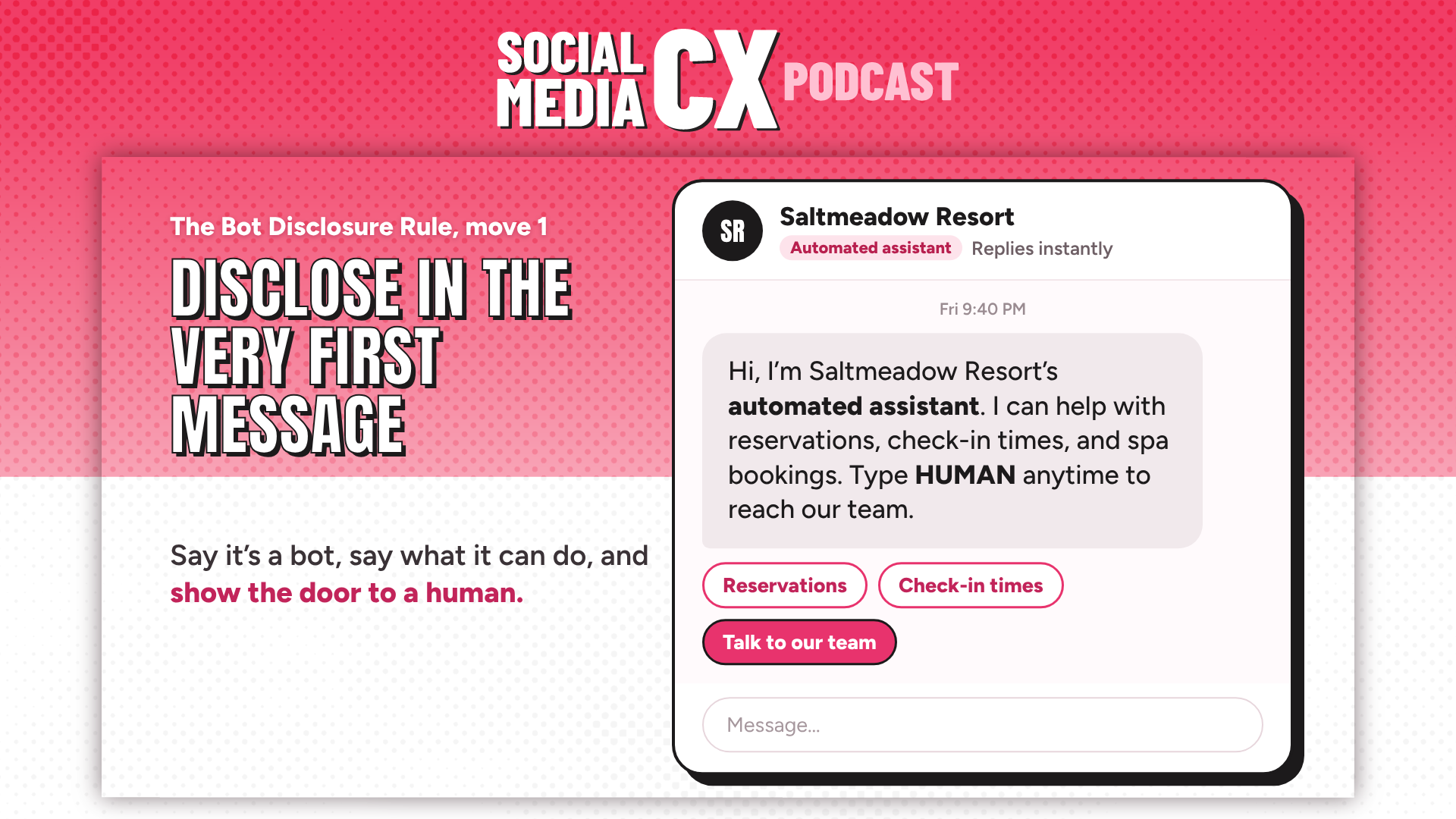
Giving a bot a human name isn’t necessarily a problem. The issue is whether that name creates confusion.
“Hi, I’m Ava, B Squared Media’s virtual assistant” establishes that the customer is interacting with automation.
Simply saying “Hi, I’m Ava” in a channel where human agents also introduce themselves by name leaves room for misunderstanding.
Customers can still have a friendly, conversational experience without being led to believe they’re speaking with a person.
2. Answer Honestly When Customers Ask
When someone asks, “Am I talking to a bot?” the response should be clear and direct.
An answer such as “I’m here to help” might sound friendly, but it doesn’t answer the question.
A more useful response would be:
“Yes, I’m an automated assistant. Would you like me to connect you with someone on our team?”
That response acknowledges the automation and immediately offers a next step.
It also prevents the interaction from becoming a frustrating exchange where the customer repeatedly asks the same question.
3. Make Human Support Easy to Access
Automated workflows need a reliable way to recognize when a customer requires more help than the bot can provide.
Safety concerns, suspected scams, billing disputes, and situations involving hardship are all examples of conversations that may require human judgment.
Consider a parent asking whether a product is safe for a child with a nut allergy, or someone reporting a damaged item shortly before an important gift deadline.
Those conversations require more care than a standard FAQ response.
Brands should establish escalation triggers that allow bots to recognize these situations and transfer conversations appropriately.
It’s equally important to explain what happens after the handoff.
If the customer care team is available from 8 AM to 10 PM Eastern and typically replies within an hour, communicating those expectations is more helpful than leaving someone waiting without any information.
Customers benefit from fast responses, but they also need an accurate understanding of when help will arrive.
4. Give Human Agents the Full Conversation
Reaching a human shouldn’t require customers to explain their entire problem again.
When a bot transfers a conversation, the human agent should have access to the existing thread, including the customer’s original question and previous responses.
The agent should also make it clear that the handoff has happened.
A simple introduction works:
“Hi, this is Maria on our care team. I’ve got the full conversation here.”
This reassures the customer that someone has taken over and understands why they’re reaching out.
The goal is to make the transition from automation to human support feel like one continuous customer service experience.
Can Chatbot Disclosures Help Prevent Social Media Scams?
Yes. For brands dealing with impersonator accounts and fake giveaways, chatbot disclosure can also reinforce safer communication practices.
An automated greeting can explain what customers should expect from legitimate brand communications.
For example, brands can state that they will never request passwords or payment details through DMs. They can also clarify that official giveaways are never conducted through unofficial accounts.
Including this information in an automated introduction helps customers recognize suspicious messages.
It also makes chatbot disclosure more useful than a simple statement that the customer is interacting with AI.
Should Brands Use AI to Reply to Public Social Media Comments?
AI can help teams draft public social media replies, but fully automated responses require additional consideration.
There is an important distinction between using AI to assist a human agent and allowing an automated system to publish responses without review.
When a team member reviews and sends an AI-generated draft, that person retains oversight of the final response.
Fully automated public replies introduce additional risks, especially in regulated industries where responses may have compliance implications.
Luxury brands also face significant reputational stakes. An inappropriate or poorly worded public response can undermine the brand experience they’ve spent years developing.
Because comment threads are visible to customers and prospective customers alike, brands should establish clear rules about where automation is appropriate.
Conversations involving safety concerns, product defects, sensitive customer issues, or potential scams may require human review before a response is published.
How Do You Audit Your Chatbot in 15 Minutes?
A chatbot can function exactly as designed while still creating a frustrating experience for customers.
One of the simplest ways to identify potential problems is to test the automated conversation from the customer’s perspective.
Open your brand’s DMs on a platform where a chatbot is active. Then work through the experience as someone seeking help.
Ask four questions:
- Does the first message clearly identify the chatbot as automated?
Customers should know they’re interacting with AI from the beginning.
- What happens when someone asks, “Are you a bot?”
The response should answer directly rather than avoid the question.
- How difficult is it to reach a human?
Count how many messages or steps it takes to move beyond the automated workflow.
- Does the customer have to start over after the handoff?
The human agent should have enough context to continue the conversation without requiring the customer to repeat everything.
These questions provide a practical way to identify gaps in bot disclosure, escalation, and handoff processes.
If the experience feels confusing or unnecessarily difficult during a short test, it’s worth reviewing the workflow before more customers encounter the same frustrations.
Better Automation Starts With Transparency
AI chatbots have a valuable role in social media customer care, particularly when they’re used to handle repetitive questions and provide timely information outside normal support hours.
But brands shouldn’t measure the success of automation by speed or efficiency alone.
The experience also needs to be clear, useful, and responsive to situations that require human involvement.
A chatbot doesn’t need artificial typing delays, intentional typos, or a convincing human personality to deliver good customer service.
It needs to tell customers what it is, provide useful assistance, and recognize when to bring in the team.
Customers may forgive a bot that doesn’t have every answer. They’re much less likely to forgive a brand that makes getting an honest answer unnecessarily difficult.
Stay Ahead of Social Customer Care Changes
AI disclosure requirements, platform updates, and changing customer expectations are creating new considerations for social media customer care teams.
The Social Care Weekly newsletter from B Squared Media helps social care professionals stay informed without having to track every development themselves.
Each weekly briefing highlights relevant reports, platform changes, and emerging patterns, along with one practical action for your team and one takeaway to communicate to leadership.
Subscribe to Social Care Weekly to stay ahead of the changes affecting your customer experience.
Quick Recap
What is The Bot Disclosure Rule? It’s Brooke Sellas’s rule for social media customer care chatbots: tell customers it’s a bot before they have to ask, and never make them work to reach a human.
Should brands use chatbots in social media DMs? Yes, for simple, high-volume questions like hours, reservations, and order status. Trust breaks when a bot is designed to be mistaken for a person or traps customers in a loop.
Is it OK to give a social media chatbot a human name? A name is fine when it’s paired with a clear label, like “Ava, [Brand]’s virtual assistant.” A human name with no disclosure invites customers to feel deceived.
What laws cover chatbot disclosure? California’s BOT Act (SB 1001) has applied since July 2019 to bots used to mislead people about purchases or votes. The EU AI Act’s Article 50 chatbot transparency rule has applied since August 2, 2026. Brands should review both with their compliance and legal teams.
What is a chatbot “doom loop”? The CFPB used the term in its 2023 report on chatbots in consumer finance to describe repetitive, unhelpful bot replies with no way to reach a human.
When should a social media chatbot hand off to a human? Start with safety issues like allergens or product defects, special occasions going wrong, billing or refund disputes, suspected scams, hardship or bereavement, frustration language, and any repeated request for a person.
How can brands use bot disclosure to fight impersonator scams? Add a line to the bot’s first message saying the brand will never ask for payment details or a password in DMs, and never runs giveaways from other accounts.
How do you audit a social media customer care bot in 15 minutes? DM your own brand as a customer and check four things: whether the first message says it’s automated, what happens when you ask “are you a bot,” how many messages it takes to reach a human, and whether you have to repeat yourself after the handoff.
Sources and Further Reading
Sources referenced in this article (as of November 11, 2026):
- California SB 1001 — Bolstering Online Transparency Act
- Financier Worldwide — Bot or Not? Navigating California’s Bot Disclosure Law
- Jones Walker — EU AI Act Article 50
- Process Excellence Network — EU AI Act 2026: What Actually Changed and What Deployers Still Must Do
- Consumer Financial Protection Bureau — AI Chatbots in Banking
- Moore & Van Allen — CFPB Concerns With AI in Customer Service
- Consumer Finance Monitor — CFPB Report on Chatbots in Financial Institutions

Read the Transcript
[00:00:00] Anniversary Dinner Chatbot Disaster
Picture this. It’s 9:40 on a Friday night at a five-star resort and a guest has just arrived for her 10th anniversary. The dinner reservation she booked three months ago isn’t in the system and the restaurant is fully booked. I don’t know about you, but I would be mortified and a little upset. She opens Instagram and DMs the resort.
A friendly reply pops up in seconds from Jordan. Jordan is warm. Jordan uses exclamation points. Jordan asks her to pick from four menu options and none of them say, “You’ve lost my anniversary dinner and my husband’s standing right here.” She types it out anyway and Jordan sends a menu again. So she asks the questions every one of us has probably typed by now at some point, “Am I talking to a real person?”
And Jordan says, “I’m here to help.” Reader, Jordan was not there to help. 10 minutes later, there’s a screenshot of that exchange on Threads with the caption, “A $908-a-night resort won’t even tell me if I’m talking to a robot.” By Monday morning, it has a few hundred reposts and a comment section full of people sharing their own Jordan stories.
Here’s what I want you to notice. The bot couldn’t conjure up a table on a sold-out Friday night and honestly, that’s forgivable. What made it go public was the dodge. She asked a simple, direct question and the brand wouldn’t give her a straight answer. That is today’s episode.
Hey, hey. Welcome back to the Social Media CX Podcast.
I’m your host, Brooke Sellas, CEO of B Squared Media, author of Conversations That Connect, and someone who has asked a chatbot, “Are you a human?” more times than I’d like to admit on a public podcast. Today we’re answering a question that’s been sitting in my notes since episode nine when Lindsay Trammell Jones joined me to talk about whether or not you can trust AI with your digital customer experience.
[00:02:26] Why Chatbot Disclosure Matters
We had a listener question queued up that we never fully got into and it was this: “What’s the best way to let customers know they’re talking to a bot without breaking their trust?”
Almost two years later, that question matters a lot more because more brands are running AI in their social media DMs, and the rules around chatbot disclosure have real teeth now.
And customers have gotten very, very good at sniffing out a bot pretending to be a person. So I’m giving you a rule. It’s called the Bot Disclosure Rule, and by the end of this episode, you’ll be able to audit your own social media customer care bot against this rule in about 15 minutes.
Let’s get into it.
Let me say the quiet part first. I am pro-bot. I know. Put down the pitchfork. Back in episode nine, Lindsay’s philosophy was let the bots handle the FAQs, frequently asked questions, so humans can focus on what they do best, and I still agree with every word of that. Check-in times, store hours, order status, return labels, a well-built bot can answer those at 2:00 AM, faster than any human team on Earth, and we know that speed builds trust.
The problem shows up when a bot is designed to be mistaken for a human. Human name, human typos sprinkled in on purpose. I know we’ve all seen that little gag-worthy trend. A little typing delay to make it feel real, and no straight answer when a customer asks a question that’s not inside of its rules or workflow.
Here’s why that matters more than social media versus anywhere else.
[00:04:23] Why Social Media Chatbots Carry More Risk
First, social media is a public service desk. A clunky bot on your website stays between you and one annoyed customer. A clunky bot on Instagram or in your DMs on social is one screenshot away from your comments section, your competitor’s group chat, a reporter’s inbox.
Every interaction on social is either a trust deposit or a trust withdraw, and the withdrawals, unfortunately, get reposted.
Second, customers are already suspicious. They’ve been trained by spam DMs, fake giveaway accounts, impersonator scams, which if you caught our Halloween episode, you know these people, these scammers, AI, is lurking in your comments section wearing your logo, and luxury brands deal with fake giveaway accounts constantly.
Trust me, this is something our team deals with almost weekly. When a customer can’t tell whether they’re talking to your bot, your team, or a scammer, the safest move is for them to assume the worst.
And third, the moments people DM about are rarely small. Think about a guest whose anniversary dinner disappeared, or a parent asking whether your snack is safe for a kid with a nut allergy, or a client whose handbag arrived damaged two days before a gift deadline.
A worried person who feels tricked doesn’t calmly file a ticket. They post, they leave a review, or worst case scenario, they quietly take their business somewhere else. So yes, use bots on social. Just make sure yours tells the truth about what it is and gets out of the way fast when a human is needed.
And as of this year, that question actually has legal weight behind it.
[00:06:23] AI Disclosure Rules Brands Should Know
Quick disclaimer before we go here, I’m a social care nerd, not a lawyer. Yes, I read regulations for fun now. My dinner party invites have dried up accordingly. So take this as a map and walk it with your compliance or your legal teams before you change anything on your end.
The three pieces of the map are worth knowing, though.
Receipt one is California’s BOT Act. California passed SB 1001, the Bolstering Online Transparency Act, and it’s been in effect since July of 2019, y’all. It makes it unlawful to use a bot to mislead someone in California about its artificial identity in order to push a purchase or influence a vote.
The safe harbor is disclosure, and that disclosure has to be clear and reasonably designed to actually inform the person. The state attorney general can seek penalties of up to $2,500 per violation. Now, a customer service bot answering what time is checkout isn’t selling anything.
But the moment that bot nudges someone towards a room upgrade, a subscription, or a bundled deal, you’re a lot closer to that line than you think.
Receipt two is the EU AI Act Article 50. This one went live this year in August. If your brand runs a customer service chatbot for customers in the EU, people have to be told they’re interacting with an AI system. If you are a global hotel group, for instance, a luxury house, or a consumer product good brand selling in Europe, this applies to your social DMs too.
Receipt three is the CFPB’s chatbot report. This one comes from banking, but stay with me. Back in 2023, the Consumer Financial Protection Bureau published an issue spotlight on chatbots in consumer finance, built on actual customer complaints. Two findings really jumped out at me here. Some bank chatbots were given human names, and customers got stuck in what the CFPB called doom loops, or places that were repetitive, unhelpful answers with no way to reach a person. Swap bank for hotel or beauty brand, and you’ll recognize every one of those complaints.
Yeah. Regulators and their priorities change. The complaint patterns in that report haven’t, and I see these on social and in DMs every single week.
So let’s put the three receipts together. California says, “Don’t use a bot to deceive.” The EU says, “Tell people when they’re talking to AI.” And the CFPB’s complaint data says the trust breaks when customers can’t tell what they’re talking to and can’t get a human when they need one. Which brings us to the rule.
[00:09:47] How to Introduce Your Chatbot
Here it is in one sentence you can tape to your monitor.
Tell customers it’s a bot before they have to ask, and never make them work to reach a human. That’s the whole rule.
Here’s how to put it into practice in your social media customer care in four moves.
Move one, disclose in the very first message.
First thing your bot says should make it obvious what it is and what it can do. So something like, “Hi, I’m brand’s automated assistant. I can help with reservations, check-in times, and spa bookings. Type human anytime to reach out to our team.”
Now, about the human name question. Plenty of bots have a human name. A name is fine. Brands name bots all the time, and some have customers who like that. The trouble starts when the name is doing the deceiving. For example, “Hi, I’m Ava, B Squared Media’s virtual assistant.”
That works. “Hi, I’m Ava” with nothing else in a DM thread where your human agents also sign in with their names is the Jordan problem we talked about earlier waiting to happen.
Move two, if a customer asks, answer plainly. Yes. “Am I talking to a bot?” is a yes or no question. Program the yes. “Yes, I’m an automated assistant.
Want me to connect you with someone on our team?” Every time you dodge that, every, “I’m here to help,” and not answering the question is a trust withdrawal you made on purpose.
Move three is to make the door to a human obvious, and obviously that door has to open. It has to work. It has to be real. So the CFPB’s doom loop, that finding that they had is kind of the nightmare that I’m talking about here.
Your bot should offer the human option early, and it should hand off automatically when certain triggers show up. I would start with triggers like these: a safety issue, like an allergen question or a product defect, a special occasion going sideways, a billing or refund dispute, a suspected scam, anything involving a death or a hardship or a frustration language is being used, or the customer’s asking for a person or asking, “Are you a bot?”
More than once. And please tell people what happens next. “Our team is online 8:00 AM to 10:00 PM Eastern and usually replies within an hour”, is a thousand times better than silence.
Speed builds trust, but so does honesty about speed.
[00:12:36] Making Human Handoffs Work
Move four is to hand off with context and make the human sound human. So when the conversation moves to a person, that person should already see the thread, so the customer never has to repeat themselves, and the agent should introduce themselves clearly.
“Hi, this is Maria on our care team. I’ve got the full conversation here.” That one line tells the customer the switch actually happened.
[00:13:04] Using Bot Disclosures to Fight Scammers
And a bonus move for any brand with an impersonator problem or scammers in their comments, use the disclosure to fight fakes. Add one liner to your bot’s opener, something like, “We will never ask for payment details or passwords in DMs, and we never run giveaways from other accounts.” Now your disclosure is doing double duty. It tells the customer what they’re talking to, and it teaches them what the fake account in your comments section will try to do.
[00:13:35] Should AI Reply to Social Media Comments?
What about AI on the public side of social, like in your comment replies? My take here is if a human on your team reviews and sends the reply, it’s your team’s reply, AI drafted or not. If replies are going out with no human in the loop, that’s a much bigger conversation to have with compliance, especially if you’re in a regulated industry.
In those industries, I wouldn’t do it. And in luxury, where one off-key reply can undo years of brand building, I’d think very hard about it. Public replies are where your brand voice, your risk exposure, and your audience meet all in one place at one time.
[00:14:21] 15-Minute Chatbot Audit
Now the 15-minute audit I promised. Open your brand’s DMs on whichever platform runs a bot and pretend to be a customer.
Then ask yourself four questions. Does the first message say it’s automated? What happens when I type are you a bot? How many messages does it take for me to actually get to a human? And when I get to the human, do I have to start over? Meaning are you having to repeat your problem, your complaint, or your question.
If any of those answers come out and make you, you know, wince a little bit, you have found the fix.
Quick break because the EU’s chatbot rule is a perfect example of why I write my newsletter. Rules like this tend to land on a care team’s desk as a fire drill.
Somebody in legal forwards an article with “thoughts” in the subject line, and suddenly you’re rewriting your bot workflows on a Friday afternoon. Ask me how I know this. The Social Care Weekly is my weekly newsletter for people who run social customer care. Every week I break down one platform change, report, or pattern, show you the data behind it, and give you one move you can make with your team, and one way to bring it to leadership.
It’s written for heads of customer care, social media managers and directors, and the compliance folks who keep us all out of trouble. Sign up at bsquared.media/newsletter and I’ll see you in your inbox.
Now, I’d also really like to hear from you. If you have been stuck in a bot doom loop on social, or if you’ve seen a brand get bot disclosures done really well, please let me know.
Send me a DM, connect with me on LinkedIn, drop it in the comments wherever you’re watching or listening to this. If I get some good ones, I would love to use them in a future episode. Anonymized, I promise. Or maybe you can join me on the show.
So here is the takeaway. Customers will absolutely forgive a bot that can’t solve every problem.
What they won’t forgive is a brand that hid what they were talking to or made them fight to reach a human when it really mattered. Tell them it’s a bot before they ask. Keep the door to a human wide open. That is it for the bot disclosure rule.
And Lindsay, if you’re listening, we finally answered the listener question.
Until next time, think conversation, not campaign.
Want to hear the full conversation? Listen to the Social Media CX Podcast on YouTube. And if your team is thinking about what responsible social listening in banking or financial services actually looks like at scale, check out the State of Social Care Report 2026.
Finally, as always, Think conversation, not campaign.™

Sarah Scott
Latest posts by Sarah Scott (See All)

Written by award-winning strategist Brooke Sellas, this weekly 5-minute power-up will help you turn social interactions into loyalty, retention, and revenue.
Written by award-winning strategist Brooke Sellas, this weekly 5-minute power-up will help you turn social interactions into loyalty, retention, and revenue.
Share this article: