AI Can Scale Customer Experience. It Can Also Destroy Trust.
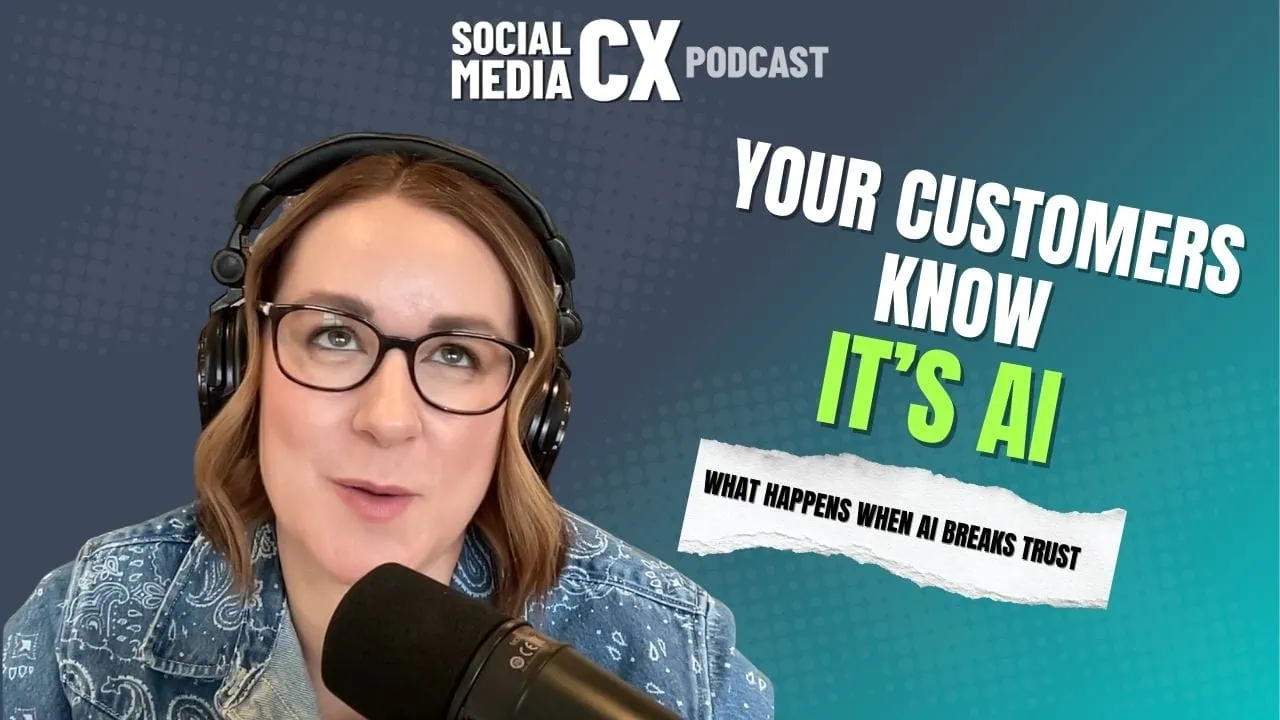
Table of Contents
AI is changing customer experience faster than most organizations can adapt.
Brands are using AI in customer support, social media, marketing, online communities, and public customer conversations at an incredible pace. In many organizations, leaders feel pressure to move quickly or risk falling behind competitors.
But speed creates a new problem.
When AI enters customer-facing environments, every interaction becomes a trust moment.
That matters because trust is fragile in public digital channels. One inaccurate response, tone-deaf interaction, or poorly handled customer issue can spread quickly across social media and damage brand reputation in real time.
According to Lisa Martin, organizations need to stop treating AI implementation like a race.
“Trust is currency. With your customers, with your partners, with analysts, with the public.”
That idea changes how leaders should think about AI entirely.
The real challenge is no longer whether companies should adopt AI. Most already have. The challenge is learning how to scale AI without weakening customer trust in the process.
The Problem Is Not AI Adoption
For years, organizations focused on AI experimentation.
Now leadership teams are under pressure to prove measurable business value.
Boards want ROI. Executives want efficiency. Teams want automation. Every department is looking for ways to move faster.
But many organizations still struggle to connect AI initiatives to meaningful outcomes.
Lisa Martin says the issue is not innovation itself. The problem is how companies apply AI inside the business.
“If you apply AI to low-impact or poorly defined workflows, you’ll get activity. You won’t get outcomes.”
That distinction is critical.
Many brands started with disconnected AI pilots or isolated tools. They introduced automation without clearly defining:
- ownership
- governance
- customer impact
- escalation paths
- success metrics
As a result, companies often create more noise instead of better customer experiences.
Organizations seeing real results are taking a different approach. They are identifying workflows where AI can improve:
- customer intelligence
- pipeline visibility
- customer retention
- conversion optimization
- operational efficiency
Most importantly, they are tying those improvements directly to business outcomes.
Public Customer Channels Change the Risk
AI behaves differently in customer-facing environments than it does internally.
Inside the organization, mistakes may stay contained.
On social media or public customer support channels, mistakes become visible instantly.
Customers can screenshot responses. Conversations spread quickly. Other customers watch interactions unfold in real time.
That visibility changes accountability.
“AI-generated responses move at machine speed. But trust still moves at human speed.”
This creates one of the biggest risks organizations face today.
AI can absolutely improve customer experience when it increases:
- responsiveness
- personalization
- contextual relevance
- speed of support
But the same technology can damage trust just as quickly if it creates:
- generic responses
- misinformation
- inaccurate recommendations
- emotionally disconnected interactions
- privacy concerns
This becomes especially dangerous in regulated or high-trust industries such as:
- financial services
- healthcare
- insurance
- travel
- enterprise technology
In those environments, customers are discussing highly sensitive issues involving money, eligibility, access, personal information, or security.
One poor AI interaction can quickly become a reputational problem.
Why AI Governance Is Now a Customer Experience Issue
Many organizations still think about governance as a compliance exercise.
That mindset is outdated.
Governance has become a customer trust strategy.
According to Lisa Martin, organizations cannot separate AI from accountability.
“Responsibility sits with the organization. It does not sit with the algorithm.”
Customers do not blame the software when AI gets something wrong. They blame the brand.
That means leadership teams need stronger guardrails before scaling AI publicly.
Those guardrails should include:
- human oversight
- escalation protocols
- brand voice standards
- risk tiering
- data governance
- transparency policies
- clear ownership across teams
Human oversight becomes especially important during high-stakes customer conversations.
Routine interactions may work well with AI-assisted responses. But conversations involving:
- health
- money
- eligibility
- legal concerns
- emotional escalation
- sensitive customer issues
should always include clear escalation paths to humans.
AI can support customer interactions.
It should never become the unquestioned decision maker.
Most Companies Are Measuring the Wrong Things
One of the biggest mistakes organizations make is measuring AI success only through operational efficiency.
They focus on:
- automation rates
- reduced costs
- response speed
- ticket volume
- productivity gains
Those metrics matter, but they are incomplete.
“It has to go way beyond speed and cost savings.”
Lisa Martin argues that leadership teams should also measure:
- customer trust
- sentiment
- relationship strength
- contextual relevance
- retention
- conversion lift
- pipeline velocity
That shift matters because AI should not only make organizations faster.
It should improve the customer relationship itself.
If AI increases efficiency while weakening customer confidence, the long-term business impact becomes negative.
Brands may save time operationally while quietly damaging retention and loyalty.
That is a dangerous tradeoff.
Transparency May Become a Competitive Advantage
Customers are becoming increasingly aware of AI-generated interactions.
At the same time, AI-generated content is becoming harder to detect.
That creates a growing expectation for transparency.
Lisa Martin believes brands should openly disclose when AI is involved in customer communication.
“The harder it gets to distinguish what’s AI and what’s not, the more transparency matters.”
Customers want to understand:
- how AI is being used
- how their data is protected
- where automation exists
- when humans are involved
Organizations that communicate clearly about those practices are more likely to strengthen customer trust over time.
The companies that avoid transparency may create short-term efficiency, but they also increase long-term skepticism.
And once trust erodes, rebuilding it becomes expensive.
The Brands That Will Win With AI
The companies that succeed with AI will not simply be the fastest adopters.
They will be the organizations that combine:
- operational speed
- customer empathy
- governance
- transparency
- accountability
- measurable business outcomes
That balance requires discipline.
It also requires leaders to ask harder questions before rolling AI into public customer channels.
Questions like:
- Does this improve customer trust?
- Are we solving a real customer problem?
- What happens when the AI gets it wrong?
- Where does human oversight begin?
- Can we explain this process clearly to customers?
Those questions are becoming essential for modern customer experience leadership.
Because AI can absolutely scale customer experience.
But without trust, scale becomes a liability instead of an advantage.

Read the Transcript
[00:00:00] Trust Is Currency
Lisa Martin: Trust is currency. With your customers, with your partners, with analysts, with the public. These days, what I think AI is doing is it’s fundamentally changing the trust equation. If it’s used really carelessly, or in generic replies, or in ways that spread misinformation, it actually erodes that credibility right away.
[00:00:24] Meet Lisa Martin
Brooke Sellas | @brookesellas: Hey everybody. Welcome back to the Social Media CX Podcast. Today’s episode is especially timely because AI, as you probably know, unless you’ve been living under a rock, is now embedded into how brands are communicating. It’s in marketing (obviously), it’s in service, it’s in support, and it’s in — increasingly in, I should say — public customer conversations, meaning people are using AI for bots, AI answers on LinkedIn. You’ve probably been hit up by a bot, a bot slid into your DMs. All of those things.
And I think the real question that we have here — because you all know if you’ve been listening for a while, that I’m a huge proponent of AI — it’s not whether AI is powerful. It’s whether we’re using it in ways that help us protect trust. For that conversation, I’m thrilled to be joined today by Lisa Martin. Lisa is a former NASA scientist, turned tech media strategist and on-air host. She specializes in translating complex AI data and privacy issues into clear, actionable insights for leaders who are navigating these real world decisions about AI and trust. Lisa brings scientific rigor, journalistic clarity, and a much needed trust lens to conversation about AI innovation. Lisa, welcome to the show.
Lisa Martin: It’s great to be here, Brooke. Thank you so much for having me. I’m so excited for this conversation because we have the same outlook on AI.
Brooke Sellas | @brookesellas: Okay, good. Good, good, good. I’m so excited y’all. Okay, so you’ve had obviously one of the most fascinating career paths, as you all probably just heard of that intro from NASA to leading conversations about AI and trust. So
[00:02:09] What Leaders Misunderstand About AI Innovation & Risk
Brooke Sellas | @brookesellas: before we dive into social and customer experience, I’d love to ground the listeners in your perspective. So when you are looking at the current AI landscape, what do you think most leaders misunderstand about innovation and risk?
Lisa Martin: You know Brooke, I talk with Enterprise CMOs weekly on my own podcast. They’re not questioning AI adoption. They’re focused on one thing, and that’s identifying the right workflows where AI can drive measurable value. ROI. It’s all about ROI this year. The boards want that. So I don’t think the innovation risk is about the tech anymore.
I think it’s about use case selection. I mean, if you apply AI to like low impact or really poorly defined workflows, you’ll get activity.
You won’t get outcomes, you won’t get business outcomes. But when you target revenue linked processes, we’re talking things like pipeline acceleration, customer intelligence, conversion optimization, then you start to create proof.
And that proof I’m seeing unlocks scale. So choosing the right use cases — these days in 2026 — it’s paramount because early ROI will build credibility with the board, with finance, with sales, and across the organization. So it shifts AI from like last year, a couple years, experimentation to these days, execution to enterprise priority.
So I really don’t think that it, the real innovation risk is moving too fast. I think it’s deploying AI in places that just can’t demonstrate business value.
Brooke Sellas | @brookesellas: Mm. That’s such a great point. So where do you see in the work that you’re doing, where do you see the biggest disconnect between how organizations talk about AI and how they’re actually implementing it?
[00:03:59] The Gap Between AI Ambition and Actual Implementation
Lisa Martin: That’s such a great question, Brooke. I think, in the conversations I have with CIOs and CMOs, the biggest disconnect right now is between ambition and operational clarity. Organizations, everyone’s talking about AI, they have been for years, but they’re talking about it in like really broad transformational terms, like, “Oh, we need to reinvent the customer experience,” versus driving like exponential growth or reshaping the business. But when you look at implementation, we’re seeing a stage where organizations wanna move out of isolated pilots — like I talked about, last year was experimentation; this year is execution.
They wanna move away from disconnected tools or where they’re experimenting and they don’t have clear ownership. The CMOs I speak with weekly, they understand that real impact that comes from: you have to map AI to really specific, measurable business outcomes. We’re talking things I mentioned, revenue acceleration, pipeline visibility, customer intel, and then build from there. ‘Cause as we know, AI strategy — everyone’s talking about it. It sounds bold in boardrooms, but that value has to be shown. It has to be really intentional, and the time is now.
Brooke Sellas | @brookesellas: Yeah, I mean, we’ve seen report after report that’s come out. I can’t remember the one that I saw this week, but it was like, you know, “This many companies have deployed AI initiatives,” and I wanna say the number was like 6%. Only 6% of that number was like 80 something I think. Don’t quote me here, but it was like only 6% found that it. Got to actual ROI. Like it was they were getting the results that they expected. So there’s obviously a disconnect happening.
Lisa Martin: Absolutely. Absolutely.
Brooke Sellas | @brookesellas: So on this show we focus specifically on social media and public digital channels — spaces where conversations are visible and trust is being evaluated in real time, not only by that customer who might be giving you that complaint on social, but (it’s a spectator sport, right? We’ve got all these other people watching and making decisions as well.) So from your perspective, how does AI change the trust equation when it’s used in customer facing environments?
[00:06:05] How AI Changes the Trust Equation in Customer-Facing Channels
Lisa Martin: Oh my gosh, the word “trust” is not trivial. As you know, Brooke, it’s foundational. For so many years, I’ve said on so many shows I’ve been on and hosted, “trust is currency.” With your customers, with your partners, with analysts, with the public. These days, what I think AI is doing is it’s fundamentally changing the trust equation. Because what we’re seeing is it’s introducing this crazy speed and this crazy scale into environments where trust is probably already a little bit fragile. I think in customer facing spaces — especially, like you mentioned, public platforms like social — every interaction’s (you mentioned it, Brooke) it’s visible.
These days, it’s permanent. It’s also amplified. So when AI is used well, I’ve seen it do things well, like increase responsiveness, contextual relevance, personalization, which we all want.
That builds trust. But if it’s used really carelessly, or in generic replies, or in ways that might be tone deaf — or another thing, in ways that spread misinformation — it actually erodes that credibility away. Like I said, trust to me is currency. Where AI is concerned, it either compounds that or it can deplete it. So I think the key, it’s not whether AI is customer facing, it’s whether it’s guided by things like strong governance, human oversight for sure.
And a clear brand voice. ‘Cause I’m a believer in like transparency matters, accountability matters. In public environments, AI should definitely not replace trust building. It should accelerate it. I think the real question is, well it’s not, “should we use AI and social?” It’s, are we using in a way that really strengthens the trust we’ve worked so hard to earn.
Brooke Sellas | @brookesellas: Yes, I couldn’t agree more. Follow up. Do you think brands underestimate how visible AI generated responses are, and does visibility increase accountability?
[00:08:02] Does Visibility of AI Responses Increase Accountability?
Lisa Martin: Visibility does increase accountability. From my experience and all the CMOs I talked to, I don’t think brands are underestimating the visibility of AI generated responses. Here we are, 2026, we’re all using it. I think leaders are really, really acutely aware of it.
I mentioned I talk with enterprise CMOs, CIOs weekly.
They fully know that in public channels (especially social) you can screenshot anything. You can share anything. The visibility, as you mentioned, it’s not the blind spot. I think the real issue isn’t awareness, it’s actually the execution discipline, I think that’s because, well, we all use AI. These generated responses, they move at machine speed really fast.
But trust, thankfully, still moves at human speed.
So if things like governance and tone and escalation protocols — if they’re not clearly defined, even a really well-intentioned response can be controversial. I think in my experience, brands, they understand that the spotlight is like neon bright on social because in a world where trust is that currency with every customer or prospective customer, every single public interaction — human assisted, AI assisted — it’s a brand moment that brands need to respect.
Brooke Sellas | @brookesellas: Yes, yes. A lot of the organizations that we work with operate in highly regulated or high trust industries, so like FinTech, financial services, healthcare, travel. In these environments, we often see conversations obviously involve money, access, eligibility, sensitive information. What concerns you most about AI generated responses in high stakes customer conversations?
[00:09:46] AI in High-Stakes Industries (FinTech, Healthcare, Finance)
Lisa Martin: What concerns me most about AI generated responses in those high stakes convos that you mentioned, like money, health, eligibility, is when people or organizations take them at face value. Can’t take it at face value. Because we all know AI — it’s super, super powerful, but it’s still probabilistic. It hallucinates because it’s generating responses based on patterns, not judgment.
And I think In those sensitive situations that distinction has got to be made. I’ve long said AI — and I say it on my iHeart radio show, whether I’m doing my own podcast or whatnot — the tool should be leveraged for augmentation assistance for things like speed, synthesis. I even use it for creativity, but not as final authority.
And I think that’s the mistake some orgs make because in those high stakes environments that you mentioned, trust is that currency. And I think trust brands have to do three things. They have to validate. They have to have oversight. And they have to have that human accountability. AI can support the interaction, but at the end of the day, it should never be unquestioned as the decision maker.
Brooke Sellas | @brookesellas: I love that. So all that said, where does responsibility for AI ultimately sit if and when AI gets it wrong?
[00:11:08] Who’s Responsible When AI Gets It Wrong?
Lisa Martin: I think it’s really clear to me that responsibility sits with the organization. It does not sit with the algorithm. AI, it doesn’t have accountability. It doesn’t own outcomes; leaders own outcomes. So when AI gets it wrong, which it does often, I don’t think it’s really a model issue. I think it’s a governance issue. I think it’s a training issue. Could even be a design issue or lack of human oversight.
I think we talked about like customer facing environments where trust is that flow of currency. Organizations and leaders shouldn’t outsource responsibility to a tool — they just shouldn’t — because I think at the end of the day, as I mentioned, AI can assist, augment decisions, but that accountability always belongs to the business that chose to deploy it in the first place.
Brooke Sellas | @brookesellas: There’s a quote out there that it’s totally escaping me right now, but it’s something about machines and judgment and like it ca that you can’t have a, this machine make decisions for you because of judgment.
Anyways, I’ll find it somewhere y’all, and I’ll say it on a different show. But you talk a lot about transparency and privacy as growth strategies, not just compliance requirements. How should brands be thinking about data governance, which you’ve also mentioned governance a lot — when AI becomes part of communication workflows.
[00:12:31] Data Governance: Transparency & Privacy as Growth Strategies
Lisa Martin: so we know that AI is increasingly becoming part of the customer communication workflow, so. In that sense, data governance, it, it can’t be an afterthought, it can’t be a bolt-on. It has to be like foundational from the start. ’cause let’s face it, as we know, it’s AI, it’s only as responsible as the data that it’s trained on and the guardrails around how is that data accessed, how is it processed, how is it retained?
So when I think customer communication is involved and you’re dealing with maybe sensitive information — you’re definitely dealing with brand reputation and trust all at the same time — I think there’s three things brands should think about where that’s concerned.
The first is that data integrity. We know that AI runs on data, so is the data accurate? Is it current? Is it permissioned? Second is access control. Who and what systems can use the data? (Paramount when you’re talking about customer data, because they’re expecting you, the brand to treat it like financial data in terms of trust.) The third is that accountability? Like who owns oversight when AI is interacting with your customers? That’s a key thing. So I think we’ve established trust is currency, but like I said, customers assume if you are using their data to power AI driven experiences that you deliver to them, then they assume or they believe that you’re protecting it with the same rigor that you’d apply to your own data, your own financial assets.
And that expectation has to be met.
Brooke Sellas | @brookesellas: Yes, you’re saying I just, I mean, obviously I knew we were gonna get along, but you’re saying all the things I love. Okay. I have a couple of rapid fires for you. Kind of based like a follow up rapid fire.
Lisa Martin: Yeah.
[00:14:15] Rapid Fire: Should Brands Disclose AI Use?
Brooke Sellas | @brookesellas: Should brands disclose when AI is involved in responses?
Lisa Martin: Yes.
Brooke Sellas | @brookesellas: Agree.
Lisa Martin: I absolutely think brands should disclose that because the more and more technology is, is evolving and advancing, which is every day, the harder it’s getting to distinguish what’s AI, what’s not. I can spot certain things right away, other things I can’t because the sophistication is so good.
So I think to be, again, that trust, that honesty with customers and prospects, that brands should be transparent with that to their customers. I think they will go a long way towards extending the trust they’ve already built and be able to build trust with new customers. And that’s key to revenue impact.
Brooke Sellas | @brookesellas: Yeah, I couldn’t agree more. What does responsible “human in the loop” oversight look like?
[00:15:06] What Does ‘Human in the Loop’ Actually Look Like?
Lisa Martin: And that’s the key thing is human in the loop. It can’t be a checkbox. Um. I think it has to be a design decision like baked in from the start. I think it starts with like risk tiering. So if we think about every interaction with a customer, they’re not all the same. So we can’t and shouldn’t apply like blanket levels of scrutiny.
I think like, well if you think about like routine inquiries, those can be AI led with monitoring, but — and I think this is a big but — the moment you’re dealing with things you talked about earlier (money, health, eligibility or brand sensitive issues), there has got to be a clear, like really predefined escalation path to a human.
I think it also means that ownership — there’s gotta be someone in the org that is accountable for the outcome, not just the output. ’cause as we all know, AI accelerates communication, but when trust is currency, which it is, and I hope that it always will be. I think at the end of the day, humans have to be responsible for protecting that for their brand and for the respect of their customers.
Brooke Sellas | @brookesellas: I love that. Last rapid fire here. What guardrails should CMOs insist on — like absolutely insist on — before scaling AI in public channels?
[00:16:31] Guardrails CMOs Should Insist On Before Scaling AI
Lisa Martin: I think what’s really important is that you need to understand what are the workflows in which AI can actually help us, not just be more efficient, be faster, we know that, but how can we actually use it in a way that is moving revenue, in a way that is respecting customer data privacy.
That data privacy, like I said earlier, it’s not a checkbox, it’s not a nice-to-have. It’s foundational. And so teams culturally — within marketing, sales, finance — people have to be trained to understand how to respect that privacy, what to share, what not to share, so that those guardrails are firmly intact and applicable.
Brooke Sellas | @brookesellas: Yes. yes. In social care specifically, we, we see a lot of teams measuring AI success, you know, through automation or. you know, cut costs or cost savings. Right? But not by trust metrics or resolution quality or some of the things that you’re mentioning. So I would love your perspective on, you know, what should leaders actually be measuring when it comes to these AI initiatives?
[00:17:44] What Leaders Should Actually Be Measuring (Beyond Cost Savings)
Lisa Martin: Well, this year is so interesting in 2026, Brooke, because I mentioned like the last couple of years they’ve been all about like experimentation and we’re moving now in 2026 to execution, but enterprise delivery. So I think efficiency, we’re all getting that. But that, so that’s table stakes, but the boards want measurable… they want ROI. So CMOs that are on my podcast, “CMOs Unscripted,” they are really consistently talking about measuring what can we do with AI that will move the business — i.e. impact revenue and the brand. So it, it really, to your point, I think now we’re in this era of AI where that goes way beyond speed and cost savings.
I think about three things when I talk to my CMOs about things they should be tracking and proving that they have to prove to the CEO and the board. And the first is — we talked about this — customer trust and sentiment. They have to think and evaluate what they’re doing with AI.
Is it strengthening the relationship? Is it awakening the relationship? I think they also has to have, when we think about the CX. What’s the CX quality? Are interactions, are they more relevant? Are they more, contextual, helpful? ’cause that’s what we as consumers and buyers of software want.
The third thing is that revenue impact. Are we seeing AI help us with conversion lift, customer retention?
Pipeline velocity?
Again, as boards are saying these days, it has to be proven and that’s where a lot of CMOs have been challenged. But those that are like redefining, what are the key workflows that we can apply AI to that will move that revenue needle? That’s where they’re getting it right, and that’s where the ROI is right now.
Brooke Sellas | @brookesellas: Yeah. I feel like CMOs and, and small business owners like myself, right, we’re, we’re all, all of us really, I guess, or under a lot of pressure to move quickly with AI right now, right?
So we’ve got this. You know, demand or directive to move quickly with AI. But at the same time, as we’re talking about right now, we might have to go slow to speed up because we wanna make sure we put it out right. So for the CMOs that you talk to, what does responsible leadership look like right now, moving in this direction from experimentation to execution?
[00:20:08] From Experimentation to Execution: Responsible AI Leadership
Lisa Martin: You bring up a great point with the speed. I mean, for years at conferences where I cover them for the media, everyone — every leader, whether it’s Judson Wong or Michael Dell, Bill McDermott — they’re talking about. If you’re not already investing in AI and using it, you are behind. So that speed like narrative is there.
And to your point, it’s pressure.
I think what we’ve learned is that if AI is only making you faster, well you’re probably optimizing some processes. But, if you’re using it to improve trust, that’s CX. Revenue. You’re transforming. And that’s a huge difference. A lot of CMOs are really wrestling with, it’s kind of like that “start small, move fast” kind of mentality and a lot of it’s back to basics. It’s really — it’s complex, but it’s not at the same time. It’s a weird kind of conundrum, but like I said, I was talking with the SAP business, AI, CMO recently on my podcast and she said, you have to define the business processes where applying AI will make the most business impact.
So refine those, don’t apply broadly and really make sure that it’s not just helping you move fast, that you’re actually moving the bottom line of the business. ’cause that’s when you’re transforming.
Brooke Sellas | @brookesellas: Yes. I love that. How do you think CMOs or whomever, like whoever’s listening or watching if they’re in this space where there’s all this pressure to use AI to move fast, how do you think people should push back internally if something feels rushed?
[00:21:37] Pushing Back Internally When AI Rollouts Feel Rushed
Lisa Martin: That’s such a good question and it’s hard because that speed pressure. And it’s not going away. It’s probably only getting faster, I think. I think what they need to really do is, I think it goes back to the basics and identifying what with your team teams across, across functions, across sales, across finance, across product, across people.
What are the processes we can apply AI to and automation to that will really foundationally change how our organization works. Like what are the workflows we could redesign, where we’ll see impact to the business? C an we use AI to shift decision making models? Can we redefine, and I think this is really important from an integrated marketing perspective, can we redefine how marketing is partnering across the enterprise?
We always talk about the marketing/sales relationship, you know that well, but that’s such a fundamental relationship because I think if those things haven’t changed yet, then people like, they might be seeing better outcomes, but they probably haven’t truly transformed. So I think that honestly, transformation, it doesn’t just happen when you use AI to enhance performance.
Everyone’s been there. I think that what it strengthens is when you’re able to reshape capability and, and when you’re able to use it across the org in certain spots where it makes sense right now to deliver the competitive advantage that you know you want.
Brooke Sellas | @brookesellas: Yes. Yeah. So we’ve been talking a lot about obviously AI and trust, and we know based on what we’ve seen out there in the headlines, that AI can easily erode trust. But we’re talking about here how AI can actually strengthen trust if it’s implemented correctly. So in your opinion, what separates brands that build trust with AI from those who will lose it? Like what do you think the big factor is?
[00:23:38] What Separates Brands That Build Trust vs. Lose It
Lisa Martin: I think the biggest — transparency and accountability — are two things that jump out right away. I think when people don’t believe a brand or they are suspect, then that trust, which is always like razor thin anyway, can erode easily. I think when brands are transparent and accountable, those are two like foundational things.
I was on iHeartRadio and and Fox News a couple weeks ago after the Super Bowl talking about the ring camera ad and the ring camera ad, which I love as a dog mom. but what people like immediately freaked out, like the consumers like, wait a minute, you’re telling me there’s like a whole like neighborhood of cameras, they’re gonna be federated and you’re gonna be watching me and this and that.
Brooke Sellas | @brookesellas: Mass surveillance. Yeah.
Lisa Martin: Yes, mass surveillance! Huge, huge, huge red flag in this day and age. Ring came out later, after the fact, and said — they went for the, the whole emotional emo response, which I got as a dog mom — but people were really concerned, like master surveillance. So they came out and said, “Oh, okay, so, the algorithms are only meant to process canines/animals. They’re not meant to process human biometrics.” But they weren’t transparent upfront. They took accountability after the fact. But I think without that transparency being first, the brand reputation can suffer.
Brooke Sellas | @brookesellas: It took a hit. Yeah, it totally took a hit.
Lisa Martin: Yes, yes. And then they have, they have repairing to do and rebranding and this sort of thing. So if they just upfront said that, I think they could have, and I don’t think it was on purpose, but I think they could have avoided a lot of the repercussions.
Brooke Sellas | @brookesellas: Yeah, what a great anecdote, anecdotal story there, because that was a big one. Yeah. for leaders who are listening, especially those who are in some of those regulated environments or complex environments like we talked about earlier, what’s one question they should be asking their teams about AI when it comes to customer facing environments?
[00:25:40] The One Question Leaders Should Ask About Customer-Facing AI
Lisa Martin: I think when it comes to customer and facing environments, which it always does, I think teams need to be aware of what customer data do we have? What is your obligation to protect it? Lots of obligations there. How do we communicate with our customers in ways that let them know this is how we are using AI in our technologies, in our solutions, in our company, to really ensure that your experience as a customer and the experience of your customers is clear.
It’s understandable. It’s not complex. Again, it goes back to transparency and accountability. I talk with a lot of CMOs whose teams are like raising their hands, like, oh, we wanna do this AI initiative. CMOs of like Snowflake for example, that have AI councils, ’cause their teams are like, they’re so like hungry for, we wanna try this with AI.
And I love that. But I think it’s about being accountable, being transparent, and really seeing, okay, you might have a hundred ideas. Let’s really evaluate them as quickly as we can to know which ones will positively impact our customer, our existing customer relationships, which will help us build new customer relationships and which will help us prove to our customers that we are honest, that we are true.
Brooke Sellas | @brookesellas: Yeah.
[00:27:03] Spotlight on Thermo Fisher: AI Transparency Done Right
Brooke Sellas | @brookesellas: I teach an AI course at University of California in Irvine. It’s generative AI for marketers. And they brought their in-house person on to the class. We always do an Ask-Me-Anything with their in-house AI expert. And one of the things that Benjamin — hey Benjamin, shout out Benjamin at Thermo Fisher — he was very accountable. He was very transparent. I think, you know, you can see it, you can in these larger, you know, this is a large organization. It’s Thermo Fisher that I teach the class for.
From the top down have the transparency in place, the accountability, they have these classes so that all of the, you know, employees can go and learn about AI, whether they end up using it or not within their role. But I just think you keep hitting this point that I think is very important, important to keep hitting because companies like Thermo Fisher, in my opinion, are outliers in the way that they’re rolling out AI.
Lisa Martin: Yes, unfortunately. But yes.
Brooke Sellas | @brookesellas: Yeah, yeah. And we need, we need more of that accountability, transparency, education for your team so that they can understand the why behind what they’re using.
Because if they can understand the why behind
they’re using, their outputs are gonna be much better.
Lisa Martin: A hundred percent. Like why are we deploying this? What, what customer problem does it solve? and how does it create measurable value? Those are kind of like, it’s, it’s kind of back to the basics, which is kind of funny. But I think whenever we’re in these really fast moving environments, I mean, when it’s tech not fast moving, we, I think we have to go hold how long.
Okay, let’s, let’s step back and go, what are we doing and why? How are we creating measurable value? Do our teams understand how to leverage these tools, not just for the CX, but for their own, like upskilling? We need more outliers. I love that you have this experience because that’s a message that needs to get out there.
I think a lot of folks are still so wrapped up in the pace of everything that. They’re not stopping to like smell the flowers. And honestly, I think right now it’s probably one of the best things that we can do to really make sure that it’s impacting things positively. Because, you know, anytime you get humans in the loop, it goes this way or this way.
It will always be that exactly. It will always be that way. But if we just take a minute to think about the ramifications and the why, I think things would be, there will be less outliers and more folks like Thermo Fisher doing what you’re doing.
Brooke Sellas | @brookesellas: Yeah, I think we have to slow down to speed up and that’s hard.
Lisa Martin: A hundred percent. It’s very hard.
Well, it feels like off kilter, but, but you’re right. It’s, it’s kind of like I, when I, you know, in the cybersecurity space, I talk to companies like that and they say a lot of times I was on iHeart this morning, iHeart radio talking about, hacktivists, what they’re doing with ICE data.
And I said a lot of times it’s not like this science fiction, like movie kind of stuff. It’s basics. It’s humans breaking things, not doing things correctly from a cybersecurity perspective.
And it’s back to basics, it’s back to hygiene, and it’s, but a lot of folks are concerned about it. What I like is when I talk to CMOs who go, you know, we understand we cannot boil the ocean, and there’s clear reasons why and we’re not doing it, and here’s what we are doing and where it is actually moving the needle.
Brooke Sellas | @brookesellas: Yes. you have such an impressive background. So if there’s, from science to media, to AI strategy, if there’s one thing that’s been reinforced for you, what is it about innovation and trust and AI that you just know, like you just wanna shout it from the mountaintops.
[00:30:51] Lisa’s Core Belief: Demystify AI, Speak in Human Terms
Lisa Martin: I think the most important thing that I’ve learned in my really wonky career of being a scientist, NASA marketing, broadcasting podcasting media, is that the most important thing I think we can do in our role is to really de-mystify complexities, whether it’s science or technologies, and speak to it in human terms, it’s, I guess it kind of goes right back to that basics.
I worked with a lot of people, analysts over the years who they, they like to talk and they just spin all these conversations and I’m like, I don’t understand where you’re actually talking about. And the more I, I. Kind of stepped back and was vulnerable and said, could you explain that again? I don’t really think I followed that.
The more I noticed people were opening up, I think the more transparent you are. We’ve talked about this, I think it goes in transparency, accountability, whether it’s professional, personal, it just goes such a long way because we have, I think, a responsibility to. And I think about this with my iHeartRadio audience, which is consumer based.
The rest of my work is enterprise based. A lot of consumers are so afraid of AI because there’s so many negative narratives. So I want to acknowledge that, but I also want to show where all of the positives are because they are, they’re there. So we just approach anything — tech, science — with that transparency, that demystification approach to let, let’s help people understand this.
We’ll all be better off for it.
Brooke Sellas | @brookesellas: I couldn’t agree more. Clarity over like words cleverness.
Lisa Martin: Yes,
Brooke Sellas | @brookesellas: so Yeah.
Lisa Martin: a hundred percent any day.
Brooke Sellas | @brookesellas: Yeah.
Lisa Martin: Mm-hmm.
Brooke Sellas | @brookesellas: works work we’re
Lisa Martin: Yes. Let’s go. Let’s go back to basics. So, so hard.
Brooke Sellas | @brookesellas: Yes. Oh, Lisa, this has been such a grounded and necessary conversation. Thank you for bringing clarity and going back to basics with us and holding our hands.
Lisa Martin: My pleasure, Brooke. Thank you so much for having me.
Brooke Sellas | @brookesellas: because this is, you know, it feels like a hype driven space, but it’s not, you know, but we have to kind of get past the noise and get to the signal.
For listeners who wanna connect with you.
Lisa Martin: Of noise out there.
Brooke Sellas | @brookesellas: Yes. So much noise. A lot of AI Slop.
Lisa Martin: Yes, tons. Wasn’t that like the word of the AI Slop was like the word of 2025?
Brooke Sellas | @brookesellas: Is that,
Lisa Martin: It, but it’s true. I think it was, it was one of them. Yep.
Brooke Sellas | @brookesellas: I’d have
Lisa Martin: Yep.
Brooke Sellas | @brookesellas: that up now.
[00:33:13] Where to Find Lisa Martin & Outro
Brooke Sellas | @brookesellas: so for listeners who wanna connect with you, follow your work, listen to you on iHeartRadio, where should they go?
Lisa Martin: Find me on X, Instagram @LisaMartinMedia. you find me on LinkedIn. Lisa Dali Martin, (D-A-L-I). you can also find my website, LisaMartinMedia.com.
Brooke Sellas | @brookesellas: Awesome. If y’all are listening and not watching (so if you’re listening to the podcast), all of those links will be in the show notes, which happen on the YouTube episodes. You’ll have to hop on over to YouTube, grab Lisa’s episode and we’ll have all of those links for you. So you could just click on ’em and go follow her, reach out, talk to her, all the things, because obviously…
Lisa Martin: Please do.
Brooke Sellas | @brookesellas: …She’s amazing.
Lisa Martin: Thank you.
Brooke Sellas | @brookesellas: And for those of you who are thinking more deeply about AI and how it intersects with public digital customer experience, we actually unpack governance, trust metrics, and operational discipline in our State of Social Care Report for 2026. I’ll put those in the show notes as well, the link to that.
And as always, if this show is helping you think differently about customer experience and risk in public channels, please rate and review us at RateThisPodcast.com/SMCX It’ll help us bring on more thoughtful leaders like Lisa and keeps our community growing with intention. Until next time, think conversation, not campaign.
Thanks for tuning in to the Social Media CX podcast. If you loved today’s episode, don’t forget to subscribe, leave a review and share it with someone who needs to up their social care game.
Want to hear the full conversation? Listen to the Social Media CX Podcast on YouTube. And if your team is thinking about what responsible social listening in banking or financial services actually looks like at scale, check out the State of Social Care Report 2026.
Finally, as always, Think conversation, not campaign.™

Latest posts by Brooke B. Sellas (See All)
- You’re Treating Business Intelligence Like Social Engagement - August 19, 2026
- Your Customer Complaints Are Shaping What AI Says About Your Brand - August 12, 2026
- The Customer Signals Hidden Inside Your Social Care Data - August 5, 2026

Written by award-winning strategist Brooke Sellas, this weekly 5-minute power-up will help you turn social interactions into loyalty, retention, and revenue.
Written by award-winning strategist Brooke Sellas, this weekly 5-minute power-up will help you turn social interactions into loyalty, retention, and revenue.
Share this article: