The Real Reason Brand Content Isn’t Building Loyalty

Table of Contents
Most marketing teams are creating more content than ever. Campaign calendars are full. Social channels stay active. Brand messaging is polished and consistent.
Yet many enterprise marketers are asking the same question: Why isn’t all this content creating stronger loyalty?
The issue is rarely volume. The issue is depth.
Many brands are producing content that informs, announces, or promotes — but never creates the kind of connection that builds long-term trust. That’s where the gap begins.
Brand Content Is Visible — But Not Always Memorable
Modern brands have mastered publishing. Campaigns launch on schedule, social feeds remain active, and messaging stays consistent across channels.
Visibility, however, does not automatically create loyalty.
Customers rarely become attached to a brand because they saw another announcement or milestone update. Loyalty grows when people feel connected to the relationship behind the message.
For many organizations, content has become informational rather than relational. Audiences notice that difference quickly.
“That’s not a relationship. That is a press release dressed up in casual font on social.”
That quote captures the tension clearly.
Much of today’s brand content sounds polished and professional, but it often lacks emotional depth. When every message feels safe or predictable, audiences stop paying attention.
The result is familiar:
- Customers scroll past
- Engagement stays low
- Comments disappear
- Trust never deepens
Posting consistently is not the problem. The bigger question is whether content creates interactions that move customers closer to the brand.
Why Brand Content Loyalty Depends on Relationship Depth
One useful framework for understanding loyalty comes from Social Penetration Theory.
Created in 1973, this communication theory explains how relationships become stronger over time. The concept is often called the “Onion Theory” because trust develops in layers.
Surface-level communication sits on the outside. As trust builds, conversations become more meaningful.
Brands can apply the same structure to content.
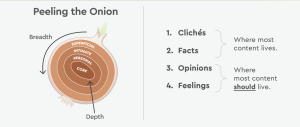
The Four Layers of Relationship Building
Layer 1: Clichés
The outer layer contains familiar, low-risk messaging.
Examples include:
- “We’re excited to announce…”
- “Happy Monday!”
- “We’re proud to share…”
These phrases are common because they feel safe. Unfortunately, they rarely create emotional connection.
Layer 2: Facts
The next layer focuses on information.
Brands often use facts to share industry insights, explain products, publish research, or highlight customer statistics.
Useful information builds credibility, but facts alone do not create loyalty.
Layer 3: Opinions
A deeper layer introduces perspective.
At this stage, brands move beyond reporting information and begin explaining what they believe, what matters, or how they interpret trends.
Perspective creates discussion because audiences have something to react to.
Layer 4: Feelings
The deepest layer involves empathy, transparency, and emotional connection.
When customers feel understood, trust grows.
That trust becomes the foundation of brand content loyalty.
Why Most Brand Content Stops at Cliches
Enterprise marketing teams often work within complex approval systems.
Legal review, compliance requirements, brand governance, and internal stakeholders all influence what gets published.
Because of that structure, messaging can become cautious.
Safe content is easier to approve, but it is rarely memorable.
When every post sounds interchangeable, audiences struggle to find a reason to respond.
This does not mean brands need to become controversial.
A better goal is specificity.
Specific messaging feels more relevant. Relevance encourages engagement. Engagement creates relationship depth.
That depth is what strengthens brand content loyalty.
Before diving deeper into strategy, it helps to remember that meaningful engagement rarely comes from publishing more often.
Brands that consistently create loyalty tend to build systems around conversation, not simply campaigns.
For marketing teams looking to improve relationship-driven content, Brooke Sellas’ Talk Worthy Content Course expands on these principles with practical frameworks for creating content that encourages response rather than passive scrolling.
Why Social Media Algorithms Reward Deeper Conversations
The shift toward relationship-driven content is not only psychological. Technology plays a role as well.
Social platforms increasingly reward content that creates interaction.
Comments, conversations, and thoughtful replies now carry more weight than passive engagement.
Platforms such as LinkedIn, Instagram, and TikTok prioritize signals that show audiences are participating rather than simply viewing.
Likes and impressions still matter, but conversation often reveals stronger intent.
A comment indicates that someone paused long enough to respond.
That response tells the platform the content created value.
When audiences engage, visibility increases. When people scroll past, reach tends to decline.
Brands are no longer competing only for attention.
They are competing for response.
Why Social Care Plays a Bigger Role in Loyalty Than Marketing Teams Realize
Many organizations still separate marketing from customer service.
One team creates campaigns while another handles support.
Customers, however, do not experience brands in departments. They experience brands through interactions.
That is why social care matters.
A response on social media often becomes one of the clearest expressions of brand personality.
Generic replies feel transactional. Thoughtful responses feel human.
Consider the difference between:
“Thanks for reaching out. Please DM your account number.”
And:
“We understand why this is frustrating. Let’s fix it together.”
One response closes the interaction quickly.
The other builds connection.
Brand content loyalty is not created only through campaigns.
It grows through every interaction customers have with the brand.
Teams that want to go beyond awareness metrics often struggle with one question: what does relationship-building actually look like in practice?
That is where ongoing examples matter.
Brooke Sellas regularly explores real-world social care, customer loyalty, and conversation-driven marketing strategies through the Lost to Loyal Newsletter on LinkedIn. It offers an ongoing look at how enterprise brands strengthen trust through engagement rather than volume.
The Question Marketing Leaders Should Be Asking
Most marketers ask:
How do we increase engagement?
A more useful question might be:
How do we create relationships strong enough that engagement becomes natural?
That shift changes strategy.
It moves teams away from posting more and toward communicating better.
It encourages marketers to think beyond reach and impressions.
And it reframes content as part of a larger relationship-building system.
How to Build Stronger Brand Content Loyalty
If your brand content feels visible but disconnected, consider these shifts:
Move Beyond Generic Announcements
Replace broad language with specificity.
Speak to real customer situations instead of general messaging.
Share Perspective, Not Just Information
Facts are useful.
Perspective makes content memorable.
Create Opportunities for Conversation
Ask questions.
Invite responses.
Make it easier for audiences to participate.
Treat Customer Responses as Content
Social care is not separate from brand marketing.
Every reply contributes to how people experience your brand.
Focus on Relationship Signals
Measure more than impressions.
Track comments, conversations, and sentiment.
These indicators reveal whether trust is growing.
Continue Building Stronger Customer Relationships
Relationship-driven content is not built overnight.
It develops through consistent experimentation, stronger messaging decisions, and a willingness to move beyond surface-level communication.
If you want to continue exploring how social care, conversation strategy, and trust-building shape customer loyalty, the Lost to Loyal Newsletter on LinkedIn shares ongoing insights and real-world examples.
Join the newsletter:
https://www.linkedin.com/newsletters/6815661085677383680/
For teams looking for a more structured learning experience, the free Talk Worthy Content Course breaks down how to create content that encourages engagement and meaningful interaction.
Take the course:
https://bsquared.media/courses/talk-worthy-content/
Final Thought
Brand content loyalty is not built through volume alone.
It is built through trust.
And trust rarely grows through surface-level communication.
The brands that create lasting loyalty are not necessarily posting more.
Communication becomes more layered and intentional.
Messaging shifts away from simple announcements toward meaningful perspectives.
Conversations emerge because audiences have something worth responding to.
And they build relationships strong enough to matter.

Read the Transcript
[00:00:00] Why Most Brand Content Feels Like a Press Release
Brooke Sellas, CEO B Squared Media: If you look out there right now at content, branded content on social media, you will see most content, most brands are stuck at that cliche layer.
I’ll give you some examples. “We are so excited to announce… we’re so proud to share… happy Monday.”
Happy Monday. Y’all. Happy Monday.
That’s not a relationship. That is a press release dressed up in casual font on social, and your customers totally feel that they scroll right past it.
They are not commenting. They’re not engaging and they definitely aren’t trusting your brand more because of those types of cliche posts.
Brooke Sellas, CEO B Squared Media: Hey. Hey, and welcome back to the Social Media CX podcast. I’m your host, Brooke Sellas, CEO of B Squared Media, author of Conversations That Connect, and apparently someone who wrote her undergraduate thesis on a 50-year-old relationship theory. And then accidentally built an entire marketing agency around that theory. Which if you know me, kind of tracks completely.
Today is the first episode of what I’m calling our May series, and I have to tell you this one is personal for me. Like super personal. We’re gonna talk about the social penetration theory, what it is, where it comes from, why I wrote my thesis on it, and why I genuinely believe that it’s the most important framework in social media today, that like, no one else is talking about.
We’re also gonna talk about B squared media’s 14th birthday because we turned 14 this month, which is May, 2026. And it’s so wild because the social penetration theory, let’s just call it the SPT, has quietly been the backbone of everything that we’ve built. So grab your coffee because we’re going deep on how this runs our entire agency and maybe how it can help yours as well.
[00:02:19] The Relationship Theory Behind Customer Trust
Brooke Sellas, CEO B Squared Media: All right, so let me set the scene. I’m in college. I’m totally fascinated by communication theory. And I come across this framework developed by two psychologists, Erwin Altman and Dalmas Taylor. And this is back in 1973. So this is way before social media. They call it the social penetration theory, and it’s a terrible name, but the concept behind it is brilliant because here’s what it actually says.
The SPT looks at how relationships and trust are formed, and basically Altman and Taylor say that relationships deepen through progressive self disclosures. So we like to think of it as an onion.
The theory is also called the Onion theory, I’m guessing because no one wanted to say social penetration theory.
[00:03:14] The Four Layers of Brand Relationship Building
Brooke Sellas, CEO B Squared Media: So we’ll just call it the Onion theory or the SPT. But think of the theory like an actual onion. On the outside or going around the onion, you’ve got that surface layer conversation; small talk, pleasantries, cliches. The stuff that you would say to a stranger. So like, I’m in an elevator and I look at you, and I’m like, the weather’s nice, isn’t it?
Mm yes. Yes it is. Right. Small talk cliche. Or maybe we’re at the water cooler at work. Do people still do that? Am I aging myself? And I say, how about those Eagles? GO BIRDS! or you know, insert your local sports team in there. Right?
As you build trust, as you build meaningful relationships with people, you actually go deeper inside the onion.
You’re peeling back layers, and layer two is facts. Layer three is opinions. And then if the relationship is going well and deep enough, you get to level four, which is feelings. These are your real, authentic, vulnerable feelings.
And Altman and Taylor’s insights were that the depth and the breadth of those disclosures determine how close a relationship becomes.
I was obsessed with this theory. I wrote my entire undergraduate thesis on it, and what I did was I looked at how the theory worked on social media channels, specifically Facebook. I wanted to see if we still build relationships with brands the same way we do with humans. And instead of IRL in real life, how we did these things on social media, specifically Facebook.
I wrote my entire undergraduate thesis on this theory, and I really just couldn’t stop thinking about how it applied to human communication; how we decide who to trust, who to buy from, how much we decide to share with someone or with a brand, how we decide whether or not a relationship is worth investing in.
So in 2012, I founded B Squared Media, and from day one, even before I realized I was doing it, I was applying the SPT and the Onion Theory to everything that we did in our social media work at B Squared Media. I just didn’t quite realize it. Now, here is the connection that changed everything for me.
[00:05:42] Why Most Brand Content Never Moves Beyond Surface Level
Brooke Sellas, CEO B Squared Media: If you look out there right now at content, branded content on social media, you will see most content, most brands are stuck at layer one, that cliche layer.
I’ll give you some examples. “We are so excited to announce… we’re so proud to share… we’re thrilled to welcome so and so to the team… happy Monday.”
Happy Monday. Y’all. Happy Monday. That’s not a relationship. That is a press release dressed up in casual font on social, and your customers totally feel that they scroll right past it.
They are not commenting for the most part on these types of cliche posts. They’re not engaging and they definitely aren’t trusting your brand more because of those types of cliche posts. Now, here’s where it gets interesting for social care specifically. So social media customer service. Those same layers apply to how brands respond to potential customers or customers on social media when they have questions.
So when a customer reaches out via a comment or a DM or a tagged post, most brands respond with layer one. Right, the cliche, canned, generic, safe. It might look something like this. “Thanks for reaching out, Brooke. We’re sorry to hear you’re experiencing this. Please DM us your account number.”
That’s a cliche response. It’s fine, but it does the same thing as the cliche post does. It signals to the customer that there’s no real relationship here. It’s just a transactional process. We’re just checking a box to help you out. But when you respond with genuine specificity, when you acknowledge what they actually said, or answer what they actually asked, and do it with warmth and with brand voice? Now we’re starting to get into the other layers. We’re moving to facts. We’re moving to opinions. Maybe we’re even moving to feelings. And that’s when your customers start to feel like your brand has a real person on the other end.
And when something goes wrong and you handle it with transparency, accountability, and actual empathy, that truly is layer four. That’s that feelings layer where trust is built, and that’s where loyalty comes from. Trust: it’s how you get to loyalty. And that in a nutshell is what B Squared Media has been doing for the past 14 years.
[00:08:23] What Social Algorithms Reward That Brands Miss
Brooke Sellas, CEO B Squared Media: Now, here’s where it gets super interesting and timely. Because it’s not just relationship science that validates the SPT framework, it’s also now the social media algorithms. Because every social media platform right now -LinkedIn, Instagram, TikTok, Facebook -they are all weighting conversations and comments higher than other forms of engagement.
So likes, impressions, right? They can view things, but if they’re not actually leaving a comment and engaging, that’s passive engagement. LinkedIn, by the way, just started showing you how many impressions your comments are getting on other people’s posts. So not your post impressions, your comments. And sometimes, I see this right in my own analytics, my comments where I go and I post on someone else’s content, get more reach than my actual published posts of content.
Think about what that means. The platforms are literally now telling us, through their algorithms, that we are going to reward content that makes people respond. We are going to reward content that sparks a conversation, or content that goes deeper than the surface. Around the onion cliches… we need to go into those layers. Cliches, don’t do that.
And facts, by the way, alone, don’t do that. Opinions do it. Feelings do it. Which is exactly why the SPT or the Onion Theory, has been correct since 1973. And is still correct today, even on a different medium, which is social media. I’ve been screaming this from the mountaintops for the past 15 years.
Think conversation, not campaign. That is literally our tagline, but now the algorithms are finally telling us, Hey, yeah, it really is think conversation, not campaign. And lemme tell you, vindication feels good. Not gonna lie.
So. Here is what we were doing for the month of May, our birthday month, at B Squared Media.
[00:10:30] Why Loyalty Comes From Going Deeper
Brooke Sellas, CEO B Squared Media: Every episode of the Social Media CX Show in May is going to map one layer of the social penetration theory, SPT, or Onion Theory. So this week we talked about layer one cliches and we said, Hey, it doesn’t work. Don’t do that anymore. It’s costing you. You’re not building trust and loyalty. Next week we’re gonna go into layer two, which is facts, and I’m gonna talk about why data and information are necessary but not sufficient for meaningful engagement.
In week three, we’re gonna talk about layer three, which is opinions. And this is where conversations really start to get going on social. And where most brands go completely silent. Because opinions feel risky. We’re gonna talk about why they feel risky and how you can mitigate that risk.
Week four and layer four is feelings, and this is the deepest layer. But it’s also the hardest to get to.
So I’m going to explain how B Squared Media has had zero client churn across eight years of social care using layer four specifically for those social media responses. Again, y’all eight years, zero churn. And I’m saying it again because it makes me a little emotional.
Um, we’ve been doing this for so long and I just. I, I want everyone to do it with us. I want everybody to understand the power of this framework. ’cause we’ve woven all of this that we’re talking about into our newsletter, into our Lost to Loyal articles that you see on LinkedIn. Everything that we’re publishing this month, by the way, is going to be going into the Social Penetration theory, onion Theory, or SPT.
So if you haven’t signed up for our newsletter, if you haven’t gone and followed me on LinkedIn and joined our Lost to Loyal newsletter there, please do. Because we’re going deep on all the platforms and it’s not gonna be all the same content because, hi. We know that doesn’t work. And ultimately my goal is to answer the question that everybody is asking right now, or at least all the people that we’re talking to about their social media strategy, which is: how do I get people to actually engage with what I’m posting on social media?
I’m gonna answer that. Here on this podcast and on the newsletters. We also built a free course all around this content; the the Social Penetration Theory as well. It’s called Talk Worthy Content, and it lives at bsquare.media. You can go to resources courses and then go to talk worthy content. It’s completely free.
It’s pretty good if I do say so myself, and it really does map directly to what we’re talking about this month. So go grab it. The link will be in the show notes, which is the transcript of this show. Wherever you’re listening or watching.
Before I let you go, I wanna just sit here for a moment and say thank you. Because B squared media turning 14 is huge. Um, it’s just like I can still not wrapping my head around it, I don’t think. But it’s been 14 years of conversations. 14 years of showing up in the comments, the dms, the tagged posts, the crisis moments, the campaign launches, the product questions, the complaints that turned into compliments.
14 years of peeling back layers with our clients and their customers. And I guess I’m emotional because when I got laid off from my job in in nonprofit back in 2009, I had no idea that I was going to build something that would last 14 years. I had no idea I was going to find a way to take this communication theory that I wrote about in college and turn it into a methodology that would define an entire agency.
But here we are.
And I think, I really believe. That the reason we are still here and we’re still growing and we’ve had zero client churn in social care, is because we’ve never stopped trying to go deeper. To get to that feelings layer with our clients, with their customers, with the work itself, with the team, with you, with everyone. That is the SPT way, and it’s the B squared way.
Alright, I’m getting too sentimental for a podcast. So let’s wrap this up Before I actually start to cry, which let’s be honest, let’s go ahead and save the tears for week four when feelings come along.
Thank you so much for being here today. If this resonated, if you’ve been thinking about how to go deeper with your social content or your social care program, I want to hear from you.
Find me on LinkedIn, drop me a comment, send me a dm. Let’s have a real conversation because that’s what this is all about.
And if you loved this episode or you love this podcast, please take a minute and leave me a review. It will take you about 30 seconds or so, but it will mean the world to me. I’ll see you next week for layer two: facts.
Until then, think conversation, not campaign.
Want to hear the full conversation? Listen to the Social Media CX Podcast on YouTube. And if your team is thinking about what responsible social listening in banking or financial services actually looks like at scale, check out the State of Social Care Report 2026.
Finally, as always, Think conversation, not campaign.™

Latest posts by Brooke B. Sellas (See All)
- You’re Treating Business Intelligence Like Social Engagement - August 19, 2026
- Your Customer Complaints Are Shaping What AI Says About Your Brand - August 12, 2026
- The Customer Signals Hidden Inside Your Social Care Data - August 5, 2026

Written by award-winning strategist Brooke Sellas, this weekly 5-minute power-up will help you turn social interactions into loyalty, retention, and revenue.
Written by award-winning strategist Brooke Sellas, this weekly 5-minute power-up will help you turn social interactions into loyalty, retention, and revenue.
Share this article: