Blog » Social Care »
Social Media Customer Care: Done Right It Leads To Retention And Sales Opportunities
Table of Contents
Most brands still treat social media customer care like a cost center.
But here’s the truth: customer care on social doesn’t just solve problems, it fuels retention and revenue.
- Every resolved complaint builds loyalty.
- Each question answered publicly earns trust.
- Conversations may move someone closer to purchase.
Time to break down how social media customer care drives both repeat business and new sales.
And how to turn every interaction into an opportunity with simple, repeatable plays.
Social Media Customer Care Is Your Loyalty Engine
Retention is the first place you’ll see ROI from excellent social care.
Loyal customers aren’t just “satisfied.” They’re less price sensitive, more forgiving, and far more likely to recommend you. When you answer quickly and helpfully on the platform they chose, you reduce effort and increase trust. That combination is retention rocket fuel.
According to McKinsey, companies that formalize a social media servicing framework, like clear SLAs (SLA stands for Service Level Agreement), dynamic templates, etc., can cut response time by 75% and resolution time by 43%.
Faster help isn’t just efficient. It’s memorable. Customers remember how you made them feel, and the combination of speed and empathy is what will keep them coming back for more.
What does this look like in real life? Imagine a frustrated post about a shipment delay. The typical brand replies with a canned “DM us.”
The better brand replies within minutes, acknowledges the inconvenience, offers a status update publicly (so others see you show up), then moves to DMs for details and resolution.
That difference is the difference between churn and cheerleader. It’s all about how much you C.A.R.E.
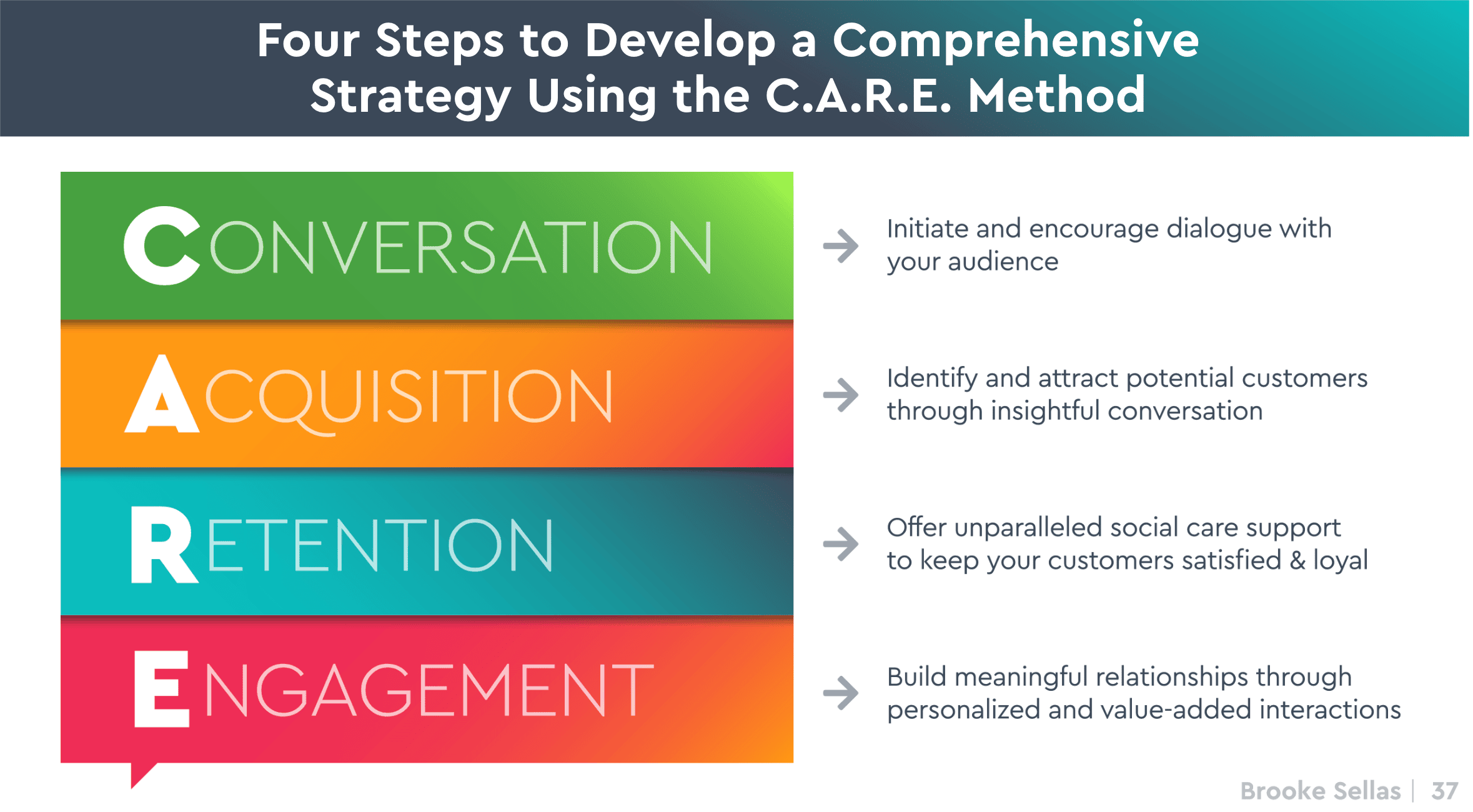
[Source = Our C.A.R.E. Method™]
Why It Works
- Speed builds trust. Quick replies reduce uncertainty and stop emotion from escalating.
- Visibility drives confidence. Public help becomes proof. One resolved thread reassures hundreds of lurkers.
- Empathy creates equity. Small, human touches (“We’ve got you”) bank goodwill you’ll draw on later.
Actions You Can Take This Week
- Rapid Triage. Tag “where is my order?” or “can’t log in” posts to surface your top customer pain points.
- Template + Personalize. Build three short templates per top issue. Personalize the first line and make sure to include the next steps.
- Public-to-Private Hand-off. Answer the general question publicly, then invite the user to DM sensitive info.
- Recovery Tokens. Empower reps with small, instant make-goods (extended trials, free shipping, gift cards) to close the loop.
Social Media Customer Care Metrics to Watch
- First Response Time (FRT). Your leading indicator of trust.
- Public Resolution Rate. Percentage of issues resolved on-platform without switching channels.
- Retention Signals. Repeat purchase rate and time-to-repeat for users who engaged with care vs. baseline.
Turn Satisfied Customers Into Repeat Buyers
Social media customer care involves more than “fixing.” It’s great for sensing intent.
In comments and DMs, customers tell you what they want next: a more advanced tier, an add-on, a bundle, or simply reassurance that switching plans won’t be a headache.
If you’re listening for these cues, you’ll spot upsell moments every day.
Think of upselling as “serving with options.” The goal is never to push; it’s to take the logical next best step based on context.
If someone loves Feature A, they’ll likely benefit from Feature B that unlocks the full workflow.
When a customer posts a milestone (“Just hit 10K subscribers!”), it’s time to upgrade them from the starter plan. Your reply can be both celebratory and directional.
Social Media Customer Care Spots Upsell Moments
- Praise posts. “This app saved our launch.” → “Love hearing that. If you ever outgrow manual workflows, our Pro plan cuts setup time by 40%. Want to sign up for a free trial?”
- Curiosity cues. “Do you support multiple locations?” → “Yes. Our Advanced plan lets you manage permissions per location. Would a 2-minute overview help?”
- Expansion signals. “Adding two new reps.” → “Congrats! Our Team tier includes shared inbox + roles so everyone stays in sync.”
- Use-case tags. “Any way to integrate with Shopify?” → “Absolutely. Here’s the native connector. If you’re processing >500 orders/month, our Growth plan adds automation features.”
Try This Action Workflow (Tag → Triage → Offer)
- Tag. In your social inbox, label posts as interest, intent, or advocacy.
- Triage. Route intent to a care-to-sales queue.
- Offer. Share one helpful next step (demo link, comparison, or self-serve upgrade). Keep it consultative, not pushy.
Guardrails That Keep It Human
- One offer max. Don’t stack links. Solve first, then offer a single, relevant option.
- No pitch slaps in public. Use public replies to educate; move pricing and specifics to DM or email.
- Follow up once. If no response, leave a value breadcrumb (guide, checklist) and close the loop.
Want more selling triggers and messaging examples? See The Definitive Manual on Social Media Sales Optimization.
New Sales: When Prospects Turn to Your Comments For Proof
For prospects, social media customer care is a live demo of how you treat people.
They’re watching how you respond to confusion, bugs, or even snark. And comparing your tone to your competitors. All while deciding whether your team looks like the kind they want to work with.
Most customers use social for customer service at least once, and expectations for speed are high. Nextiva’s 2025 roundup compiles multiple studies showing the shift to messaging and social care alongside tighter response expectations.
Translation: Be where your buyers ask questions. And respond in a timely fashion.
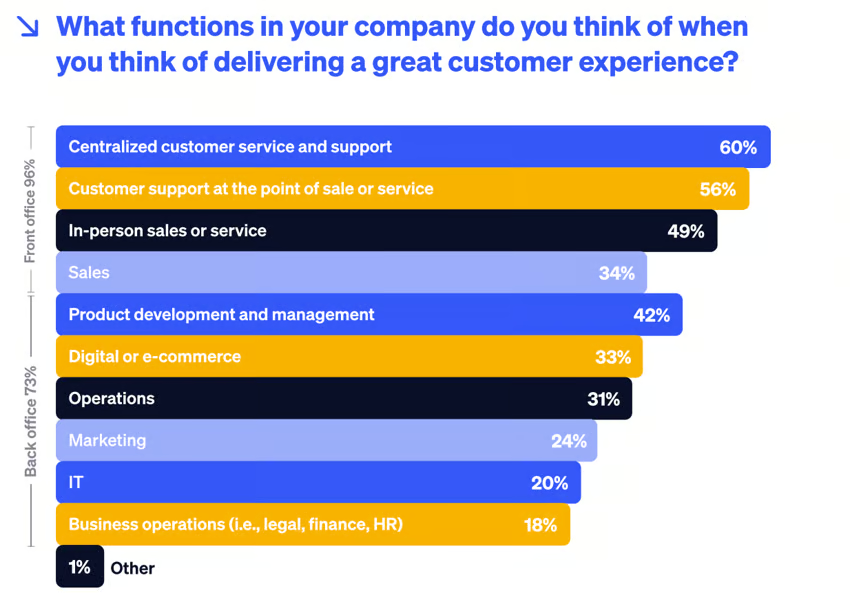
[Source = Nextiva 2025 Customer Service Statistics Roundup]
Customer Care Conversion Plays
- Answer + Action. Provide the concise answer publicly, then add a single CTA: “Want a 2-minute walkthrough?”
- Proof Over Pitch. Link to a tutorial, mini-case, or ROI snippet rather than a generic homepage.
- Frictionless Path. Offer two next steps: “DM for quick details” or “Book a 10-minute fit check here.”
- Social Screens. When appropriate, include a short screen recording (hosted) that shows the fix or feature. Visuals close gaps faster than text.
What does a great prospect exchange look like?
A user asks if your warranty covers international buyers. You confirm publicly, note the coverage window, and add “We can check your region specifics in a quick DM if you’d like.” In DM, you provide the exact policy, ask a single qualifying question, and drop a booking link. No pressure, just progress.
For platform-specific prospecting and sales ideas, see How to Maximize Sales Enablement with LinkedIn.
Connect Social Media Customer Care To The Customer Experience
Great social care doesn’t end when an issue is resolved. It extends into every stage of the customer journey.
When your care team collaborates with marketing, sales, and product teams, customers feel seen, supported, and understood wherever they show up.
The takeaway? Consistency matters more than complexity.
Your customers want one clear, caring voice — whether they comment on Instagram, message you on LinkedIn, or tag your brand on X.
When you build loyalty with care and consistency, sales are likely to follow.

How to Build Seamless Social Care
- Centralize communication. Use one shared inbox or platform so your team can view the full conversation history — no channel silos, no repeat explanations for the customer.
- Keep tone and empathy consistent. Create a care style guide that defines voice, tone, and style that sounds human, not templated.
- Close the loop publicly. When a customer issue gets resolved, post a short follow-up or thank-you note. It demonstrates accountability and serves as an example of what to expect from your brand.
- Document learning. Every solved issue is data. Capture trending questions and feedback themes, then share them with content and product teams weekly.
Social Care Habits That Scale
- End Of Shift Notes. Spend a few minutes reviewing yesterday’s sentiment and document frequently asked questions to prep for the next day’s conversations.
- Weekly Review. Highlight top care wins and areas to improve response tone or accuracy.
- Empathy Training. Role-play difficult social scenarios to keep your team’s tone human and supportive.
- Feedback Fridays. Share standout interactions in a Slack or Teams channel to celebrate care that converts.
When your care team operates with shared habits and a consistent human voice, you don’t need more tools. Because you have a real connection.
Social care becomes less about managing messages and more about maintaining relationships that drive retention, referrals, and repeat business.
👋 Ready to Turn Social Media Customer Care Into Conversion?
The line between customer service and sales is gone. Today, social media customer care is the front line of your revenue engine. If your team knows how to listen for intent, respond with empathy, and connect the dots between service and sales, you’ll see results — not just reactions.
👉 Download our Social Media Customer Service for Beginners eBook to start turning conversations into conversions.
Frequently Asked Questions About Social Media Customer Care
- How does responding quickly to customer inquiries on social media affect customer retention compared to slower or automated responses? Speed and sentiment together equal care. A quick, human reply signals respect and reliability; two qualities that drive repeat business. Automated replies buy time, but real retention comes from genuine, two-way conversation.
- Can proactive social media customer care really lead to higher sales, or is it just about preventing negative reviews? It’s both. Proactive care turns “we fixed it” moments into “we get you” moments. The kind that converts browsers into buyers. When brands reach out first (answering FAQs publicly, checking in after purchases), customers spend 20–40% more on average. Prevention protects reputation; proactivity drives revenue.
- What strategies work best for creating customer loyalty and repeat business through social media platforms? Start with consistency and empathy. Respond quickly, remember names, and personalize every interaction. Celebrate wins publicly. Surprise loyal followers with exclusive content or early access. Over time, these small, authentic touches stack up to what we call “emotional equity,” the reason customers stay even when competitors discount.
- Is there a measurable difference in retention between brands that handle customer service directly on social media versus those that redirect users to other channels? Absolutely. Brands that resolve issues directly on social channels see retention rates up to 25% higher than those that push customers to email or phone. Meeting people where they already are reduces friction and builds trust.
- How can small businesses with limited budgets make social media care a driver of retention and sales? Focus on what scales: responsiveness and personality. Use built-in platform tools (saved replies, comment filters) to stay organized, and let your tone do the heavy lifting. A quick thank-you, a personal emoji, or a same-day reply outperforms expensive automation. Consistency beats capacity every time. Customers remember how you made them feel.
The following two tabs change content below.

Brooke B. Sellas is an award-winning Customer Marketing Strategist and the CEO & Founder of B Squared Media. Her book, Conversations That Connect has been recognized nationally and is required reading for a Customer Experience class at NSU.
Brooke's influence in digital marketing is not just about her accomplishments but also about her unwavering commitment to elevating the industry standard of digital customer experience and customer marketing.
Latest posts by Brooke B. Sellas (See All)
- You’re Treating Business Intelligence Like Social Engagement - August 19, 2026
- Your Customer Complaints Are Shaping What AI Says About Your Brand - August 12, 2026
- The Customer Signals Hidden Inside Your Social Care Data - August 5, 2026


Written by award-winning strategist Brooke Sellas, this weekly 5-minute power-up will help you turn social interactions into loyalty, retention, and revenue.
Category: Social Care
Written by award-winning strategist Brooke Sellas, this weekly 5-minute power-up will help you turn social interactions into loyalty, retention, and revenue.
Share this article: